
The US government has imposed an immediate suspension of access to Anthropic’s Fable 5 and Mythos 5 models, citing national security concerns.
The order imposes strict export controls, prohibiting the use of the systems by any non-US citizen worldwide.
The decision was made after information about a “jailbreak” method that allows Fable 5 to analyze and fix errors in code bases.
Older models such as Claude Opus and Sonnet remain available.
The company is reacting strongly, emphasizing that identical capabilities are widely available in models on the market, such as OpenAI’s GPT-5.5.
Anthropic has disabled access to its new AI models Fable 5 and Mythos 5 worldwide, following a US government order. The ban concerns export controls and strictly excludes any non-US citizen. The action was sparked by reports of a “jailbreak” that allows Fable 5 to analyze code and fix software vulnerabilities.
The US government’s intervention was swift. The directive, based on broad national security powers, required the immediate suspension of access to the two advanced language models for any foreign national, regardless of their physical location. The measure is presented as extremely sweeping, prohibiting use even by Anthropic’s own employees who do not hold US citizenship.
As a direct result, the company was forced to proceed with a horizontal deactivation of Fable 5 and Mythos 5 for all of its customers, with the aim of ensuring complete legal compliance. The official government document did not provide detailed technical details about the nature of the threat. The only justification concerned information about a method of artificially bypassing Fable 5’s security controls, without further documentation of successful cyberattacks.
In the field of productive AI, “jailbreak” refers to the technique of introducing specific instructions (prompts) to overcome the model’s built-in limitations. Anthropic clarifies that the government relied solely on “verbal cues” for a non-universal jailbreak. The difference is fundamental, as a universal jailbreak completely breaks the security of the system, allowing any malicious command to be executed, while this particular non-universal jailbreak was limited to simply asking the AI to read a specific code base and fix software bugs.
Anthropic’s leadership points out that the architecture of Fable 5 was subjected to thousands of hours of rigorous testing. The testing involved private parties, the UK Artificial Intelligence Security Institute (UK AISI), and US government agencies. In fact, the protocols were so strict that top developers reported multiple “false positives,” i.e. false rejections of perfectly legitimate requests to write code.
Anthropic’s defense strategy is based on the doctrine of “Defense in Depth.” Recognizing that creating a completely invulnerable system is considered practically impossible with today’s technology, the company designed the ecosystem so that jailbreaks require enormous computational costs.

At the same time, it imposed a controversial policy of retaining user data for 30 days, precisely in order to quickly identify and neutralize corresponding attacks. Furthermore, the company emphasizes that identical code analysis capabilities are widely found in competing models on the market, directly naming OpenAI’s GPT-5.5, which is used daily by cybersecurity professionals (defenders).
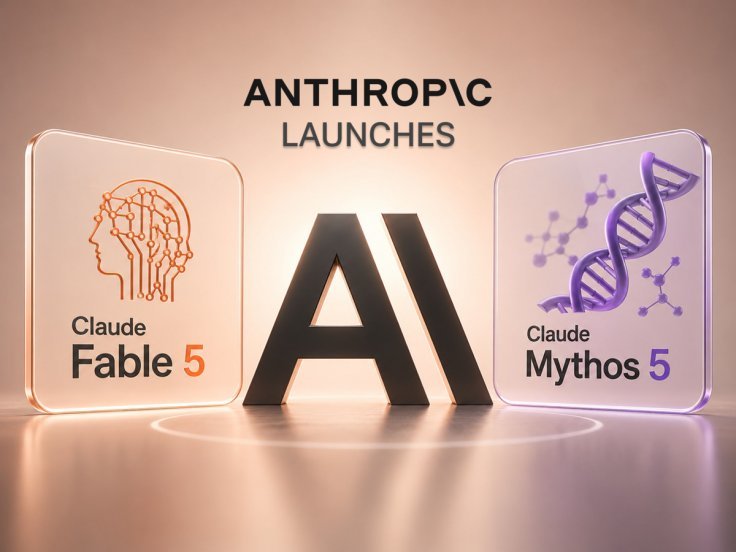
The launch of the new models was accompanied by a clear separation in their areas of application:
Claude Fable 5: Designed for commercial development and access by the general public. It incorporates strict content filtering algorithms, with the aim of protecting against malicious use.
Claude Mythos 5: While its initial version (Preview) was presented in April 2026, the final model was explicitly designed for state-of-the-art applications in cybersecurity and biology. Its security controls were deliberately reduced, as it was intended for use in strictly controlled environments by researchers of approved organizations.
The imposition of American export controls puts the new systems out of operation throughout Europe, translating into an immediate exclusion for the Greek public as well. Greek developers, startups and technology companies that had time to experiment with the APIs of Fable 5 or Mythos 5 during the first days of their release, suddenly lost access to these tools.
The technical alternative is now limited to the forced downgrade to the company’s previous, known-value systems, with the Claude Opus, Sonnet and Haiku models still operating normally, as they are exempt from the government directive.