DeepSeek Challenges Industry Giants: Frontier Intelligence at a Fraction of the Cost
In a major move that is reshaping the global AI landscape, the Chinese research lab DeepSeek has officially launched two preview versions of its latest large language model, DeepSeek V4. Coming off the massive success of last year’s R1 reasoning model, V4 enters the market as a direct competitor to OpenAI’s GPT-5.4 and Google’s Gemini 3.1 Pro, but with a radically different economic model.
1. Architectural Breakthrough: Mixture-of-Experts (MoE)
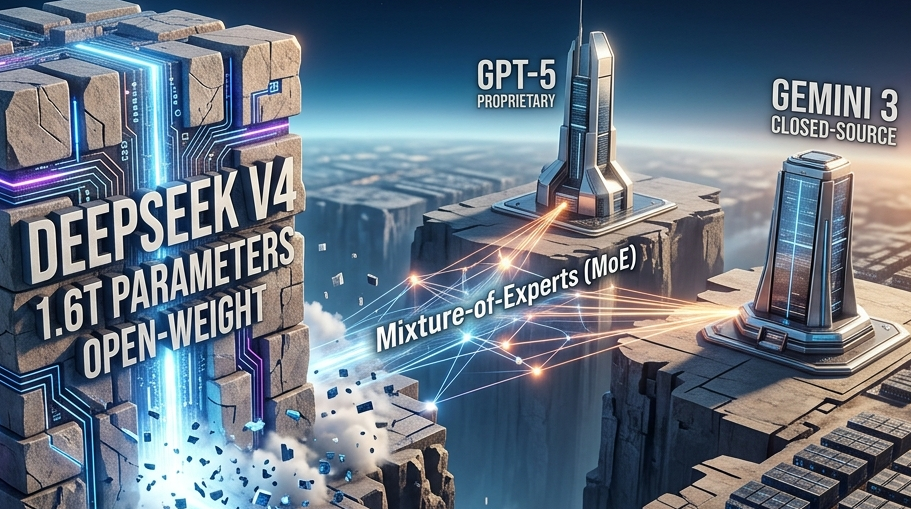
DeepSeek V4 utilizes a sophisticated Mixture-of-Experts architecture, designed for maximum efficiency. By activating only a specific subset of parameters for any given task, the model maintains high performance while significantly lowering operational costs.
- DeepSeek V4 Pro: A massive model boasting 1.6 trillion total parameters (with 49 billion active), making it the largest open-weight model currently available.
- DeepSeek V4 Flash: A streamlined version with 284 billion parameters (13 billion active), optimized for speed and agentic workflows.
- 1M Context Window: Both models support a context window of 1 million tokens, allowing users to process massive codebases or entire document libraries in a single prompt.
2. Performance: Closing the “Frontier Gap”
DeepSeek claims that V4 has effectively “closed the gap” with the world’s leading proprietary models. In coding benchmarks and complex reasoning tasks, V4 Pro shows performance comparable to GPT-5.4. While it still trails behind frontier models in general knowledge tests by approximately 3 to 6 months, its specialized capabilities in logic and mathematics are world-class.

3. Market Disruption: The Pricing Revolution
The most significant aspect of the DeepSeek V4 launch is its aggressive pricing strategy. It is currently the most affordable frontier-class model on the market:
- V4 Flash: Priced at $0.14 per 1M input tokens, undercutting GPT-5.4 Nano and Claude Haiku 4.5.
- V4 Pro: Priced at $0.145 per 1M input tokens, offering a massive cost advantage over Gemini 3.1 Pro and GPT-5.5.
4. Geopolitics and Intellectual Property Tensions
The release of V4 comes at a time of heightened international friction. The U.S. recently accused Chinese entities of industrial-scale IP theft from American AI labs. Furthermore, DeepSeek has faced allegations of “distillation”—essentially using outputs from models like GPT-4o and Claude 3.5 to train its own. Despite these controversies, DeepSeek’s reliance on the Huawei Ascend chip ecosystem demonstrates a growing independence from Western hardware.
Strategic Conclusion
By prioritizing text-based reasoning over multimodality (audio/video), DeepSeek has created a specialized “logic engine” that is both powerful and accessible. For developers and enterprises, DeepSeek V4 offers a high-intelligence alternative that challenges the cost structures of Silicon Valley’s biggest players.