A U.S. judge rejected the government’s demand to force Google to sell its advertising exchange, delivering the company a major legal victory while imposing new restrictions on how it operates its ad business.
Google has avoided one of the biggest threats to its advertising business. A federal judge in Virginia has rejected the U.S. Department of Justice’s request to force Google to sell its advertising exchange, AdX, bringing a major legal victory for the company after years of antitrust battles over its dominance of online advertising.
The decision does not mean Google has been cleared of wrongdoing. The court had already found that Google illegally monopolized parts of the digital advertising market. Instead, Judge Leonie Brinkema decided that forcing the company to sell AdX was not the right remedy.
Google will instead face behavioral restrictions designed to give competing advertising technologies more room to operate.
For Google, the distinction is enormous. The company keeps control of a key part of its advertising infrastructure rather than being forced to hand it to a new owner.
Google Keeps AdX


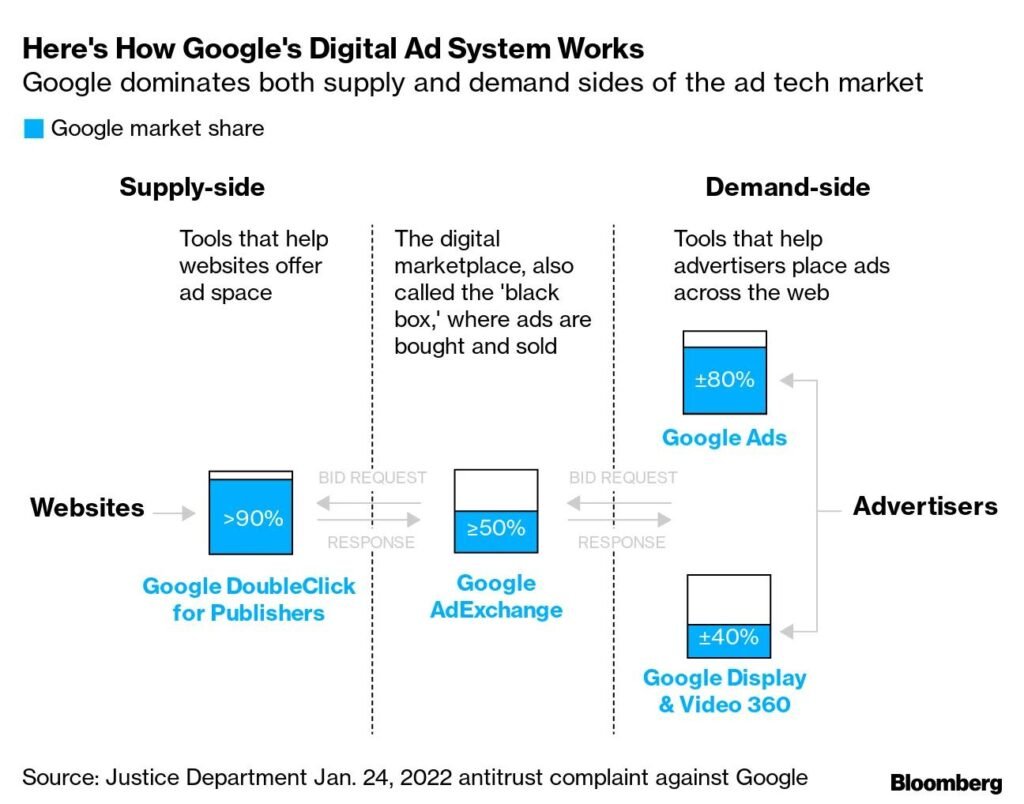
AdX sits at the center of the automated advertising system that determines which ads appear on websites.
When someone opens a page containing advertising space, automated systems can run an auction in milliseconds. Advertisers compete for that space, and the winning bid is used to display an advertisement to the visitor. Google operates technology on several sides of this process, which has been at the heart of the U.S. government’s case. The Justice Department argued that Google’s control over different parts of the advertising ecosystem gave the company an unfair advantage and allowed it to favor its own services.
In its earlier ruling, the court agreed that Google had illegally monopolized the market for publisher ad servers and ad exchanges. The judge also found that Google had tied its publisher ad server to AdX in a way that harmed competition.
The government therefore wanted a much more aggressive solution: force Google to sell AdX.
That has now been rejected.
According to the ruling, publishers currently pay Google a 20% fee through AdX when the platform facilitates advertising auctions. The advertising exchange is only one part of Google’s enormous business, but losing it would have represented a major structural change to how the company operates online advertising.
Why the DOJ Wanted a Breakup

The case is about much more than advertising.
Google’s ad technology sits underneath a huge portion of the open web. Publishers use advertising systems to generate revenue, while advertisers use the same ecosystem to reach users.
The Justice Department argued that Google’s position across multiple parts of that chain allowed it to influence the market in ways competitors could not.
The original lawsuit, filed in 2023, accused Google of using acquisitions, contractual restrictions and manipulation of advertising auctions to strengthen its position and weaken rivals.
The government specifically argued that Google’s control over both publisher-side technology and the exchange created conflicts of interest.
The DOJ’s preferred remedy was therefore structural: remove one of the critical pieces from Google’s control.
Google fought that proposal aggressively.
The company argued that separating AdX would be technically difficult and could create a long and disruptive transition for publishers, advertisers and other customers.
The judge ultimately agreed that a forced sale was not justified, choosing restrictions on Google’s behavior instead.
A Win for Google, But Not a Clean Sweep
The headline for Google is simple: the company does not have to break up its ad business.
But the ruling still leaves Google under significant restrictions.
The judge accepted most of the behavioral remedies proposed during the case, with changes intended to address the competitive problems identified by the court.
Some details remain subject to review because parts of the decision contain confidential business information. The final structure of the remedies will therefore become clearer as the court process continues.
The decision is also significant because it follows several other major U.S. antitrust battles involving Big Tech in which regulators have sought structural remedies.
For Google, this is the second major situation in which the company has avoided being forced to sell a major asset despite facing serious antitrust findings.
The result highlights one of the biggest challenges facing regulators: proving that a technology company behaved unlawfully is one thing; convincing a court that breaking apart part of the company is the appropriate solution is another.
What This Means for the Web
For publishers, the case is particularly important.
Advertising remains one of the main sources of revenue for websites, news organizations and independent creators. The technology used to sell that advertising determines how much competition exists between buyers and sellers and how much money ultimately reaches publishers.
If Google’s dominance is reduced through the new restrictions, competing ad-tech companies could have more opportunities to participate in auctions and offer alternative services.
But the practical impact will not be immediate.
Google remains one of the most powerful companies in online advertising, and AdX remains under its control. The company also operates other major advertising products, giving it enormous reach across the ecosystem.
The ruling therefore represents a compromise rather than the dramatic breakup the DOJ originally wanted.
Google keeps its infrastructure.
Regulators get new restrictions.
And publishers and advertisers will now have to see whether those restrictions actually change how the market works.
For Google, however, the immediate result is unquestionably significant: one of the most serious attempts to dismantle part of its advertising empire has failed.