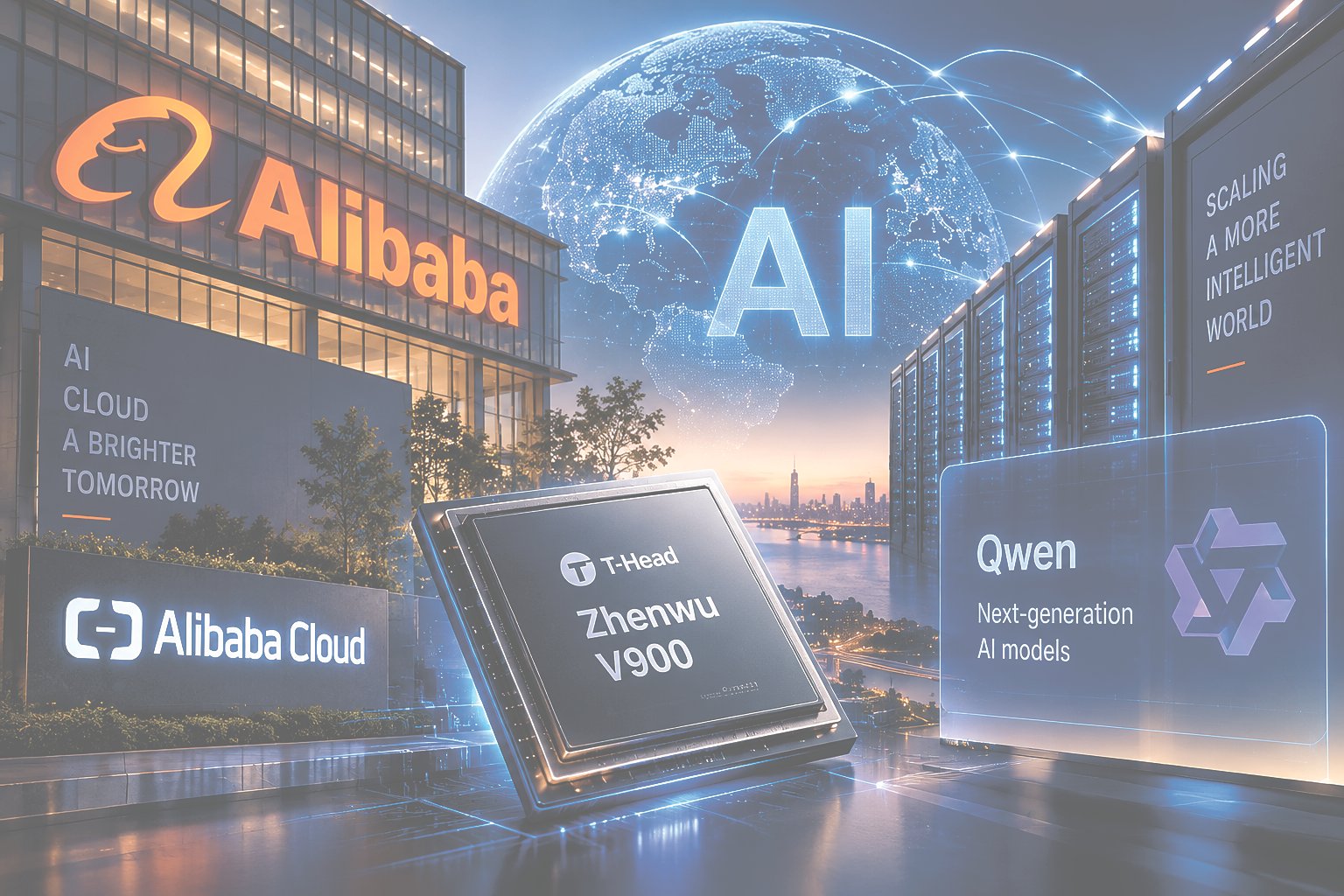
Alibaba is building more than another AI model
The AI race has often been framed around one question:
Who has the best model?
Alibaba is increasingly framing the competition differently:
Who can build the entire AI stack?
At the Apsara 2026 conference in Hangzhou, Alibaba presented a strategy covering:
- new Qwen models;
- proprietary AI chips;
- cloud infrastructure;
- data centers;
- AI-agent platforms;
- developer tools.
Alibaba said Qwen 4 is currently in training, while future Qwen 4.5 and Qwen 5 models are planned to reach 5 trillion to 10 trillion parameters.

What does 10 trillion parameters actually mean?
Parameters are one way of describing the scale of an AI model.
But there is an important caveat:
More parameters do not automatically mean a more intelligent model.
Architectures such as Mixture-of-Experts can allow very large models to activate only part of their total parameters for a given task.
Still, a target of 5–10 trillion parameters illustrates how aggressively Alibaba wants to scale its foundation models.
Alibaba launched Qwen3.8-Max in August with 2.4 trillion parameters.
That means the new roadmap could represent a model several times larger by raw parameter count.
Reuters described the initiative as part of Alibaba’s effort to build models capable of handling increasingly complex and long-horizon tasks.
But the model is only one part of the equation
A massive AI model requires massive infrastructure.
The chain looks something like:
chip → memory → networking → power → data center → cloud → software.
Alibaba is trying to control more of that chain itself.
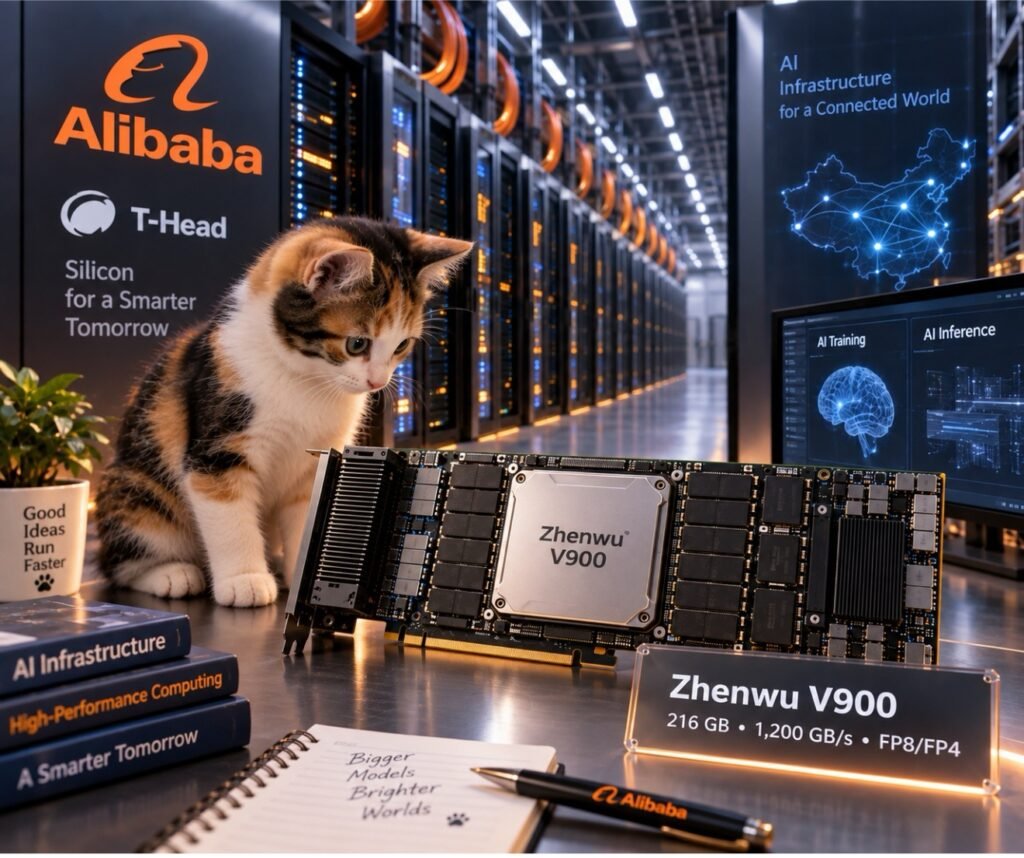
That brings us to Zhenwu V900.
Zhenwu V900: Alibaba’s new AI processor
Alibaba’s chip-design unit T-Head unveiled the Zhenwu V900.
Alibaba says the processor is designed for AI training and inference and delivers roughly three times the performance of its predecessor. It is also designed to scale into very large systems.
Alibaba said V900 can be used in clusters containing up to 500,000 accelerators.
That matters because next-generation AI models will not run on a single chip.
They require thousands or even hundreds of thousands of compute units working together.
That makes chip-to-chip bandwidth, memory and networking almost as important as raw compute performance.
Alibaba wants the full AI stack
This may be the most important part of the announcement.
Alibaba is not simply saying:
“We have a larger model.”
Its strategy is closer to:
Model → Chip → Data Center → Cloud → Agent → Application
Alibaba Cloud says the roadmap includes Qwen models, proprietary chips, an agent-focused cloud and an AI-agent platform that can give smartphone manufacturers access to Qwen-powered systems capable of handling complex cross-app tasks.
That reflects a broader shift in the AI industry toward vertical integration.
From chatbot to agent
One of the biggest changes is not model size.
It is what the model can do.
Alibaba introduced Qwen Intelligence, an agent-oriented solution designed for smartphones.
Instead of simply asking an AI application a question, users could eventually give an agent a goal and let it coordinate actions across different applications.
For example:
“Find a hotel, check my calendar and prepare the booking.”
Instead of manually switching between multiple apps, the AI agent could coordinate the workflow.
That is becoming one of the industry’s major directions in 2026.
And Alibaba wants Qwen to be part of it.
AI helping design AI hardware
Alibaba also highlighted an experiment involving chip design.
The company said Qwen3.8-Max was used in an experiment involving more than 10,000 EDA tool calls over more than 60 hours.
Alibaba says the system produced production-grade chip bus modules and reduced chip area by 42% without compromising performance, based on the company’s own results.
That result should be treated as a company-reported claim rather than an independent benchmark.
But the broader concept is significant:
AI can help design the hardware that will be used to run future AI.
That creates a potential loop:
AI → chip design → chip runs AI → AI helps design the next chip.
20 gigawatts of data-center capacity
Alibaba’s ambition extends beyond chips and models.
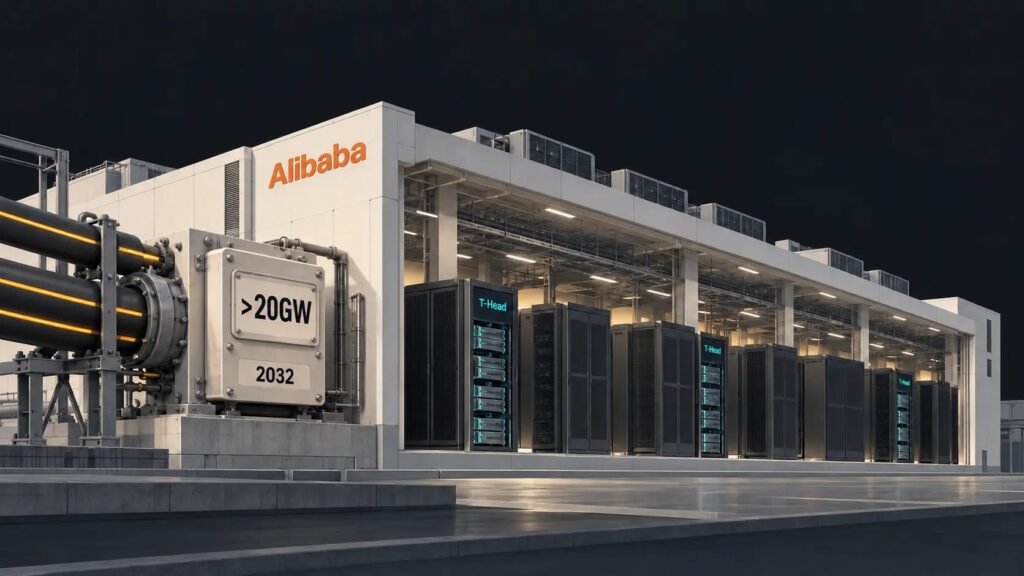
The company said it wants Alibaba Cloud’s global data-center capacity to exceed 20 GW by 2032. Reuters reported the same target.
That is an enormous infrastructure ambition.
AI is increasingly constrained not only by compute availability but also by:
- electricity;
- cooling;
- transformers;
- networking;
- land;
- fiber connectivity.
The AI race is therefore becoming an infrastructure race.
This changes cloud computing
Traditional cloud computing has largely been about renting compute when needed.
AI is pushing the model toward something much more infrastructure-intensive.
Companies need:
- large models;
- low-latency inference;
- persistent agents;
- large-scale training;
- huge memory capacity;
- high-speed networking.
That makes cloud services increasingly dependent on specialized hardware.
And it explains why Alibaba is investing across the stack.
Does this mean Qwen 10T will be the best AI model?
No.
That distinction matters.
Alibaba has announced a roadmap, not a finished 10-trillion-parameter model.
Qwen 4 is currently in training.
The 5–10 trillion parameter target applies to future model generations.
There are not yet complete public results covering:
- final benchmarks;
- training costs;
- active parameter counts;
- power consumption;
- inference costs;
- real-world performance;
- final release dates.
The 10 trillion figure should therefore be understood as a measure of technical ambition, not proof of a specific level of intelligence.

The race is shifting from models to ecosystems
That may be the biggest lesson from Alibaba’s announcements.
The first phase of the AI boom asked:
Who has the best model?
The next phase increasingly asks:
Who can train, run and distribute that model at scale?
That requires:
- chips;
- memory;
- data centers;
- cloud;
- power;
- networking;
- software;
- developers;
- customers.
A company can have a powerful model and still struggle if it cannot run that model economically.
What does this mean for users?
If Alibaba’s strategy succeeds, users may see AI becoming increasingly integrated directly into the devices and services they already use.
Instead of:
“Open the chatbot.”
The interaction could become:
“Tell the phone what you want done.”
And let the AI handle the workflow.
That could affect:
- smartphones;
- applications;
- search;
- shopping;
- translation;
- software development;
- enterprise services;
- cloud computing.
But as AI takes on more actions, security, permissions and privacy become increasingly important.
The agent race is therefore not just about intelligence.
It is also about reliability and control.
What happens next?
The immediate milestone is Qwen 4, which Alibaba says is currently being trained.
The longer-term roadmap moves toward much larger models.
On the hardware side, Reuters reports that Zhenwu V900 is expected to enter mass production in early 2027.
Alibaba Cloud is also expanding internationally. On September 23, the company announced plans to establish cloud regions in Türkiye, Finland and the Netherlands over the next 12 months, while expanding data-center infrastructure in several other markets.
So this is not simply the launch of a new AI chip.
It is a multi-year attempt to build a complete AI ecosystem.
Alibaba is betting that the next phase of AI will not be won by the model with the largest parameter count alone.
It will depend on the ecosystem that can:
train → run → distribute → integrate → monetize.
Qwen 4 is in training.
The roadmap reaches 5–10 trillion parameters.
Zhenwu V900 is designed to provide a major performance increase over the previous generation.
And Alibaba Cloud is targeting more than 20 GW of global data-center capacity by 2032.
If those plans are executed, Alibaba would not simply be another company building AI models.
It would be trying to build the infrastructure on which future AI models operate.
That makes Apsara 2026 one of the more important signals of where the next phase of the AI industry may be heading.
EDITORIAL VERIFICATION
Fact: Alibaba said on September 22, 2026 that Qwen 4 is in training and that future models are planned at 5–10 trillion parameters.
Fact: Alibaba is targeting more than 20 GW of global Alibaba Cloud data-center capacity by 2032.
TheTechSpot analysis: Model size alone does not determine AI quality; real-world performance also depends on architecture, active parameters, training data, training methods, inference efficiency and cost.