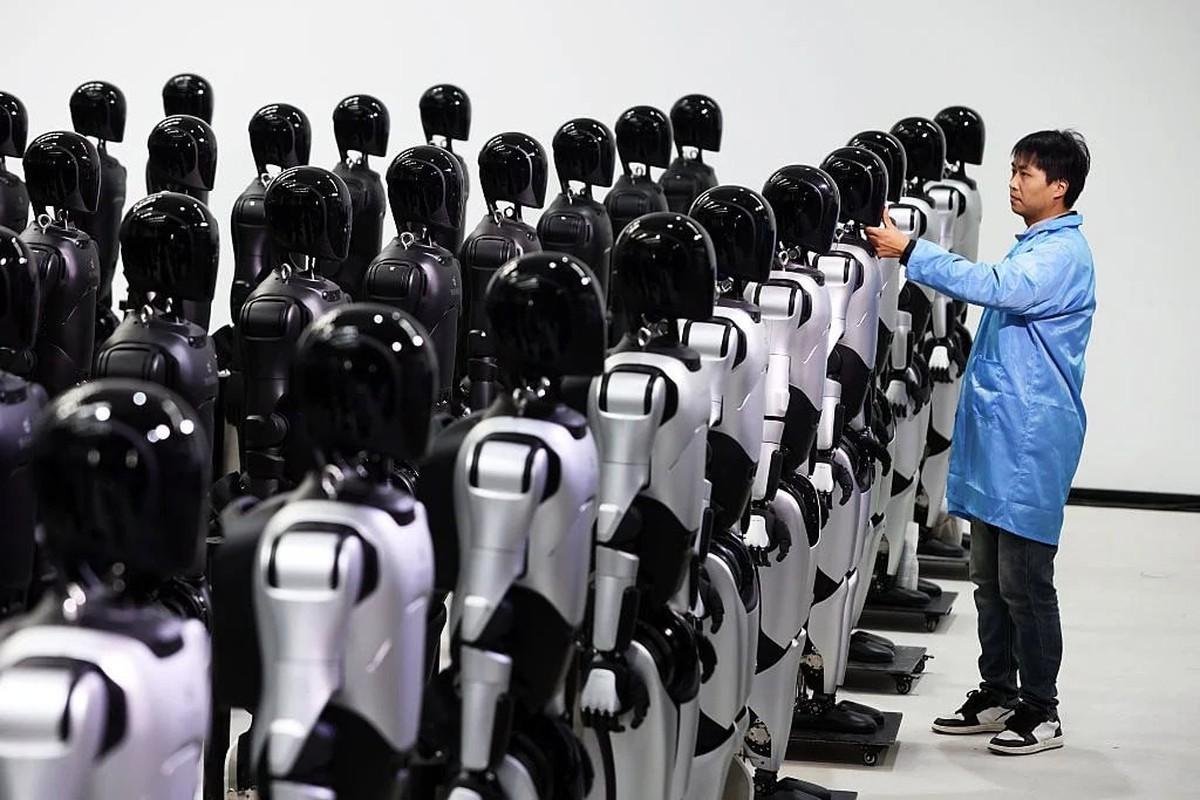
China is investing heavily in humanoid robots and building an industry that could dominate the global market. But a new Reuters investigation reveals the problem behind the spectacular demonstrations: the robots are impressive on stage, yet still struggle to perform real-world work autonomously.
In the videos circulating online, humanoid robots appear to be racing toward a science-fiction future.
They dance.
They perform kung fu.
They play football.
They box.
They run.
And sometimes they look capable of doing almost anything a human can do.
But away from the cameras, reality is much harder.
A major Reuters investigation shows that China’s humanoid-robot industry is expanding at extraordinary speed while the machines’ ability to perform general-purpose work in the real world remains far behind expectations.
More Than 150 Companies Are Racing to Build the Robot of the Future
China already has more than 150 companies working on humanoid robots.
That is more than the number of Chinese electric-vehicle brands.
During the first half of this year alone, Chinese governments spent at least $230 million buying humanoid robots and related equipment.
A year earlier, the figure was around $62 million.
In 2024, it was only $6 million.
Those numbers show that Beijing is not treating humanoid robotics as a small technology experiment.
It is treating it as a strategic industry.
And the objective is clear:
build a robotics ecosystem capable of competing globally.
The Problem: Robots Still Aren’t as Intelligent as They Look

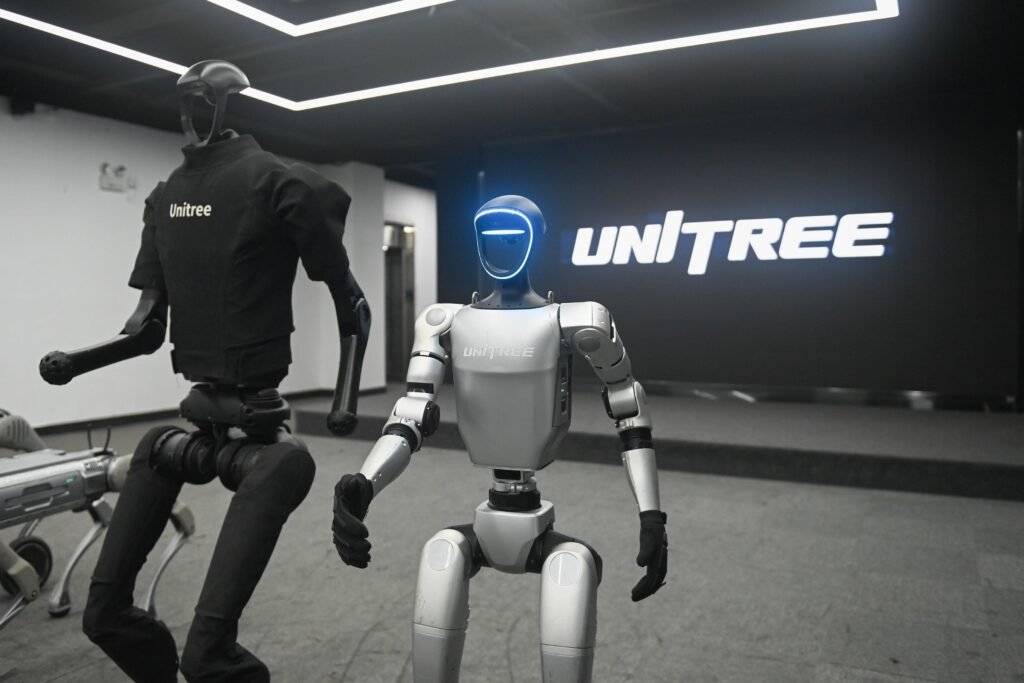
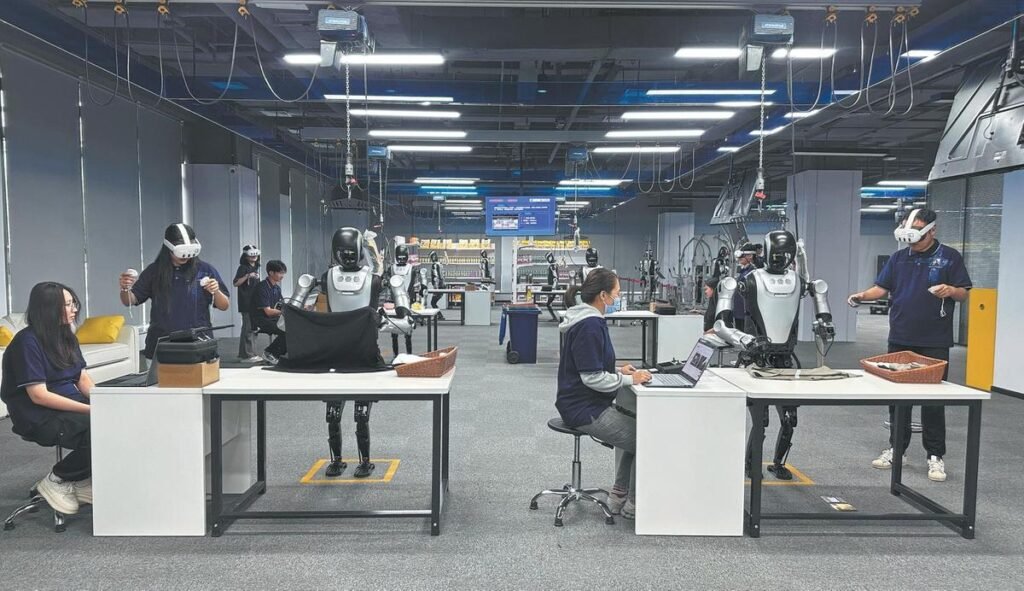
At a training center in Liuzhou, more than 100 humanoid robots stand in rows while human trainers teach them simple tasks.
Sorting boxes.
Packaging products.
Making coffee.
On paper, these are simple jobs.
In reality, the robots remain slow and error-prone.
Reuters reports that a novice trainer may need roughly 300 attempts to produce one usable movement, while an experienced trainer can reduce that to around 50 attempts.
That is the difference between an impressive demonstration and a machine capable of working an eight-hour factory shift.
“Dancing Disguised as Working”
One of the industry’s biggest problems is that many public demonstrations take place under controlled conditions.
The robot operates in a predictable environment.
The object is where it is expected to be.
The task has been predefined.
The movements have been trained in advance.
A real factory does not work that way.
A box may be slightly farther away.
An object may be rotated differently.
A cable may be tangled.
A component may be missing.
A human worker may suddenly walk in front of the robot.
And this is where humanoids still struggle.
One Chinese robotics executive described the situation bluntly: much of what looks like work is effectively “dancing disguised as working.”
China Is Building Robots Faster Than It Is Creating Demand for Them

That may be the industry’s biggest economic problem.
Manufacturers are producing.
Governments are subsidizing.
Investors are funding.
But real private-sector demand is not growing at the same speed.
Reuters found that humanoid production is currently outpacing commercial demand, while many projects remain heavily dependent on government subsidies.
That creates a pattern China has seen before with electric vehicles and solar panels:
mass production → extreme competition → falling prices → industry consolidation → a small number of survivors.
Some investors are already describing the sector as a bubble.
Unitree Is the Biggest Example
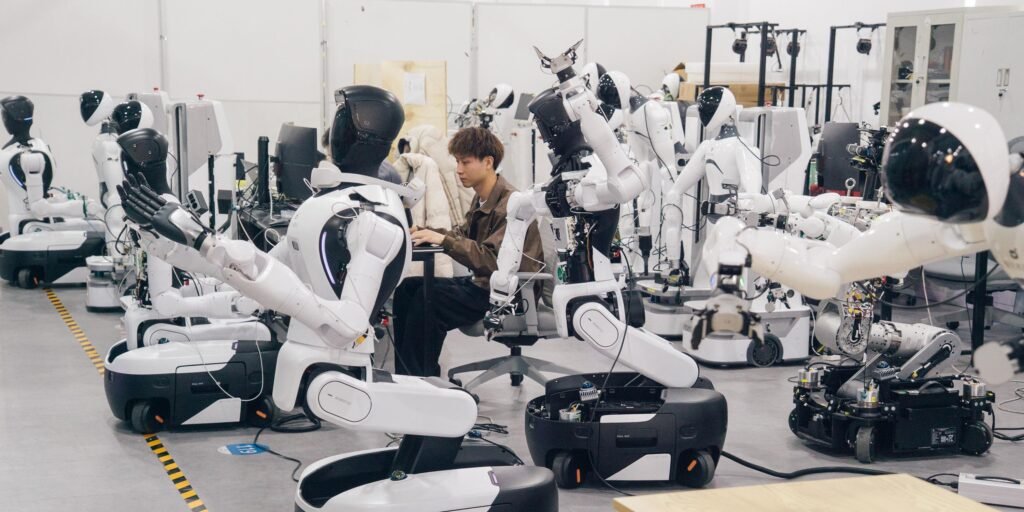
One company emerging as a major player is Unitree.
The company is already one of the world’s largest robot-dog manufacturers and a major player in humanoid robotics.
When Unitree went public in Shanghai on August 19, its shares rose more than fivefold during the debut, giving the company a valuation of roughly $50 billion before the stock later pulled back.
That shows how much capital is flowing into the sector.
But it also raises an important question:
Are investors valuing these companies based on what their robots can do today, or what they hope those robots will do tomorrow?
20,000 Humanoids Were Shipped Globally Last Year
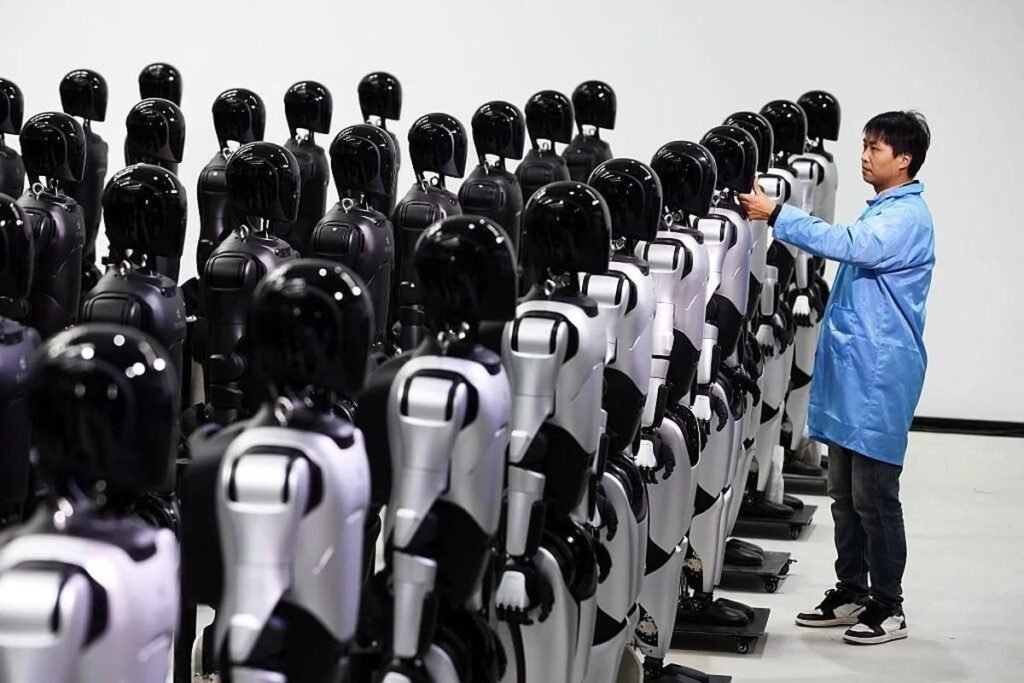
According to BofA Global Research data cited by Reuters, roughly 20,000 humanoid robots were shipped globally last year.
Chinese manufacturers accounted for about 95% of those shipments.
China expects to build more than 100,000 humanoids this year.
Meanwhile, BofA forecasts global annual shipments could reach around 1.2 million robots by 2030.
Those numbers make one thing clear:
This is no longer a small experimental industry.
It is an industrial race.
Why Isn’t a Robot That Can Walk and Run Enough?
Because walking is not the job.
Neither is running.
A robot designed to work inside a factory must be able to:
- understand its environment;
- identify objects;
- manipulate small components;
- make decisions;
- correct mistakes;
- respond to unexpected situations;
- operate for hours;
- and repeat tasks with extremely high accuracy.
That requires an extraordinary combination of AI, sensors, motors, batteries, motion control and training data.
And this is where the gap remains large.
Traditional Industrial Robots Still Have the Advantage
There is an irony here.
If the goal is simply to automate a repetitive factory task, a traditional robotic arm is often cheaper, faster and more reliable.
Industrial robots already perform millions of tasks with high precision.
Humanoids have a different potential advantage:
they can be designed to use the same doors, stairs, tools and workspaces humans already use.
If humanoids eventually reach the required level of intelligence, companies could deploy them into existing environments without rebuilding entire factories.
That is why the industry continues to invest.
The Biggest Problem May Be Data
A robot does not become intelligent simply by being manufactured.
It has to be trained.
And training requires enormous amounts of physical-world data.
According to estimates cited by Reuters, the industry currently has around 500,000 hours of high-quality training data, while as much as 100 million hours may be required to achieve a much higher level of physical intelligence.
That helps explain the industry’s obsession with scale.
The more robots operating in the real world, the more data can be collected.
The more data available, the better the models can become.
For some companies, mass production is therefore not just about selling robots.
It is also a way to collect the data needed to build the next generation of physical AI.
A Major Industry Shakeout Could Be Coming

Many analysts expect consolidation to begin in late 2026 or during 2027.
The reason is straightforward.
More than 150 companies are competing for a market that does not yet have enough demand to support all of them.
Subsidies cannot continue forever.
Investors will eventually demand results.
And robots will have to start generating real economic value.
That could trigger a wave of bankruptcies, mergers and acquisitions.
But it could also create a handful of extremely powerful robotics companies.
If China’s EV history is repeated, brutal competition could eventually produce some of the world’s cheapest and most capable humanoid robots.
TheTechSpot: The Race Won’t Be Decided by the Robot With the Best Viral Video
For the public, a robot performing kung fu is spectacular.
For a factory, the question is much simpler:
Can it work without breaking down?
Can it pick up a small component?
Can it put that component in exactly the right place?
Can it understand when something goes wrong?
Can it repeat the task 10,000 times?
And can it do all of that for less than the human or robotic alternative?
Those are the tests that will determine the winners.
China may be making an extraordinarily large bet.
There may be overproduction.
Many companies may fail.
But one thing is difficult to ignore:
China is rapidly building the infrastructure, supply chain and data foundation that could give it a major advantage in the age of Physical AI.
Today’s humanoid robots may not yet be the artificial workers promised by viral videos.
But they are getting closer.
And the question is no longer whether humanoid robots will enter the economy.
The question is:
Who will be the first to make them genuinely useful?