





A Cyber Espionage Operation Reached Some of America’s Most Sensitive Networks
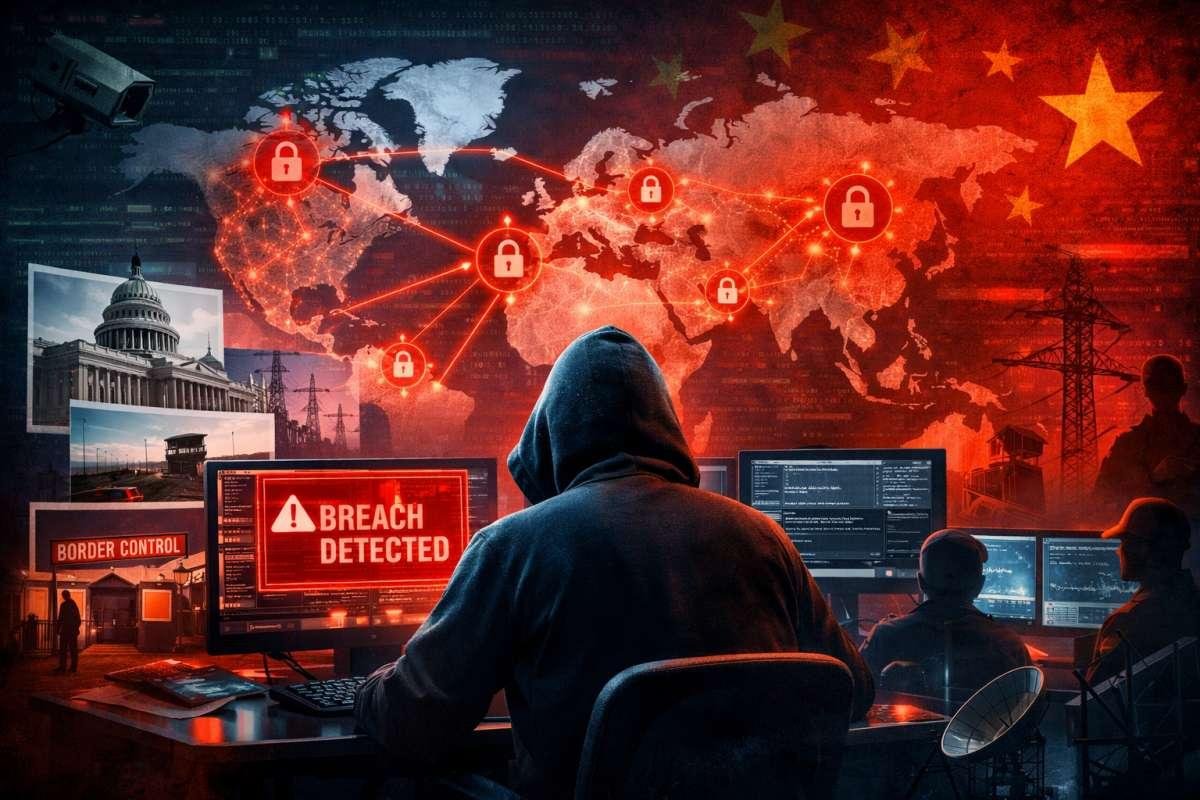
A major cybersecurity investigation in the United States has exposed the scale of a years-long hacking operation allegedly connected to China.
According to the U.S. Department of Justice, hackers used specialized platforms to target sensitive organizations across the United States, including the Department of Justice, NASA, the Federal Reserve and the U.S. Senate.
The operation was active from at least 2018, according to an affidavit released by U.S. authorities.
Investigators say the attackers used two platforms known as QScan and QTRouter, which were seized by the Department of Justice as part of the disruption operation.
The case highlights an increasingly important reality of modern cybersecurity:
The biggest cyber threats are no longer limited to stealing passwords or deploying ransomware.
Nation-state-linked groups are increasingly targeting the infrastructure, networks and information systems that support governments, financial institutions, universities and critical industries.
And in this case, the targets were exceptionally sensitive.
NASA Was Among the Organizations Targeted
One of the most attention-grabbing details of the investigation is the inclusion of NASA among the organizations targeted by the hacking campaign.
NASA operates some of the most technologically advanced systems in the United States.
Its networks contain scientific research, engineering information, aerospace data and communications infrastructure.
A successful intrusion into such an environment could potentially provide attackers with valuable information about research programs, technology development and government operations.
The DOJ says the campaign also targeted other U.S. government organizations.
That makes the operation more than a conventional corporate data breach.
It is being investigated as part of a broader cyber espionage campaign.
The Federal Reserve Was Also Targeted
The alleged targeting of the Federal Reserve is another major reason the case has attracted attention.
Financial institutions are among the most valuable targets in cyberspace.
They contain enormous amounts of sensitive financial information and operate infrastructure that is critical to the functioning of the global economy.
The Federal Reserve also plays a central role in the U.S. financial system.
An attacker attempting to gain access to systems connected to such an institution could potentially seek information about financial operations, economic policy, communications or other sensitive activities.
Authorities have not suggested that the hackers successfully compromised every organization they targeted.
That distinction is important.
The investigation describes both successful intrusions and unsuccessful attempts.
But even unsuccessful attempts reveal the level of interest that state-linked cyber groups have in critical institutions.
The U.S. Senate Was Also Targeted
The alleged targeting of the Senate demonstrates how broad the campaign was.
Government networks are attractive targets because they can contain political communications, internal documents, research and information about government operations.
According to the DOJ’s affidavit, the attackers also attempted to compromise networks connected to other U.S. government and healthcare organizations.
Those targets reportedly included the:
- Department of Energy
- Department of Health and Human Services
- National Institutes of Health
- Senate
- Healthcare organizations
- Universities
- Defense contractors
- Financial institutions
This suggests the operation was not focused on a single sector.
Instead, the attackers were looking for valuable information across multiple areas.
Who Was Behind the Operation?
U.S. authorities have linked the hacking operation to Nanjing Xinjiuwei Network Technology Company, which investigators say has connections to Chinese intelligence and military organizations.
The U.S. government alleges that the company was involved in cyber operations connected to China’s Ministry of State Security and the People’s Liberation Army.
China has rejected the accusations.
A Chinese embassy spokesperson accused the United States of using cybersecurity allegations to target Chinese companies and described the U.S. claims as politically motivated.
That means the attribution remains part of a broader geopolitical dispute between Washington and Beijing.
But the technical evidence and infrastructure seized by U.S. authorities provide the basis for the American investigation.
QScan and QTRouter Were Key Tools
One of the most interesting aspects of the case is the discovery of the hacking infrastructure used by the attackers.
Authorities identified two platforms:
QScan
and
QTRouter
These systems were reportedly used to help conduct cyber operations against targeted organizations.
The Department of Justice seized the platforms as part of its effort to disrupt the operation.
This is significant because governments traditionally face a difficult problem when fighting sophisticated cyber groups.
Even when an attacker is identified, completely removing their infrastructure can be difficult.
Servers can move.
Domains can change.
Malware can be rebuilt.
Attackers can establish new infrastructure.
Taking control of important components of an operation therefore represents a major step in disrupting it.
The Campaign Was Not Limited to Government Agencies


Although NASA, the Justice Department and the Federal Reserve are the most recognizable names connected to the case, they were not the only targets.
Investigators also identified activity involving:
Defense contractors.
Financial institutions.
Universities.
Healthcare organizations.
Technology companies.
Government agencies.
That broader targeting strategy is typical of sophisticated intelligence operations.
Attackers may not know in advance which target will contain the most valuable information.
Instead, they may compromise multiple organizations and search for useful intelligence.
Why Universities Are Valuable Targets
Universities may appear less important than government agencies.
In cybersecurity, however, they can contain highly valuable information.
Research institutions work on:
- Artificial intelligence
- Quantum computing
- Aerospace
- Biotechnology
- Engineering
- Materials science
- Defense research
- Semiconductor technology
Many universities also collaborate with governments and private companies.
That makes academic networks attractive to cyber espionage groups.
An attacker may not necessarily be looking for financial data.
They may be looking for intellectual property.
The New Cybersecurity Battlefield Is Intellectual Property

This case demonstrates how the definition of cybersecurity has changed.
Twenty years ago, many organizations primarily worried about viruses and stolen passwords.
Today, sophisticated attackers are interested in something much more valuable:
knowledge.
A company developing a new semiconductor could be targeted.
A university developing quantum technology could be targeted.
A defense contractor could be targeted.
A pharmaceutical company developing a new drug could be targeted.
A government agency could be targeted for policy information.
The goal isn’t always to steal money.
Sometimes the objective is to gain a technological or strategic advantage.
Cyber Espionage Is Becoming More Automated
Another important trend is the increasing use of automation in cyber operations.
Modern attackers can scan enormous numbers of systems looking for weaknesses.
Instead of manually searching the internet for vulnerable servers, automated tools can identify potential targets.
That makes large-scale cyber operations much more efficient.
And artificial intelligence could make this trend even more significant.
Security researchers have warned that AI can help attackers identify vulnerabilities and automate parts of cyber operations.
This creates a difficult situation.
The same technology that companies use to defend networks can also potentially help attackers find weaknesses.
This Is Not a Traditional Ransomware Attack
It is important to distinguish this campaign from the ransomware attacks that dominate cybersecurity headlines.
Ransomware groups typically want money.
They steal data, encrypt systems and demand payment.
Cyber espionage campaigns have a different objective.
The attackers may remain inside a network for long periods.
They may quietly collect documents.
They may monitor communications.
They may search for specific information.
And they may try to avoid detection.
That makes them particularly difficult to identify.
A company might discover a ransomware attack within hours.
A sophisticated espionage operation could potentially remain hidden for months or years.
Why the 2018 Timeline Matters
The operation reportedly dates back to at least 2018.
That means the campaign existed during a period when the cybersecurity environment changed dramatically.
Cloud computing expanded.
Remote work became mainstream.
5G networks became widespread.
AI became significantly more powerful.
Organizations moved more workloads online.
Every one of these changes created new opportunities — and new vulnerabilities.
The longer an attacker can maintain access to an environment, the greater the potential intelligence value.
The U.S. Is Treating Cybersecurity as a National Security Issue

The response to the investigation shows how closely cybersecurity is now connected to national security.
The DOJ didn’t simply investigate a data breach.
It moved to seize infrastructure allegedly used by the attackers.
That is a significant escalation.
Governments increasingly recognize that cyber operations can have consequences similar to traditional espionage.
A stolen document can reveal military plans.
A compromised research network can expose advanced technology.
A financial intrusion can reveal economic information.
A telecommunications breach can provide intelligence about communications.
Cybersecurity is therefore becoming part of national defense.
China Rejects the Accusations
Beijing has rejected the U.S. claims.
Chinese officials have repeatedly argued that the United States itself conducts extensive cyber operations and has accused Washington of using cybersecurity allegations to restrict Chinese companies.
That means readers should understand the geopolitical context.
The U.S. investigation represents the American government’s assessment of the activity.
China disputes that assessment.
The case therefore sits at the intersection of cybersecurity, intelligence and international politics.
The Bigger Problem: Critical Infrastructure
One of the most worrying aspects of modern cyber warfare is the growing focus on critical infrastructure.
Recent attacks have targeted:
- Energy systems
- Water utilities
- Healthcare
- Telecommunications
- Transportation
- Financial systems
- Industrial control systems
A recent cyberattack on Micro-Comm, a Kansas-based company supplying programmable controllers for wastewater processing, also attracted FBI scrutiny. The attackers reportedly stole approximately 644GB of data.
Although investigators said there was no evidence that the incident compromised water operations, the case demonstrated why industrial technology is increasingly attractive to attackers.
A cyberattack doesn’t always need to destroy infrastructure.
Sometimes simply gaining access to the systems controlling it can be strategically valuable.
Industrial Systems Are Becoming a Major Target
Industrial control systems were historically designed with reliability in mind.
Cybersecurity wasn’t always the primary concern.
Many systems were isolated from the public internet.
That is changing.
Factories, utilities and industrial companies increasingly connect equipment to modern networks so they can monitor operations remotely.
That creates efficiency.
But it also creates attack surfaces.
Security researchers and government agencies have warned about increasing attacks against programmable logic controllers and industrial systems.
The result is a difficult trade-off:
More connectivity creates more efficiency.
More connectivity can also create more risk.
What This Means for Companies
The lesson for businesses is straightforward.
Cybersecurity can no longer be treated as an IT department problem.
It is a business problem.
Organizations need to know:
What systems are exposed?
Who has access?
Where is sensitive data stored?
Which third-party vendors have network access?
What happens if an attacker obtains administrator credentials?
How quickly can the company detect abnormal activity?
How quickly can systems be isolated?
These questions are becoming more important as attackers become more sophisticated.
The Rise of Supply-Chain Attacks

One of the most difficult cybersecurity problems is the supply chain.
Large organizations often depend on hundreds or thousands of external companies.
Software vendors.
Cloud providers.
Hardware manufacturers.
IT contractors.
Consultants.
Network operators.
A company may have excellent security and still be exposed through a third party.
That’s why attackers increasingly look for smaller organizations that provide access to larger targets.
The recent Micro-Comm incident illustrates why cybersecurity agencies are increasingly concerned about the security of industrial suppliers.
The AI Connection
Although this is primarily a cybersecurity story, AI is becoming increasingly important in the background.
AI can help defenders identify unusual activity.
It can analyze enormous amounts of network traffic.
It can detect suspicious behavior.
It can prioritize vulnerabilities.
But attackers can also use AI to automate reconnaissance and vulnerability discovery.
That means the future cybersecurity battle may increasingly become:
AI vs. AI.
The organizations with the strongest defensive AI may gain an advantage.
But attackers are unlikely to remain static.
Why This Story Matters to Everyone
It would be easy to look at this story and think:
“NASA and the Federal Reserve were targeted. This doesn’t affect me.”
That’s not necessarily true.
Large cyber operations often begin with seemingly ordinary vulnerabilities.
A compromised employee account.
An outdated server.
A vulnerable third-party application.
A stolen password.
A phishing email.
The difference is what happens afterward.
Sophisticated attackers can use one compromised system as a starting point and gradually move through an organization.
That is why modern cybersecurity focuses heavily on detection, segmentation and limiting access.
The New Reality of Cyber Warfare
The internet has effectively created another battlefield.
Countries compete in cyberspace.
Companies defend intellectual property.
Criminal groups attack businesses for money.
Researchers search for vulnerabilities.
Governments monitor sophisticated threat actors.
And increasingly, AI is becoming part of every side of the equation.
The attack against organizations including NASA and the Federal Reserve is another reminder that cyber warfare is not theoretical.
It is already happening.
🔥 THE TECHSPO ANGLE
This is where I would make the article different from a simple Reuters-style rewrite:
The most dangerous cyberattacks may be the ones you don’t notice.
Ransomware makes headlines because companies suddenly stop working.
Cyber espionage can be much quieter.
An attacker can enter a network, collect information and leave without immediately causing visible damage.
That’s what makes sophisticated state-linked operations so difficult to defend against.
And as AI makes both cyberattacks and cyber defense more automated, the next generation of cyber warfare could happen faster, more quietly and on a much larger scale.
The biggest question isn’t simply:
“Can hackers break into a network?”
It’s:
“How long can they remain inside before anyone realizes they’re there?”
That is the cybersecurity challenge governments and companies are now facing.