Imagine a collapsed building after an earthquake.
People may still be alive beneath the rubble, but the spaces are too narrow, unstable or dangerous for rescuers to enter immediately.
A conventional robot may be too large.
A rescue dog may not be able to reach the victim.
But a cockroach can squeeze through spaces that are almost impossible for humans and machines to access.
That is the idea behind one of the most unusual robotics projects unveiled this week.
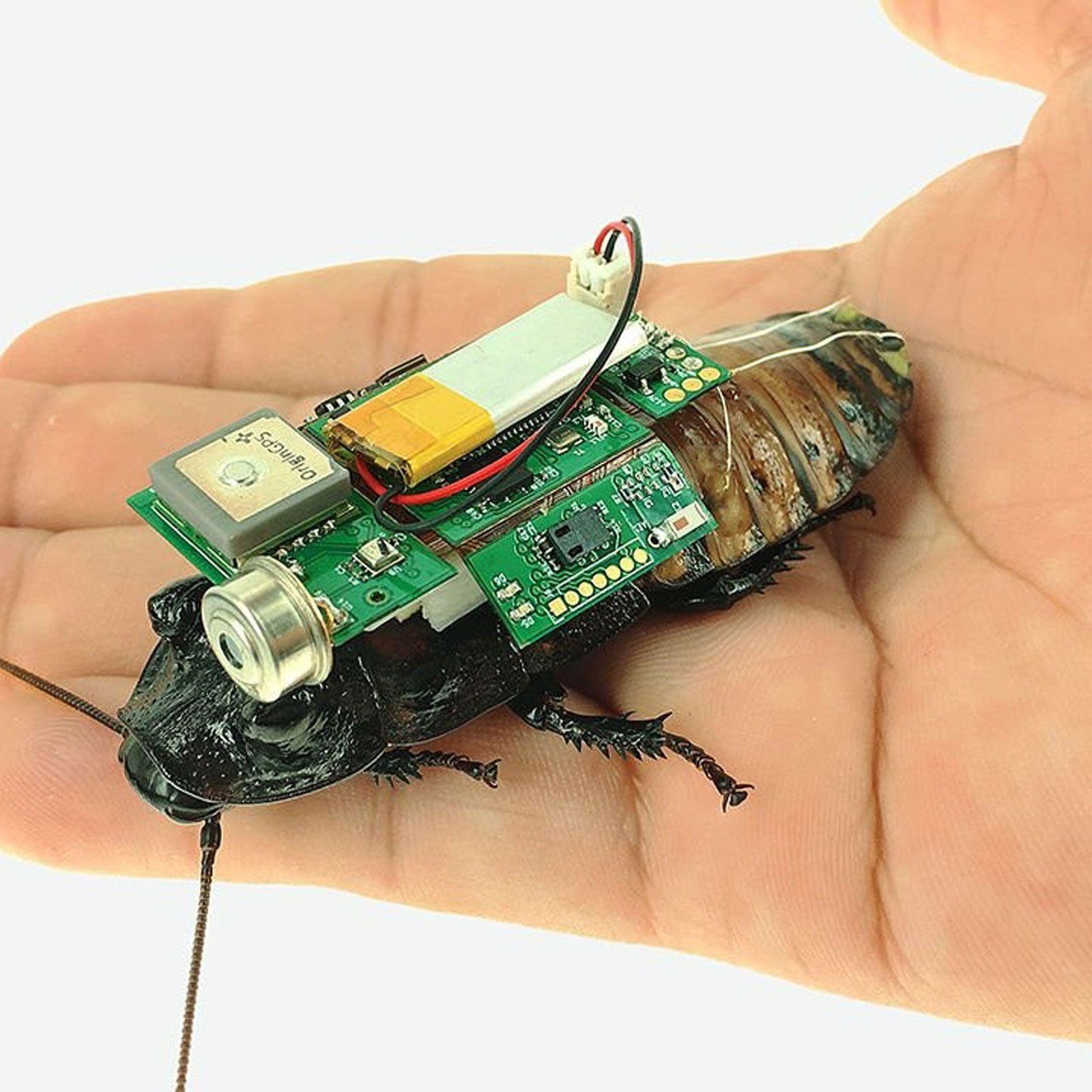
Researchers from the University of Queensland (UQ) and the University of New South Wales (UNSW) have transformed giant burrowing cockroaches into miniature cyborg paramedics equipped with cameras and tiny remotely activated medical injectors.
And the goal is not simply to find survivors.
The researchers envision a future in which these insects could locate trapped people and deliver emergency medical assistance before human rescuers can physically reach them.
From Insect to Rescue Robot
The project uses the giant burrowing cockroach (Macropanesthia rhinoceros), a large species native to northern Queensland.
The insects are large and strong enough to carry lightweight electronic equipment mounted on their bodies.
Researchers equip them with electronic systems and use electrical stimulation to guide their movements remotely.
Depending on the configuration, one insect can carry a camera for visual feedback while another can carry a miniature injection system.
The researchers refer to these systems as “Paraborgs” — a combination of a biological organism and a robotic platform.
That distinction is important.
The scientists are not trying to build a tiny robot that looks like a cockroach.
They are using the cockroach itself as part of the robot.
Why Use a Cockroach?
The answer is surprisingly practical.
Cockroaches are extremely capable movers.
They can navigate narrow spaces, uneven terrain and environments that would be difficult for conventional robots.
A tiny autonomous robot would need motors, batteries and complex mechanical systems to reproduce capabilities that the insect already has naturally.
A cyborg insect, on the other hand, uses its own muscles and biomechanics for most of its movement.
That means the electronic backpack can focus on cameras, sensors, communications and control rather than powering the entire locomotion system.
Similar cyborg insects have already been explored for disaster response.
In 2025, cyborg cockroaches were deployed as part of Singapore’s Operation Lionheart response in earthquake-hit Myanmar, where they were used to search areas that were difficult or dangerous for humans and larger robots to access.
But Now They Can Do More Than Search
This is the most important development in the new project.
For years, cyborg insects have primarily been considered living sensors.
Researchers could send them into dangerous areas.
They could attach cameras to their bodies.
They could collect environmental information.
But the UQ and UNSW teams asked a different question:
What if the insect could do more than find the victim?
What if it could actually help the person it discovered?
That led to the idea of the “paramedic cockroach.”
The Tiny Injector Is the Most Unusual Part
The researchers developed a miniature remotely activated injection system designed specifically for the insects.
The idea is that once a victim has been identified, a cyborg insect can be guided toward the target and positioned as accurately as possible.
The injection system can then be activated remotely.
Importantly, the medical decision remains under human control.
The insect does not decide what treatment should be administered.
Instead, it acts as a physical platform capable of transporting and positioning a medical device.
Researchers describe the concept as a way to bring treatment to patients when rescuers cannot yet bring the patients to treatment.
The Results Are Surprisingly Strong
In proof-of-concept testing, the Paraborgs achieved a 95% success rate for close-range injection when positioned within 15 centimeters of the target.
When the complete process — navigation, positioning and injection — was combined, the system achieved success in 72% of trials.
These numbers do not mean the technology is ready for widespread emergency deployment.
The experiments were conducted under controlled conditions.
But they demonstrate something important:
The concept works.
And that is why the project has attracted so much attention.
A Swarm of Specialized Cyborg Insects

The researchers have an even bigger vision.
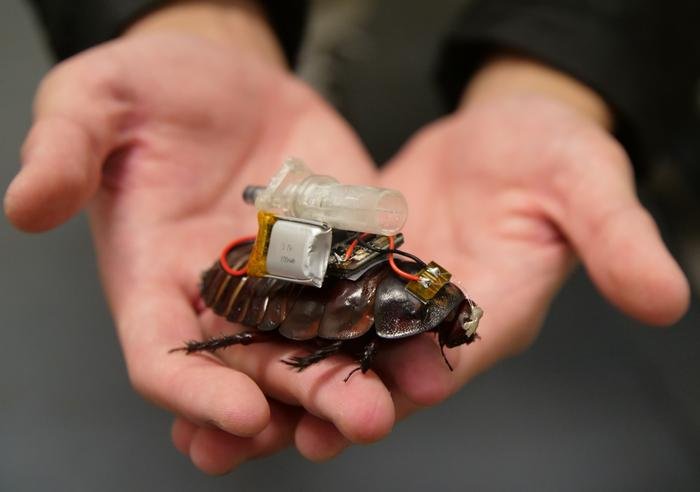
Instead of asking one insect to perform every task, they envision swarms of specialized cyborg insects.
Some could carry cameras.
Others could carry environmental sensors.
Some could transport medical equipment.
Others could map dangerous environments.
This would create a system similar to a human rescue team.
Different members would perform different roles.
That is exactly the direction the researchers say they want to explore.
Why Not Just Build Smaller Robots?
It is a reasonable question.
If robotics technology is becoming so advanced, why not simply build a tiny six-legged rescue robot?
The problem is energy, complexity and cost.
A robot has to artificially recreate what an insect already has.
Legs.
Muscles.
Balance.
Locomotion.
The ability to navigate difficult surfaces.
The insect already has those systems built into its body.
Researchers simply add the electronics required for remote control and sensing.
This is one of the most fascinating concepts in bio-inspired robotics.
Sometimes the best way to build a robot is not to copy nature.
It is to use nature itself.
Also Read: Anthropic Gives AI a Physical Body: Claude Can Now Control Robots, Microscopes and Lab Equipment
Cyborg Cockroaches Could Also Work Underwater

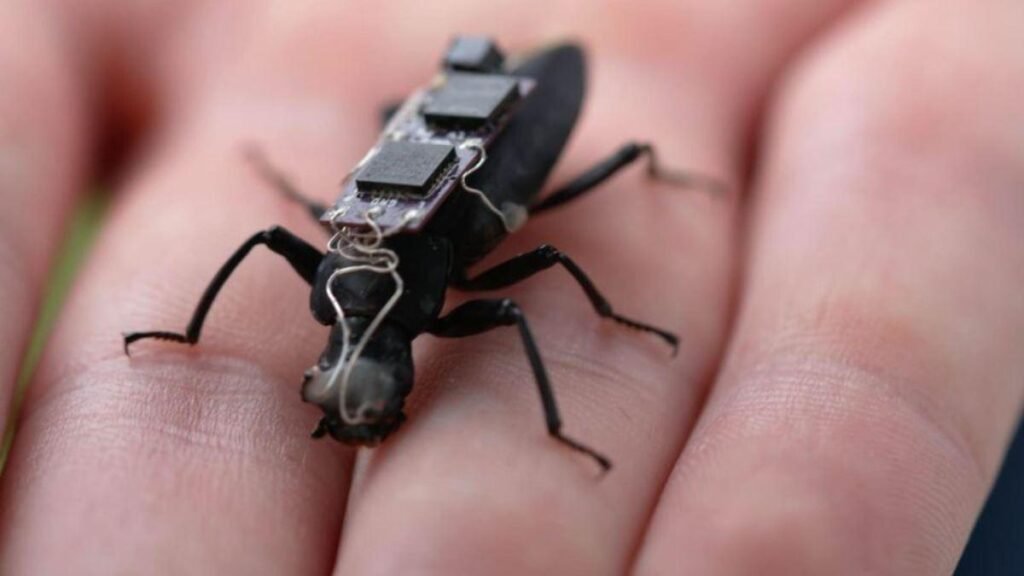
The Australian project is not the only recent development in cyborg insect technology.
In June, researchers from Nanyang Technological University and Waseda University demonstrated a flexible “diving suit” designed to allow cyborg cockroaches to operate underwater and in low-oxygen environments for up to three hours.
That could open another category of applications.
Think about:
- flooded tunnels;
- earthquake-damaged basements;
- drainage systems;
- caves;
- industrial pipelines;
- partially submerged disaster zones;
- environments too dangerous for humans.
If a cyborg insect can navigate those spaces while transmitting information, it could become a valuable tool for emergency teams.
Control Remains a Major Challenge
The technology is still far from perfect.
One of the biggest engineering challenges is accurate positioning.
The insect must move toward the target, reach the correct location, remain stable and then perform the required action.
A small movement at the wrong moment could make an injection inaccurate.
Researchers will also need to test the technology under much more realistic conditions involving dust, water, unstable surfaces, weak signals and unpredictable obstacles.
That is why the technology remains at the research stage.
What About Ethics?
A technology that combines living organisms with electronics naturally raises ethical questions.
The researchers say the insects are anesthetized during the implantation of electrodes and equipment, and that once the equipment is removed they can live for approximately as long as other cockroaches.
Still, as this field develops, researchers and regulators will have to consider animal welfare, the use of living organisms in technology and the ethical limits of bio-robotics.
Those questions will become increasingly important if cyborg insects move from laboratories into widespread real-world applications.
OLSI FEÇI
When Could They Be Used in Real Emergencies?
Not tomorrow.
Researchers at UQ estimate that it could take five to ten years before cyborg insect rescue teams could potentially be deployed in real emergencies, assuming research and field testing accelerate.
So there is no swarm of robotic cockroach paramedics waiting to be deployed today.
What exists is something more important:
A demonstration that biology and robotics can be combined to solve problems that conventional robots may struggle to solve efficiently.
🔥 WHY IT MATTERS
At first glance, this looks like a viral story about “robot cockroaches.”
But behind the strange headline is a serious technological trend.
Bio-robotics is changing what we think a robot can be.
A robot does not necessarily have to be a metal machine powered entirely by motors and batteries.
It can be a living organism enhanced with electronics.
It can use natural muscles for movement.
It can carry cameras and sensors.
And eventually, it may perform tasks that help save lives.
If the technology proves reliable in real disaster environments, rescue teams could gain a new tool for reaching places where humans and conventional robots cannot safely operate.
And perhaps the most fascinating part is this:
The robots of the future may not look like robots at all.
Sometimes they may have six legs, antennae and an appearance most people would rather not encounter in their homes.
But inside a collapsed building, a cyborg cockroach capable of locating a victim and delivering emergency assistance could become exactly the kind of technology someone desperately needs.