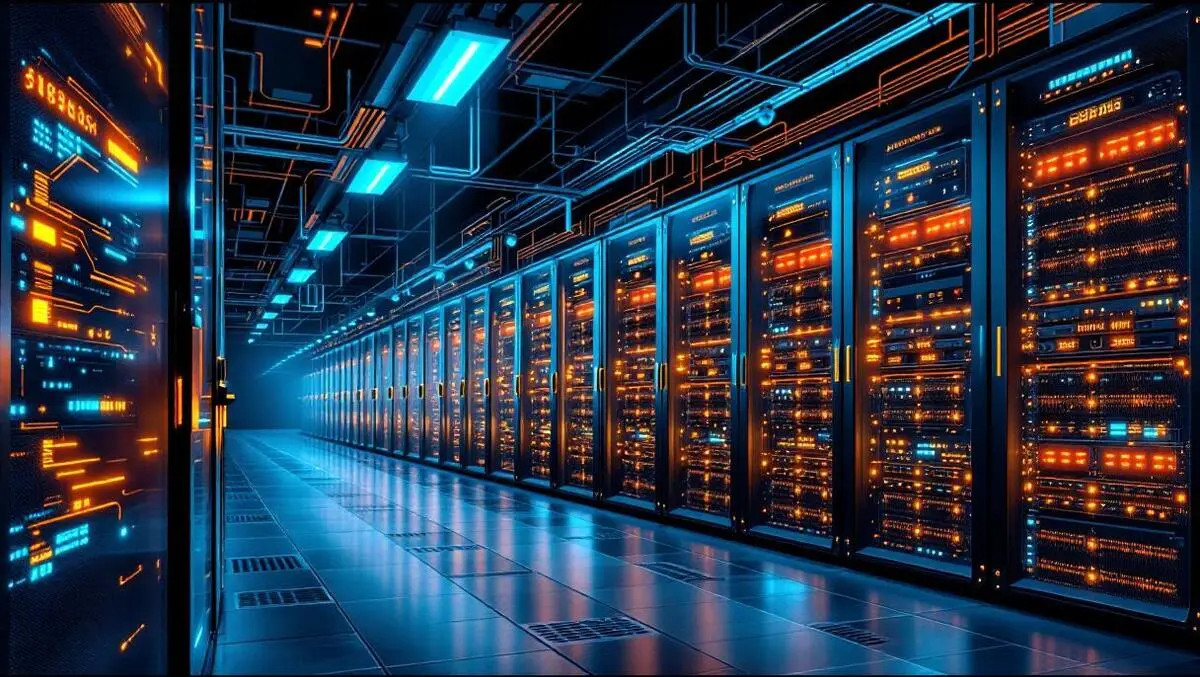
The EU is proposing a new rating system for data centers above 500 kW, measuring energy, water use and their impact on Europe’s electricity grid.
AI is creating a new infrastructure problem: where will the power come from?
Data centers have become the physical infrastructure behind the AI economy.
Every large AI model, chatbot, cloud service and GPU-intensive application ultimately depends on servers — and servers require electricity and cooling.
That is why the European Commission has proposed a common European rating scheme for data centers, focusing on energy and water use.
The system would cover individual data centers with capacity above 500 kW and is designed to make resource consumption more transparent.


What exactly is the EU proposing?
The basic idea is simple:
If a data center consumes large amounts of energy and water, that consumption should be measurable and comparable.
The proposed scheme would provide information on:
- energy use;
- water use;
- energy efficiency;
- interaction with the electricity grid;
- use of clean energy;
- potential reuse of waste heat;
- and the ability to adjust electricity consumption to grid conditions.
The Commission expects the first sustainability labels for individual data centers to appear in 2027, assuming the proposal moves through the required process.
Why water matters almost as much as electricity
When people talk about AI infrastructure, GPUs usually come first.
But GPUs running at high utilization generate large amounts of heat.
That heat has to go somewhere.
Depending on the cooling architecture, data centers can use different cooling technologies, including systems that rely on water.
That means AI expansion is not only about:
How many GPUs can we deploy?
It is also about:
How much electricity can we supply, and how much water can we use to keep those GPUs operating safely?
The European Commission explicitly links data-center growth to increasing demand for electricity, cooling water and other environmental resources.
Europe wants to triple data-center capacity
This is where the paradox appears.
The EU does not want fewer data centers.
It wants more of them.
The European Commission aims to triple Europe’s data-center capacity over the next five to seven years.
The goal is technological as well as strategic: Europe wants more computing capacity for AI and cloud services while strengthening its technological independence and digital sovereignty.
But tripling computing capacity does not necessarily have to mean tripling pressure on electricity grids.
That is why the EU is trying to establish measurement and efficiency mechanisms before expansion becomes even larger.
How much electricity do data centers consume?
The European Commission, citing IEA data, says data centers account for around 1.5% of global annual electricity consumption, or approximately 415 TWh.
According to the projections cited by the Commission, global data-center electricity consumption could exceed 945 TWh by 2030, more than doubling, largely because of accelerated computing used for AI.
Within the EU, the Commission expects data centers to account for more than 3% of total electricity demand by 2030.


An interesting idea: reuse the waste heat
One of the most interesting parts of the EU approach is that it is not only about reducing energy use.
It is also about reusing heat.
Data centers generate heat continuously.
Instead of simply rejecting that heat into the environment, it can potentially be reused in district-heating systems or nearby facilities.
The Commission says that reusing around half of the total waste heat from European data centers could correspond to the heating demand of roughly four million households.
That changes the concept of a data center.
It becomes not just a building that consumes electricity, but potentially an asset that can interact with the surrounding energy system.
The EU is preparing minimum standards too
The rating system is not necessarily the final step.
The Commission has also launched a public consultation on minimum performance standards for data centers.
The consultation is open until December 14, 2026, while a legislative proposal for minimum standards is planned for the second quarter of 2027.
The possible sequence is therefore:
measurement → transparency → comparison → minimum standards.
That could become much more significant than a label alone.
What could change for AI companies?
If these policies move forward, companies building data centers in Europe will have to think about more than:
GPU + electricity + land
They will increasingly need to consider:
water + efficiency + grid capacity + heat reuse + clean energy.
This could influence where new data centers are built.
A company may find a region with abundant electricity and strong grid infrastructure, but limited water availability could make a conventional cooling strategy difficult.
Another region might offer renewable energy, strong grid connections and opportunities to reuse waste heat.
The physical geography of AI could therefore become an increasingly important business consideration.
What does this mean for ordinary users?
At first glance, very little.
People will continue using ChatGPT, Gemini, Claude, cloud applications and AI-powered services.
But behind every request is a physical chain:
prompt → server → GPU → electricity → cooling → data center.
The more AI people use, the more important that physical chain becomes.
That is why AI infrastructure is no longer just an engineering issue.
It is becoming an energy-economics issue.
Facts, interpretation and what remains uncertain
Fact: the EU has proposed a common rating scheme for data centers above 500 kW.
Fact: the scheme is intended to increase transparency around energy and water use.
Fact: the EU wants to triple data-center capacity over the next five to seven years.
Fact: the Commission is also preparing minimum performance standards.
Editorial interpretation: Europe is trying to expand AI infrastructure while reducing the risk that the physical expansion of AI places uncontrolled pressure on electricity systems and water resources.
What remains uncertain: how strict the eventual standards will be, how they will be implemented across member states and whether transparency will eventually lead to concrete limits for highly energy-intensive facilities.
The AI race is entering a phase where model performance is no longer the only constraint.
Electricity is infrastructure. Water is infrastructure. The grid is infrastructure.
Without them, large-scale AI cannot operate.
Europe is now trying to measure that physical cost more systematically.
And that could become one of the industry’s most important shifts:
AI may increasingly be judged not only by how intelligent a model is, but by how much energy and resources it requires to run.