AMD Crosses $1 Trillion: How AI Is Turning a Chipmaker Into a Full-Stack Infrastructure Company
AMD reaches a new milestone in the AI era
AMD has crossed $1 trillion in market capitalization for the first time, becoming one of the major U.S. chip companies to reach that level.
Reuters reported that AMD shares rose 9.6% on September 21 and reached a record $613.31.
But the more important technology story is not the trillion-dollar number itself.
It is what AMD is becoming.
The company is moving beyond the traditional model of selling CPUs and GPUs as individual products. Its strategy now covers GPUs, CPUs, networking, software and complete AI infrastructure.
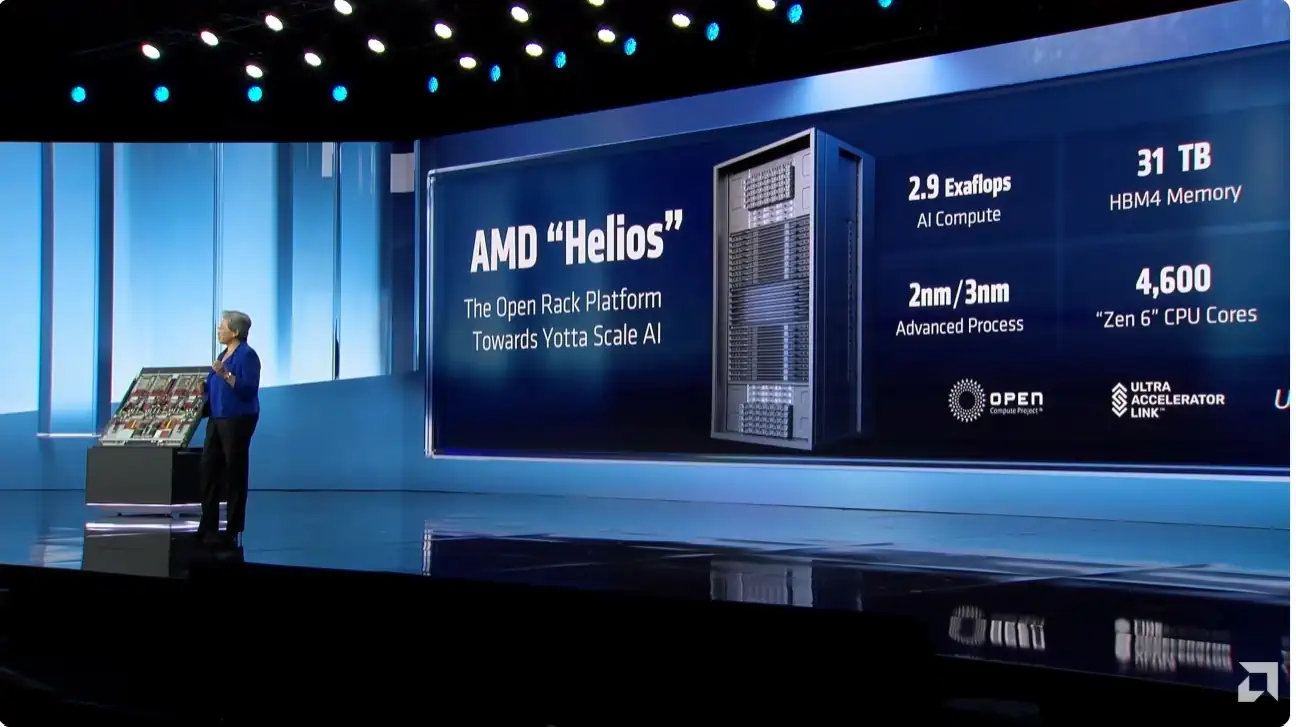
At the center of that strategy is Helios.

From a chip to an AI factory
Traditional semiconductor infrastructure was relatively straightforward: one company designed a processor while another assembled the server.
AI is changing that equation.
A company building or running very large AI models needs far more than a powerful GPU.
It needs:
- GPUs;
- CPUs;
- memory;
- high-bandwidth networking;
- software;
- power;
- cooling;
- cluster management;
- security;
- and extremely fast communication between accelerators.
AMD is trying to bring those pieces together.
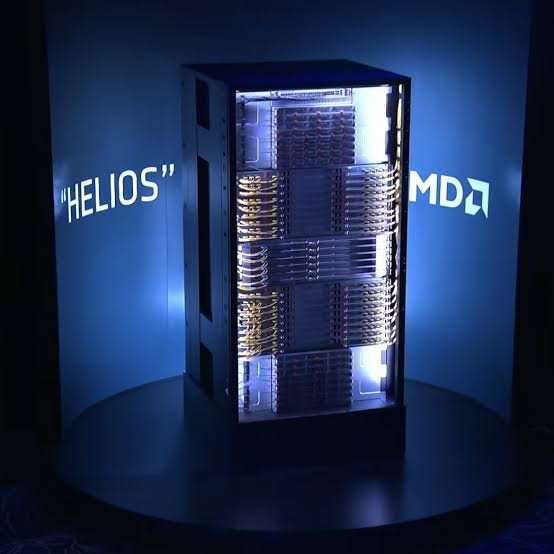
Helios combines 72 AMD Instinct MI455X GPUs, 18 sixth-generation AMD EPYC CPUs, AMD Pensando networking and ROCm software.
That changes the business proposition from “buy an accelerator” to “deploy an AI infrastructure platform.”
Why Helios matters
One of the biggest changes in AI is the shift from training toward inference.
Training is where a model learns from massive amounts of data.
Inference is where the model is actually used: when an AI assistant answers a question, an agent completes a task, a system analyzes documents or an application generates content.
The more people use AI, the more inference computing is required.
AMD says Helios is designed for frontier AI, large-scale inference and foundation-model training.

Data-center numbers tell the story
In the second quarter of 2026, AMD reported $11.5 billion in revenue, up 50% year over year.
The biggest change came from its Data Center business.
Data Center revenue reached $6.7 billion, up 107% from the same quarter a year earlier. AMD attributed the growth primarily to demand for EPYC processors and Instinct MI350 GPUs.
That helps explain why AMD is being viewed differently by the market.
AI is not creating demand only for GPUs.
It is creating demand for an entire hardware and software ecosystem.
OpenAI, Microsoft, Meta and Anthropic enter the equation
AMD has announced partnerships with several major AI companies.
Microsoft plans to deploy Helios at Azure to support frontier-model inference.
Meta and AMD are co-engineering AI infrastructure at gigawatt scale, while Anthropic has announced plans to deploy up to 2 gigawatts of AMD Instinct MI450 GPUs, with the first gigawatt expected to begin deployment in the first half of 2027.
According to AMD, OpenAI expects to bring Helios online beginning in late 2026, with deployments accelerating through 2027.
These agreements matter because the AI race is no longer happening only inside research labs.
It is increasingly a race to build billions of dollars’ worth of data-center infrastructure.
AMD vs. Nvidia: the battle is bigger than GPUs
Nvidia has built a huge ecosystem around its GPUs and CUDA software stack.
AMD is building its own full-stack alternative:
Instinct → EPYC → Pensando → ROCm → Helios
ROCm is particularly important because large customers do not simply want powerful hardware.
They need their existing AI workloads and frameworks to run efficiently without massive software migration costs.
AMD positions ROCm as the software layer connecting its accelerators and Helios systems with widely used frameworks such as PyTorch, TensorFlow, JAX and others.
But $1 trillion does not mean the race is over
Fact: AMD crossed $1 trillion in market capitalization.
Fact: Data Center revenue grew 107% year over year in Q2.
Fact: Helios has entered production and AMD is preparing large deployments.
Fact: The company has announced major commitments from leading AI companies.
Editorial interpretation: the market is increasingly valuing AMD as an AI infrastructure company rather than simply a processor manufacturer.
Market capitalization, however, measures the value assigned to a company’s shares. It is not the same thing as revenue or profit.
Reuters also noted that expectations surrounding AI have become an important factor in AMD’s valuation.
What happens next?
The next phase will be tested inside real data centers.
Helios now has to move through:
demonstration → production → deployment → scale.
AMD says Helios deployments are expected to expand through the second half of 2026 and into 2027.
If major customers deploy these systems at scale, the AI hardware race could increasingly become a race over complete infrastructure platforms, rather than simply the fastest individual chip.
What readers should remember
AMD is no longer positioning itself around a single product category.
Its strategy is increasingly:
chip + server + networking + software + data center.
Crossing the $1 trillion market-capitalization threshold is an important financial milestone reflecting how investors are valuing that transformation.
The more important test, however, will come from real-world deployments: how many Helios systems are installed, how they perform, how much the infrastructure costs and how efficiently the software scales.
Bottom line: AI is changing not only applications and the internet, but the semiconductor industry itself. AMD is one of the clearest examples of that transformation.