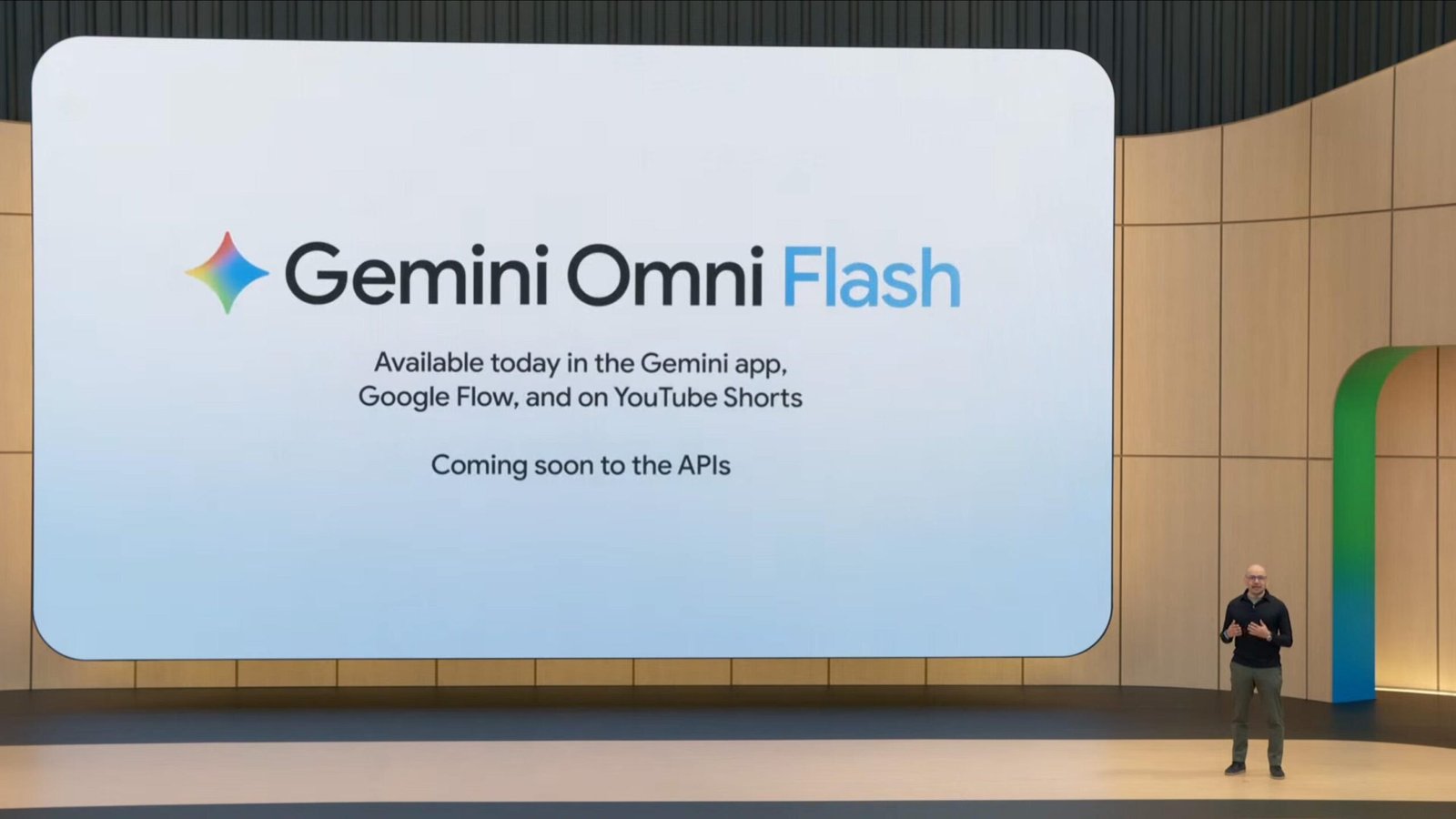
Google has introduced Gemini Omni 1.1 Flash, a new version of its multimodal model designed to make AI video generation and editing far more controllable. The model can extend scenes up to 40 seconds, control the first and last frames, generate faster 360p drafts and upscale output to 4K.
AI-generated video is moving from an era of impressive experiments toward a much more competitive race to control every part of production.
Google has just taken another major step in that direction.
The company has introduced Gemini Omni 1.1 Flash, an update to its video generation and editing model that is not focused only on visual quality.
Its main focus is control.
Google describes the release as a production-ready update for professional use through the Gemini API in Google AI Studio.
And that may ultimately matter more than 4K resolution.
From “Generate a Video” to “Direct a Scene”
One of the biggest problems with generative video has not always been quality.
It has been predictability.
You can ask an AI model to create an impressive video, but controlling exactly how the scene develops has traditionally been much harder.
Gemini Omni 1.1 Flash is designed to change that.
The model can take an existing video and continue the scene while analyzing up to 10 seconds of previous context, rather than relying only on the final second.
Videos can be extended in 10-second increments up to a cumulative length of 40 seconds.
That means creators can build longer stories without having to generate every scene from scratch.
First-Frame and Last-Frame Control

Another feature may be even more important for professional creators.
Gemini Omni 1.1 Flash allows users to specify the first and last frames of a sequence.
The model then generates what happens between them.
That can be used for:
- controlled camera movements;
- zooms;
- transitions;
- camera orbits;
- seamless scene changes;
- and video loops that need to end at a specific visual position.
That represents a significant change.
AI is moving from:
“Create something interesting.”
toward:
“Create this exact movement from this starting point to this ending point.”
4K Isn’t Actually the Most Important Part
Google is also highlighting the ability to generate or upscale video to 1080p and 4K.
But for professional users, perhaps more important is what happens before the final render.
Gemini Omni 1.1 Flash introduces a 360p draft mode that Google says can generate previews up to 60% faster and at one-third the cost of standard 720p output.
That could change how creators experiment.
Instead of waiting for and paying for a full-quality render every time, creators can generate several fast versions.
Pick the strongest one.
Then move to high-resolution output.
That is much closer to the workflow of a professional production studio.
Google Is Targeting Professionals
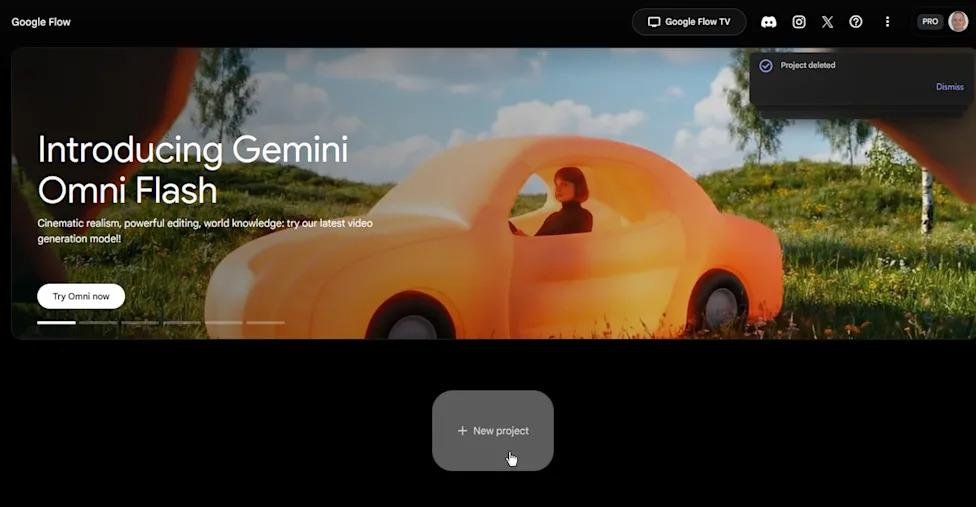
Gemini Omni 1.1 Flash is available to developers through Google AI Studio and the Gemini Enterprise Agent Platform.
The new capabilities are also rolling out to Google AI Plus, Pro and Ultra subscribers through Google Flow and Gemini.
Google is positioning the technology beyond casual users who simply want to make a social-media clip.
The company is targeting:
production studios, creative applications, editing tools and professional workflows.
That is a much larger market.
AI Video Is Becoming an Editing Tool

This may be the most important part of the release.
AI video generation is changing character.
At first, the workflow was:
prompt → video.
Now it is becoming:
video → modification → control → extension → refinement → final output.
Gemini Omni 1.1 Flash can also use up to three seconds of video reference to preserve visual context and character consistency during generation.
That makes the technology feel more like an editor than a simple generator.
Adobe, Figma and Runway Are Part of the Story
Google says several companies are already using Omni Flash in real-world products and workflows.
Adobe has integrated the technology into Adobe Firefly.
Google also highlights use cases involving Figma Weave, GMI Cloud and Runway.
That is important.
Google is not simply trying to keep the model inside Gemini.
It is building the technology as infrastructure that can be integrated into other creative products.
If that strategy succeeds, users could benefit from Google’s video technology without necessarily opening Gemini itself.
The AI Video Race Is Getting Much More Serious

Gemini Omni 1.1 Flash enters a market already filled with powerful generative-video models and platforms.
But Google is trying to differentiate itself around one clear idea:
more control, not simply more spectacular output.
That is a smart strategy.
Professional creators do not always need a video that looks impressive.
They need a video they can direct.
If a character needs to stay in the same position.
If the camera needs to perform a specific movement.
If a scene needs to continue from existing footage.
If the ending needs to connect precisely to the beginning of the next shot.
Then control becomes more important than the “wow” factor.
What Does This Mean for Creators?
For a YouTuber, it could mean less time spent in post-production.
For a marketing agency, it could mean more versions of an advertisement.
For a film studio, it could provide more powerful previsualization tools.
For software developers, it creates opportunities to build new video applications directly on top of Google’s API.
And for individual creators, the barrier to producing professional-looking content could continue to fall.
But AI Video Still Has Problems
Despite the improvements, generative video is far from solved.
Continuity, physics, character identity, hands, objects and complex motion remain difficult problems for generative models.
More control does not guarantee perfect results.
But the direction of the industry is clear.
Models are no longer trying only to generate video.
They are increasingly trying to understand what the director wants.
TheTechSpot: The Future of AI Video Isn’t Just “Generate” — It’s “Direct”
Gemini Omni 1.1 Flash shows that the industry is entering another phase.
Generating a video from a prompt was only the beginning.
The next step is control.
Who controls the camera?
Who decides where a scene begins and ends?
Who defines the movement?
Who keeps a character consistent from one scene to another?
If AI can reliably answer those questions, we will no longer have merely “AI-generated videos.”
We will have full production tools built around AI.
And that could matter more than any benchmark.
Because the moment AI stops simply creating a video and starts understanding how that video should be directed, the technology begins to change the production process itself.
Gemini Omni 1.1 Flash could be another major step in that direction.