Qualcomm has revealed the first details of its next-generation Oryon CPU, which will become the first mobile processor to reach 5GHz. The company is also introducing a new cache architecture called FlexCache that could be just as important as the headline clock speed.
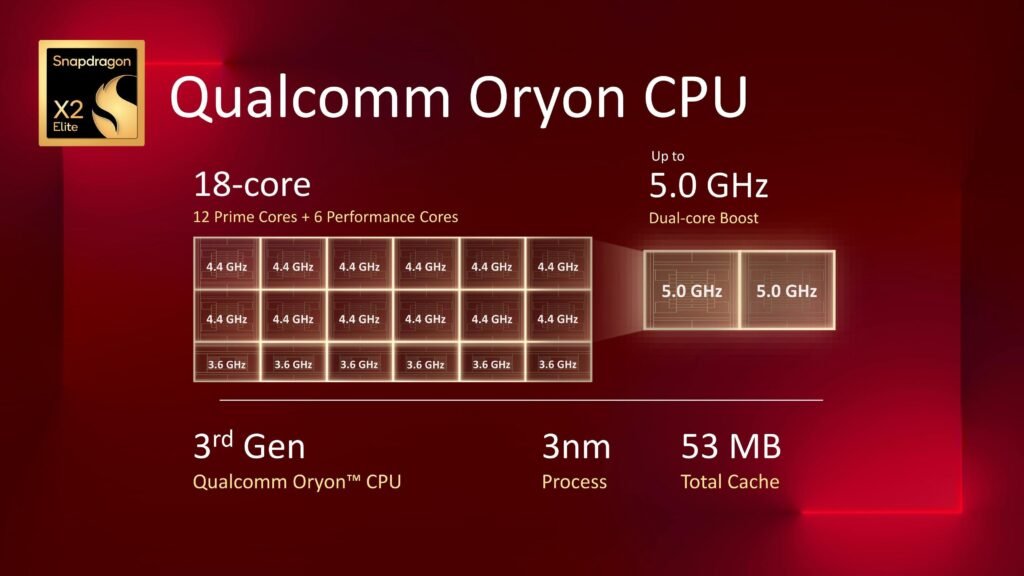
The announcement comes ahead of Snapdragon Summit 2026, where Qualcomm is expected to reveal the rest of its next flagship platform. The company says the new Oryon combines its 5GHz frequency with higher IPC, or instructions per clock, to improve real-world performance.
This is more than a race for a bigger specification number.
Qualcomm is attempting to show that mobile CPU performance can continue climbing without abandoning efficiency and smarter memory management.
5GHz Inside a Smartphone?
For years, 5GHz has largely been associated with desktop and laptop processors.
Qualcomm is now bringing that clock speed to a processor designed for mobile devices.
The new Oryon CPU will feature two Prime cores capable of reaching 5GHz, alongside six Performance cores.
But Qualcomm emphasizes that clock speed is only one part of CPU performance.
A processor can run at a high frequency and still fail to deliver the best real-world performance.
That is why the company is also focusing on IPC — Instructions Per Clock.
If the processor can complete more work during each cycle, combining higher IPC with 5GHz could produce a much larger real-world improvement than the clock-speed number alone suggests.
FlexCache May Be the Bigger Story
The most interesting part of Qualcomm’s announcement may not actually be 5GHz.
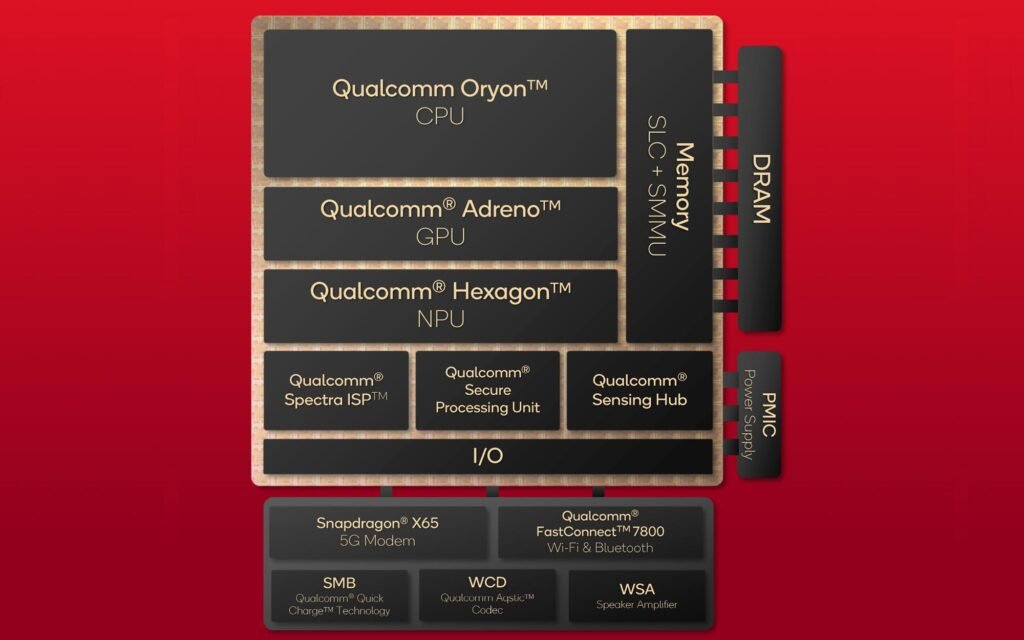
The company has introduced Oryon FlexCache, a new architecture that allows different CPU cores to access a shared cache pool.
Instead of keeping cache resources rigidly separated, FlexCache dynamically allocates cache according to workload demands.
When a demanding task needs more space, the Prime cores can access more of the available cache pool.
Why Does Cache Matter?

A CPU can be extremely fast, but it still needs to receive data quickly.
If the required information is not available in cache, the processor has to access system memory, which takes longer.
That creates waiting time.
Qualcomm says FlexCache is designed to keep more data close to the CPU cores and reduce the frequency with which the processor has to reach system memory.
In practice, this could help maintain performance as workloads become larger.
That could be especially important as the smartphone industry continues dealing with memory constraints and rising memory costs.
Gaming Could Be a Major Beneficiary
Qualcomm directly connects FlexCache with gaming.
Modern games constantly process large amounts of data, including maps, textures, objects and physics calculations.
Keeping more of that data closer to the CPU could reduce delays that contribute to frame drops and stuttering.
That could be particularly interesting for gaming phones and flagship devices increasingly attempting to deliver console-like experiences.
Multitasking Could Also Improve
Another potential advantage is multitasking.
When users move between applications, workloads can shift between different CPU cores.
If those cores can access the same cache pool, the transition does not necessarily have to start from scratch.
That could help applications resume more quickly and maintain performance during intensive multitasking.
Video Editing Is Another Target
Video editing is another workload that could benefit from the architecture.
Decoding, effects and exporting can move work between different CPU cores.
Qualcomm’s approach is designed to keep more of that data within cache instead of repeatedly sending it through system memory.
The Tech Spot Editorial Team
That could help maintain performance during long, demanding workloads.
But 5GHz Does Not Automatically Mean a Faster Phone

This is where marketing claims need to be separated from real-world performance.
Qualcomm describes Oryon as the world’s fastest mobile CPU, but independent testing will ultimately determine how large its advantage is over competing designs.
Higher frequencies can increase performance, but they can also create challenges involving:
- heat;
- power consumption;
- battery life;
- and thermal management.
Those challenges are particularly important inside smartphones, where cooling space is far more limited than in PCs.
Qualcomm Is Changing Its CPU Strategy
Oryon is one of Qualcomm’s most important efforts to build a custom CPU architecture.
The platform first appeared in Snapdragon X PCs before expanding into flagship smartphones.
Now Qualcomm is pushing the architecture further.
5GHz is the headline.
But the combination of frequency, IPC and FlexCache may ultimately determine how competitive the new CPU becomes in real-world use.
What Does This Mean for Future Smartphones?
Users will not necessarily feel a dramatic difference simply because a specification moves from the high 4GHz range to 5GHz.
But if Qualcomm can combine the frequency increase with strong efficiency, flexible caching and high performance per watt, future smartphones could improve across multiple areas at once.
More gaming performance.
Better multitasking.
Faster video editing.
More responsive applications.
And less dependence on repeatedly accessing system memory.
TheTechSpot: The Smartphone Performance Race Just Got More Interesting
For years, smartphone manufacturers have competed heavily on cameras, displays and battery life.
But the processor remains the heart of every flagship device.
With its new Oryon architecture, Qualcomm is not simply saying:
“We reached 5GHz.”
It is attempting to change how the CPU uses its available resources.
If FlexCache performs in real-world devices as Qualcomm promises, it could ultimately matter more than the 5GHz headline itself.
Now only one question remains:
How fast will a phone with this processor actually feel once it leaves the laboratory and enters the real world?
We will get the answer as Qualcomm reveals the rest of its new Snapdragon platform at Snapdragon Summit 2026.