
By TheTechSpot Editorial Team
August 19, 2026
SAN FRANCISCO — Google is making another enormous bet on artificial intelligence hardware.
Alphabet’s Google has struck a major agreement with Marvell Technology to help develop customized AI chips, in a deal that could reshape the increasingly competitive market for the hardware powering today’s AI boom.
Under the agreement, Google will receive a warrant allowing it to purchase up to 58.97 million Marvell shares at $206.58 each, potentially making Google one of Marvell’s largest shareholders.
The deal could generate as much as $120 billion in revenue for Marvell through fiscal 2033, although that figure depends on Google meeting certain performance targets.
For the technology industry, the message is clear:
Google wants more control over the chips powering its AI future.
And it isn’t alone.
The Nvidia problem
The AI revolution has created an extraordinary demand for computing power.
Companies building large AI models need enormous numbers of advanced processors to train and operate them.
For years, one company has dominated that market:
Nvidia.
Its graphics processing units, or GPUs, have become the industry’s preferred hardware for many AI workloads.
But the success of Nvidia has also created a problem for its biggest customers.
The world’s largest technology companies don’t want to depend entirely on one chip supplier.
Google is therefore investing heavily in its own AI processors, known as Tensor Processing Units, or TPUs.
The Marvell agreement represents another step in that strategy.
Google wants customized AI silicon

Traditional computer chips are designed to perform a broad range of tasks.
AI companies increasingly want something different.
They want processors designed specifically for the workloads their systems perform.
That can potentially make the hardware:
- more efficient;
- less power hungry;
- faster for specific AI workloads;
- easier to integrate with proprietary software;
- potentially cheaper at enormous scale.
Google has already developed several generations of TPUs.
The company’s latest strategy appears to involve combining its own AI expertise with outside semiconductor partners.
Marvell is particularly important because of its experience designing custom chips and data-center infrastructure.
Why the $12.2 billion number matters
The headline figure is enormous.
Google’s warrant could allow it to purchase up to $12.2 billion worth of Marvell stock.
That doesn’t mean Google is immediately spending $12.2 billion on shares.
Instead, the arrangement gives Google the right to buy the shares under specified conditions.
The structure links the financial relationship between the two companies to the success of their AI-chip collaboration.
If the partnership performs strongly, both companies stand to benefit.
Marvell could gain a massive long-term customer.
Google could gain another important source of customized AI hardware.


Investors immediately reacted
Financial markets reacted almost instantly.
Marvell’s shares rose nearly 8% after the announcement.
At the same time, shares of Broadcom, another major Google chip partner, fell more than 5%.
That market reaction reveals how important the deal could be for the semiconductor industry.
Investors are trying to determine which companies will benefit from the enormous amount of money being spent on AI infrastructure.
Nvidia remains the dominant player.
But increasingly, the market is splitting into different categories.
There are companies building general-purpose AI accelerators.
There are companies designing custom processors.
There are companies providing networking hardware.
And there are companies building the enormous data centers required to run them.
The AI boom needs more than chatbots
When people think about AI, they often think about ChatGPT, Gemini or image generators.
But behind every AI application is a huge physical infrastructure.
There are:
data centers,
servers,
processors,
networking equipment,
cooling systems,
storage,
and enormous amounts of electricity.
The AI race has therefore become an infrastructure race.
Whoever controls the infrastructure has enormous influence over how quickly AI can develop.
That is why companies such as Google, Microsoft, Amazon and Meta are investing billions of dollars into data centers and specialized computing systems.
Nvidia’s dominance is facing a new challenge
Nvidia isn’t suddenly disappearing.
Its GPUs remain among the most important pieces of AI infrastructure in the world.
But Big Tech companies have strong incentives to develop alternatives.
Google has its TPUs.
Amazon has its own AI chips.
Microsoft is developing custom silicon.
Meta is also investing heavily in customized AI hardware.
The goal isn’t necessarily to eliminate Nvidia.
Instead, companies want to avoid becoming completely dependent on Nvidia for every stage of their AI infrastructure.
That creates a much more competitive semiconductor market.
Google is playing a different AI game
Google has a unique position in this competition.
Unlike many AI companies, Google controls almost the entire technology stack.
It has:
- its own AI research;
- its own models;
- its own cloud platform;
- its own data centers;
- its own networking infrastructure;
- its own AI processors.
That vertical integration could become one of Google’s biggest advantages.
If Google can design its AI models around its own hardware, it can potentially optimize the entire system.
That could reduce costs and improve performance.
The cloud war is becoming a chip war
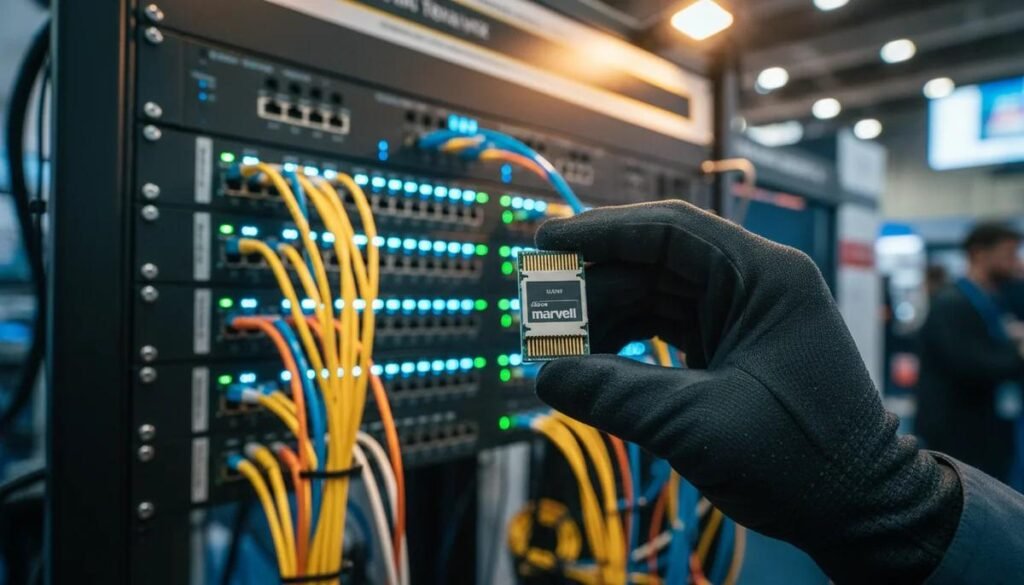
The competition between Google Cloud, Microsoft Azure and Amazon Web Services used to focus heavily on software and cloud services.
Now the underlying hardware is becoming equally important.
Customers want access to powerful AI computing.
The cloud provider that can offer the best combination of:
price + speed + availability + AI performance
could gain a major advantage.
That means custom chips are no longer just an engineering project.
They are becoming a competitive weapon in the cloud industry.
Why Marvell is important
Marvell isn’t trying to compete with Nvidia in exactly the same way.
Its strength includes designing specialized semiconductor solutions and infrastructure technologies for data centers.
That makes the company a natural partner for companies that want custom AI hardware.
Google can focus on its AI architecture and requirements.
Marvell can provide important semiconductor design expertise.
Together, they can build chips optimized for Google’s specific needs.
That model could become increasingly common as AI companies become more sophisticated.
The $120 billion opportunity
Perhaps the most eye-catching part of the agreement is the potential revenue.
Reuters reported that the deal could generate up to $120 billion in revenue for Marvell through fiscal 2033, depending on Google meeting performance conditions.
That illustrates just how much money is moving into AI infrastructure.
The AI industry is no longer just about software subscriptions.
The hardware opportunity is enormous.
Every new AI model requires more computing power.
Every increase in model size can require more processors.
Every new AI service can require more data-center capacity.
And that means semiconductor companies could become some of the biggest beneficiaries of the AI boom.
The hidden battle behind ChatGPT and Gemini
When users open an AI chatbot, they see a simple interface.
A text box.
A response.
Maybe an image.
But behind that interface is an enormous network of machines.
The AI model has to run somewhere.
The data has to be processed.
The response has to be generated.
The information has to travel through networks.
And all of that requires specialized hardware.
This is why the competition between Google, Nvidia, Microsoft, Amazon, Meta and semiconductor companies such as Marvell and Broadcom is so important.
The real AI war is happening far beyond the screen.
What happens next?
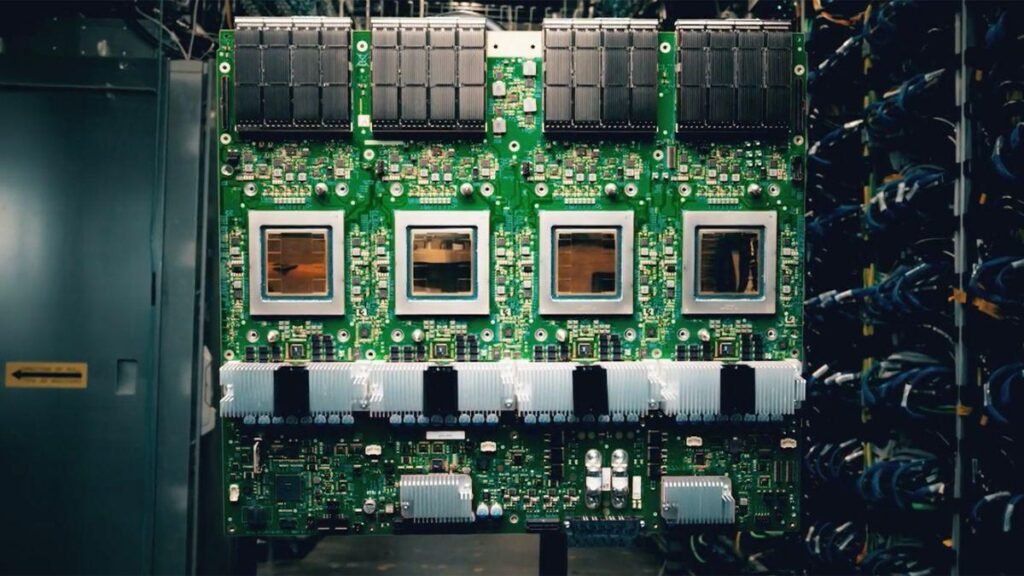
The Google-Marvell deal could encourage other technology companies to accelerate their own custom-chip strategies.
If successful, Google could reduce its reliance on external GPU suppliers while gaining greater control over its AI infrastructure.
Marvell, meanwhile, could establish itself as one of the most important suppliers in the custom AI-chip market.
And competitors will be watching closely.
The semiconductor industry is already investing enormous amounts of money to meet AI demand.
This deal adds another layer to that competition.
The most important part of this story isn’t the $12.2 billion warrant.
It isn’t even the potential $120 billion revenue opportunity.
The bigger story is the direction of the entire technology industry.
AI is moving from a software race into a hardware race.
The companies that control the processors, data centers and networking systems behind AI could have enormous influence over the next decade of technology.
Nvidia built a huge lead by supplying the chips that powered the AI revolution.
Now Google and its competitors are trying to make sure they aren’t dependent on Nvidia forever.
And that means the next major battle in AI may not be fought between chatbots.
It may be fought inside the chips.