


A new research platform combines IBM’s 120-qubit Nighthawk processor with AMD-powered supercomputing at Oak Ridge National Laboratory. The goal is to make quantum error correction faster and help researchers move closer to practical, fault-tolerant quantum computers.
Quantum computers promise to solve certain scientific and industrial problems that are extremely difficult for conventional machines. But before they can become dependable tools, researchers must overcome one of the technology’s biggest obstacles: errors.
On November 5, IBM, AMD and the Quantum Science Center at the U.S. Department of Energy’s Oak Ridge National Laboratory (ORNL) announced a new co-design platform built specifically to advance quantum error correction.
The system brings IBM quantum processors together with Oak Ridge’s high-performance computing infrastructure, powered by AMD CPUs and GPUs. Rather than treating quantum and conventional computing as separate systems, the project is designed to let them work together in a tightly integrated environment.
The announcement is significant because quantum error correction requires more than better quantum hardware. It also depends on classical computers that can rapidly analyze measurements, identify errors and help determine the next operation.
Why quantum computers make mistakes

Traditional computers process information using bits, which represent either a zero or a one. Quantum computers use quantum bits, or qubits, which can exploit quantum-mechanical properties to represent and process information in fundamentally different ways.
The problem is that qubits are extremely sensitive to disturbances from their surroundings. Small changes in temperature, electromagnetic noise or other environmental effects can disrupt calculations.
These errors can accumulate and make a result unreliable.
Quantum error correction aims to protect useful information by distributing it across multiple physical qubits and repeatedly checking for signs of errors. The system must then interpret those measurements and determine what corrections are needed.
That interpretation is computationally demanding. The classical processor must keep pace with the quantum machine, sometimes responding while a calculation is still running.
This is where the new IBM–AMD–Oak Ridge platform comes in.
Inside the new platform
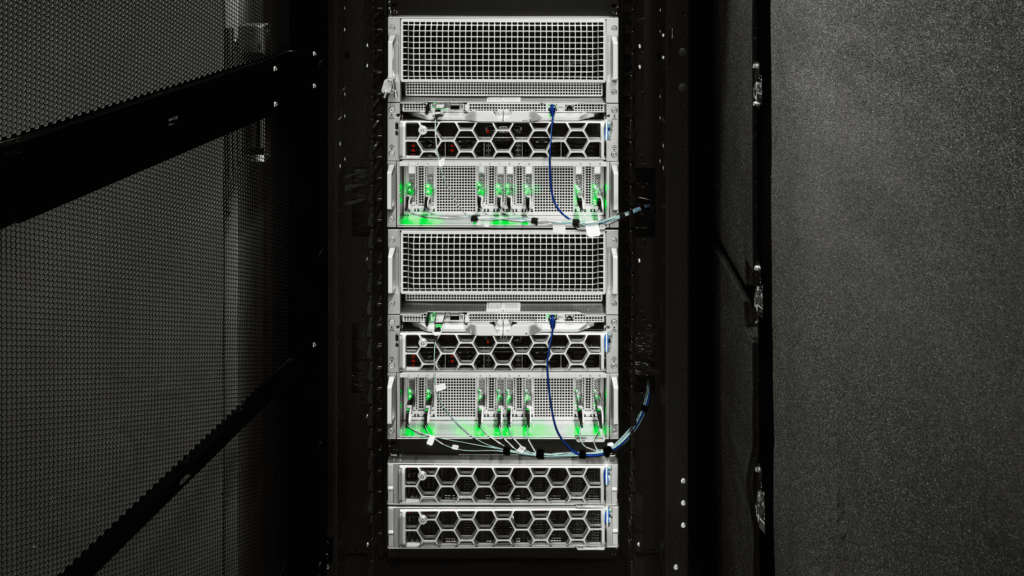
The first deployment brings together IBM’s 120-qubit Quantum Nighthawk processor and Oak Ridge’s Umbra high-performance computing system.
The classical computing side uses:
- AMD Instinct MI355X GPUs for accelerated parallel processing.
- Fifth-generation AMD EPYC CPUs for general-purpose computing.
- Software and orchestration tools designed to coordinate quantum and classical workloads.
The infrastructure is located alongside IBM’s quantum hardware at its site in Poughkeepsie, New York. The partners also plan to connect the platform with Oak Ridge’s broader leadership-computing environment in Tennessee.
This physical and technical integration matters. When quantum processors and classical computing systems are separated, transferring measurement data and coordinating workloads can introduce delays and additional complexity.
By bringing the systems together, researchers can investigate faster feedback loops and test how different error-correction methods perform under real operating conditions.
Why AMD GPUs matter to quantum computing

Quantum computing is often described as a race to build increasingly powerful quantum processors. But the supporting classical infrastructure is just as important.
Error-correction algorithms need conventional computing resources to process measurement results and identify which errors may have occurred.
GPUs are particularly useful for workloads that can be divided into many parallel calculations. The new platform will allow researchers to explore how AMD accelerators can help train, evaluate and run quantum error decoders.
The project also builds on previous collaboration between IBM and AMD, including work on decoding quantum errors using AMD hardware.
The broader idea is to design quantum processors, CPUs, GPUs and software as parts of one computing architecture rather than separate technologies connected only after they have been developed.
The road to 100 logical qubits
The collaboration is aligned with the U.S. Department of Energy’s Quantum Genesis Mission, which aims to accelerate progress toward a scientifically relevant quantum computer by 2028.
IBM says its existing research has demonstrated experiments involving up to 70 logical qubits and 438 hard operations. The Department of Energy’s Q Competition, announced as part of the broader effort, targets 100 logical qubits performing 100,000 hard operations by late 2028.
A logical qubit is not simply one physical qubit. It is an information unit protected through quantum error-correction techniques, typically requiring multiple physical qubits working together.
According to IBM’s announcement, reaching the stated target would require a substantial increase in the number of operations that can be performed reliably.
The new platform is intended to help researchers test the algorithms, hardware configurations and software workflows needed to close that gap.
What has actually been achieved?
It is important to distinguish between a new research platform and a demonstrated breakthrough in quantum computing.
IBM, AMD and Oak Ridge have announced infrastructure designed to accelerate error-correction research. They have not announced that this platform has already delivered a fault-tolerant quantum computer or achieved the 100-logical-qubit target.
An independent technical review of the announcement also notes that the partners have not yet published platform-specific latency figures, error rates or new logical-qubit results.
The real test will come from future experiments: how quickly the classical system can decode errors, how reliably logical qubits perform, and whether the integrated architecture can support increasingly complex calculations.
Why this matters beyond the United States
More reliable quantum computers could eventually help researchers investigate complex molecules, advanced materials, chemical reactions and problems in physics that are difficult to simulate with conventional computers.
Potential applications include drug discovery, materials science, energy research and optimization. However, many of these possibilities remain research goals rather than commercially available capabilities.
The project also highlights a wider shift in the technology industry. The future of computing may not be defined by quantum processors alone, but by systems that combine quantum hardware with powerful classical computing and AI infrastructure.
For Europe and other regions investing in advanced computing, the development is another reminder that quantum research requires long-term investment in hardware, software, scientific talent and computing infrastructure.
TheTechSpot Take:
Quantum computing needs more than more qubits
The announcement from IBM, AMD and Oak Ridge addresses a problem that receives less attention than processor size: the ability to keep quantum calculations reliable.
Adding more qubits does not automatically produce a useful quantum computer. If errors accumulate faster than they can be corrected, additional hardware may simply create a larger system that remains difficult to control.
That is why the integration of quantum processors with high-performance classical computing is important. It tackles the supporting infrastructure that future fault-tolerant machines will need.
Still, the announcement should be viewed as a research milestone, not proof that practical quantum computing is around the corner. The industry must demonstrate measurable improvements in error rates, logical operations and system reliability.


