
In 2025, electric vehicles reached a major global milestone: roughly one in four cars sold worldwide was electric. Yet in the United States, EVs account for closer to one in ten sales—and momentum appears to be slowing rather than accelerating.
The contrast is sharp. According to the International Energy Agency (IEA), global EV sales surpassed 20 million units in 2025, growing by around 20% year-on-year. At the same time, falling battery costs—down roughly 8% on average due to cheaper raw materials and wider adoption of lithium iron phosphate (LFP) chemistry—have helped push prices lower in many markets.
But the US is moving differently.
A Slowing US Market
While global EV adoption continues to climb, the US market has shown signs of stagnation. Growth has become uneven, with some quarters seeing declines compared to the same period the year before. Industry observers point to a combination of high prices, limited affordable models, and fluctuating consumer demand.
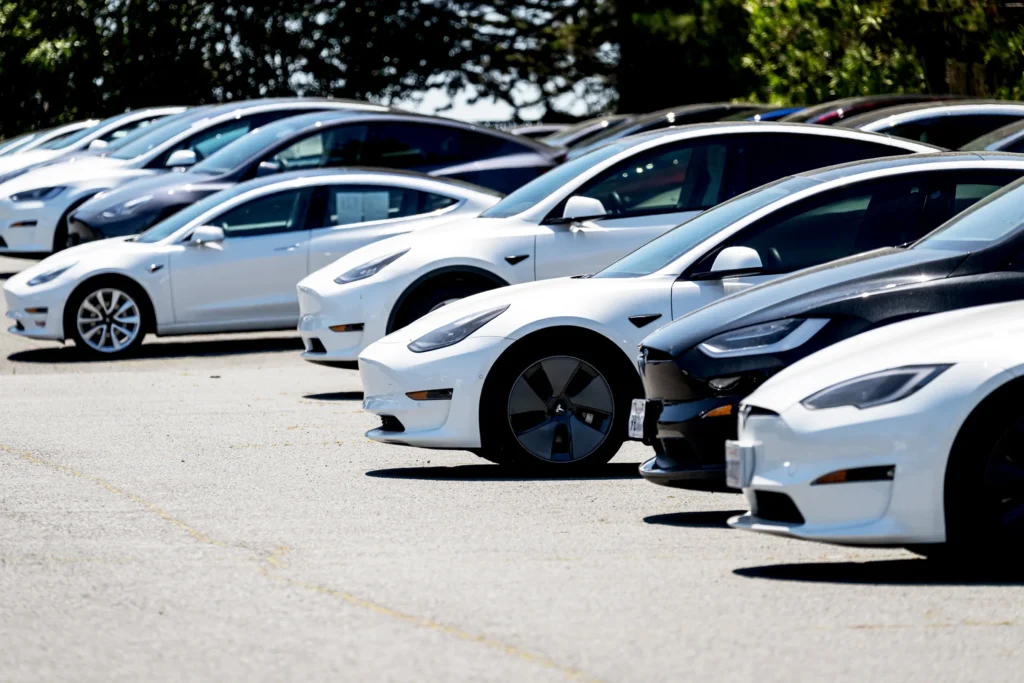
One notable factor is the structure of the US EV market itself: most available models are larger vehicles, particularly SUVs and trucks. These require bigger batteries, which increases cost and keeps average EV prices relatively high compared to smaller, more affordable EVs common in other regions.
Why Affordability Matters More Than Ever
Across global markets, the most important driver of EV adoption is simple: price.
In Europe and parts of Asia, lower-cost compact EVs have expanded rapidly, helping broaden adoption. In contrast, the US market is increasingly weighted toward premium models.
Trade policy also plays a role. High tariffs on Chinese EV imports have effectively removed many of the world’s lowest-cost electric cars from the US market. Meanwhile, interest rates and vehicle financing costs have made monthly payments a key barrier for middle-income buyers.
Automakers Are Recalibrating
US automakers are also adjusting their strategies in response to slower-than-expected demand and profitability pressures.
Rather than pursuing fully electric lineups on aggressive timelines, major manufacturers are increasingly focusing on hybrids, plug-in hybrids, and extended-range electric vehicles (EREVs). Some previously announced all-electric programs have been delayed, scaled back, or redesigned.
Examples of this broader shift include:
- A renewed emphasis on hybrid versions of mainstream models
- Reduced near-term EV production targets among legacy automakers
- Greater focus on high-margin trucks and SUVs rather than smaller EVs

The IEA’s Global EV Outlook 2026, released May 20, puts the global picture in sharp relief.
Electric car sales exceeded 20 million units in 2025, growing 20% from 2024. On average, EV battery prices dropped 8% due to lower raw material costs and wider adoption of lithium iron phosphate chemistry.
Contrary to the global trends, US sales went the other way, slightly down year-on-year. But it is when you look at the last quarter of 2025, which recorded 45% lower new EV sales than the same period in 2024, that you realize how grim the picture is.

The biggest reason behind the declining sales is the recent policy changes. The One Big Beautiful Bill Act eliminated tax credits for new and used EV purchases after September 2025. It also removed penalties for automakers that fail to meet fuel efficiency standards, essentially reducing the industry’s financial incentive to prioritize EVs.
Then there’s the 100% important duties on Chinese EVs, even the affordable ones, which are among the world’s most affordable and dominate sales across Latin America, Southeast Asia, and Europe. These are practically unavailable to American buyers.
Finally, it’s the preference for large vehicles that is keeping prices out of reach for many buyers. The report mentions that more than 85% of EV models available in the US are SUVs or other large vehicles. These come with bigger batteries, which cost more, pushing the average EV price higher.
The US seems to be doubling down on premium and heavy EVs, but in other markets like Europe, small EVs are expanding rapidly. Vietnam, where EV penetration exceeded 40% in 2025 driven by VinFast’s affordable small models, illustrates exactly what accessible pricing can achieve.

Faced with slower-than-expected consumer demand, shifting federal policy, and profitability pressures, the Big Three automakers have already scaled back their fully electric vehicle plans. Instead, they’re pivoting toward plug-in hybrids, traditional gas-electric hybrids, and ICE trucks.
For instance, Ford scrapped its three-row electric SUV, absorbing a $400 million write-down. The company has also pulled the plug on its all-electric F-150 Lightning. Instead, it is reinventing it as a range-extended electric vehicle (EREV), that will provide over 700 miles of range.
| Automaker | Previous Ambition | Current Strategy |
| Ford | Aggressive EV scaling (Three-Row EV, T3 Truck) | Scrapped 3-row EV; hybrid options for all gas models |
| General Motors | All-electric lineup focus | Reduced EV production; reintroducing plug-in hybrids (PHEVs) |
| Stellantis | Rapid transition to pure BEV platforms | Focus on gas-extended EVs (Ramcharger) and 4xe plug-in hybrids |
General Motors has also reduced its short-term EV production target, abandoning its goal of reaching a one-million-unit EV manufacturing capacity. The automaker is redirecting its manufacturing capacity to prioritize the production of gas-powered trucks and SUVs.
Stellantis is also focusing on multi-energy vehicles. While the IEA report highlights how consumers are responding to the less favorable scenario in the EV market, the Big Three’s pivot away from pure EVs reflects the shift in demand.
The Bigger Picture
Globally, EV adoption is still accelerating. But the US appears to be entering a different phase—one defined less by rapid expansion and more by pricing pressure, product mix limitations, and strategic repositioning by automakers.
Whether this is a temporary slowdown or a longer-term structural divergence will depend on three key factors:
- The availability of lower-cost EV models
- Policy incentives and regulatory stability
- Battery cost reductions and supply chain shifts
For now, the gap between the US and global EV markets is widening—not because demand has disappeared, but because affordability and product availability are moving in opposite directions.