The Anker SOLIX S2000 is a new ~2 kWh portable power station that Anker is positioning less as a general “battery box” and more as a home backup system optimized for refrigerator runtime.
What it is
- Capacity: ~2,010 Wh (2 kWh class)
- Chemistry: LiFePO₄ (long-cycle lithium iron phosphate)
- Output: ~1,500 W continuous AC
- Target use: home outage backup (especially fridges, CPAP, small appliances)
The headline claim: “up to 35 hours fridge backup”
Anker’s marketing and lab testing suggest it can run a standard refrigerator for up to ~35 hours under controlled conditions.
That number is based on:
- A ~700 L fridge
- Stable room temperature (~25°C / 77°F)
- Minimal door opening
- Optimized efficiency settings
Why it lasts longer than typical 2 kWh stations
The S2000 is not just “bigger battery = longer runtime.” Its main advantage is efficiency:
1. Very low idle consumption (~6W)
Most power stations constantly burn 15–30W just staying on. That quietly drains energy even when nothing is plugged in.
2. Higher real-world conversion efficiency
Anker claims ~88–90% efficiency in common low-to-mid loads, vs. ~70–80% typical.
3. “OptiSave” power management
This reduces waste during the fridge’s on/off compressor cycles—the key reason fridges are tricky to model.
What 35 hours actually means in real life
That “35 hours” is possible, but not guaranteed.
You’ll get close to it if:
- The fridge is modern and efficient
- It’s already cold before the outage
- You don’t open it often
- Ambient temperature is moderate
Realistic expectations:
- Efficient modern fridge → 25–35 hours
- Average household fridge → 20–30 hours
- Older / inefficient fridge or hot environment → 15–25 hours
This aligns with how much energy fridges typically use (often ~1–2 kWh/day depending on model and conditions).
Bottom line
The Anker SOLIX S2000 isn’t magic extra capacity—it’s:
a fairly standard 2 kWh battery that gets more usable runtime than competitors because it wastes less energy while sitting idle and during inverter conversion.
So the “35 hours” claim is best read as:
Not a guaranteed real-world minimum
Best-case laboratory scenario
What makes the S2000 different from other power stations
Most portable power stations compete on capacity, but Anker is making the case that runtime matters more than raw storage numbers. A survey of 759 power station users in North America found that 80% of real-world blackout needs fall under 200 watts.
The S2000 addresses this with proprietary OptiSave Technology, which reduces idle power consumption by 40 to 70% and boosts light-load efficiency above 90%. The result is 20% more real-world runtime than other 2kWh units.
It delivers 1,500 watts of AC output with a 3,000-watt peak, enough to run a fridge and several other devices at once. UPS switchover occurs in under 10 milliseconds, making it suitable for medical devices and baby monitors as well.
The specs that make Anker Solix S2000 worth considering

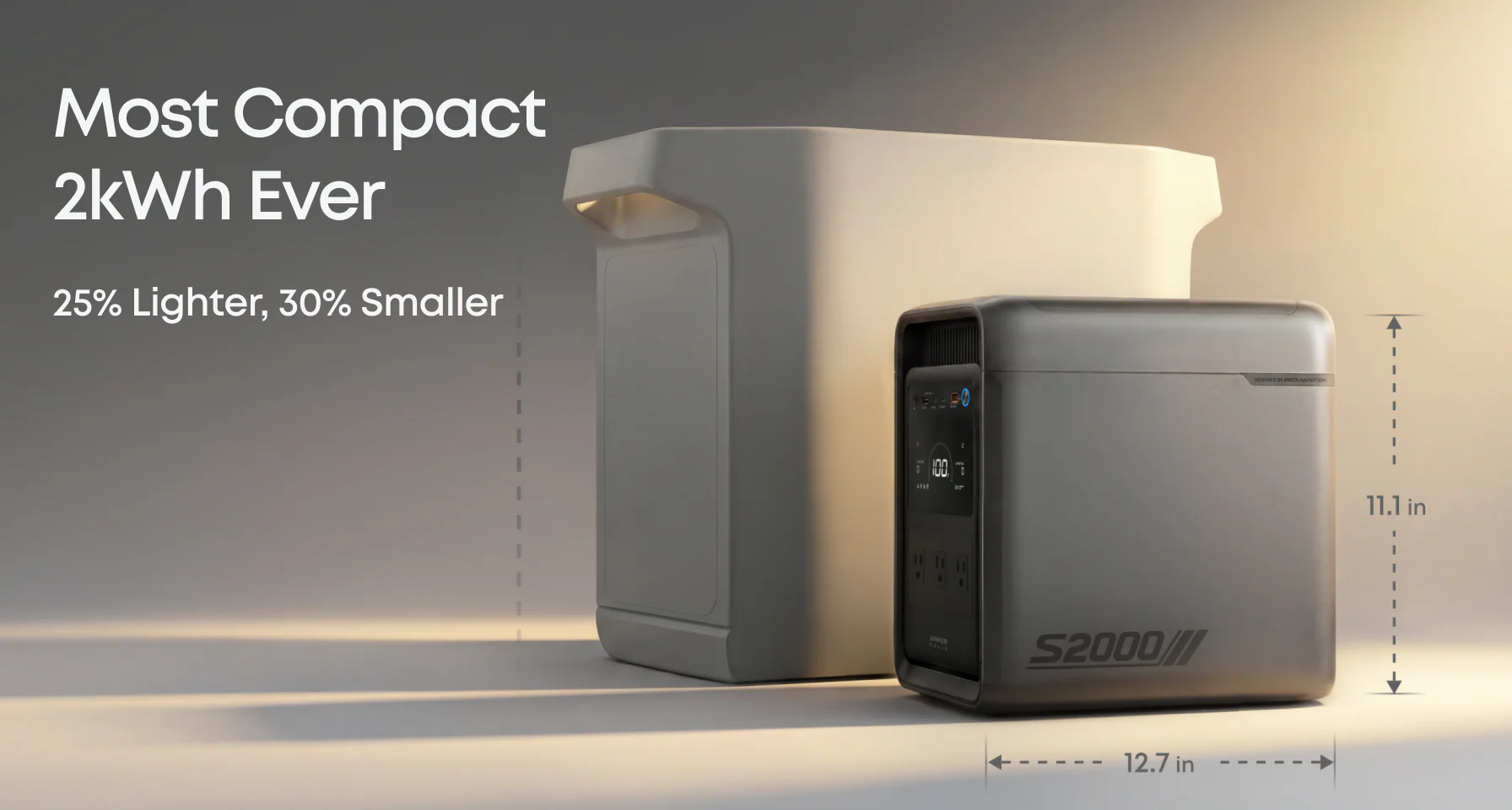
The S2000 holds 2,010Wh of capacity in a body roughly 30% smaller than comparable units, measuring just 8.19 x 11.1 x 12.7 inches and weighing 35.7 pounds.
It uses LiFePO4 battery cells rated for up to 10,000 cycles and a 15-year service life, which is double the industry average. The S2000 has rear-facing AC outlets, so you can slide it right up against the wall behind your fridge and keep all the messy cords completely out of sight.
It also supports 400 watts of solar input and can fast charge to 80% in just 1.2 hours, so it stays ready even after heavy use.
If the S2000 has caught your attention, you might also want to check out the Anker Solix E10 and Anker Solix F3800 Plus, another powerful additions to the brand’s power backup lineup.