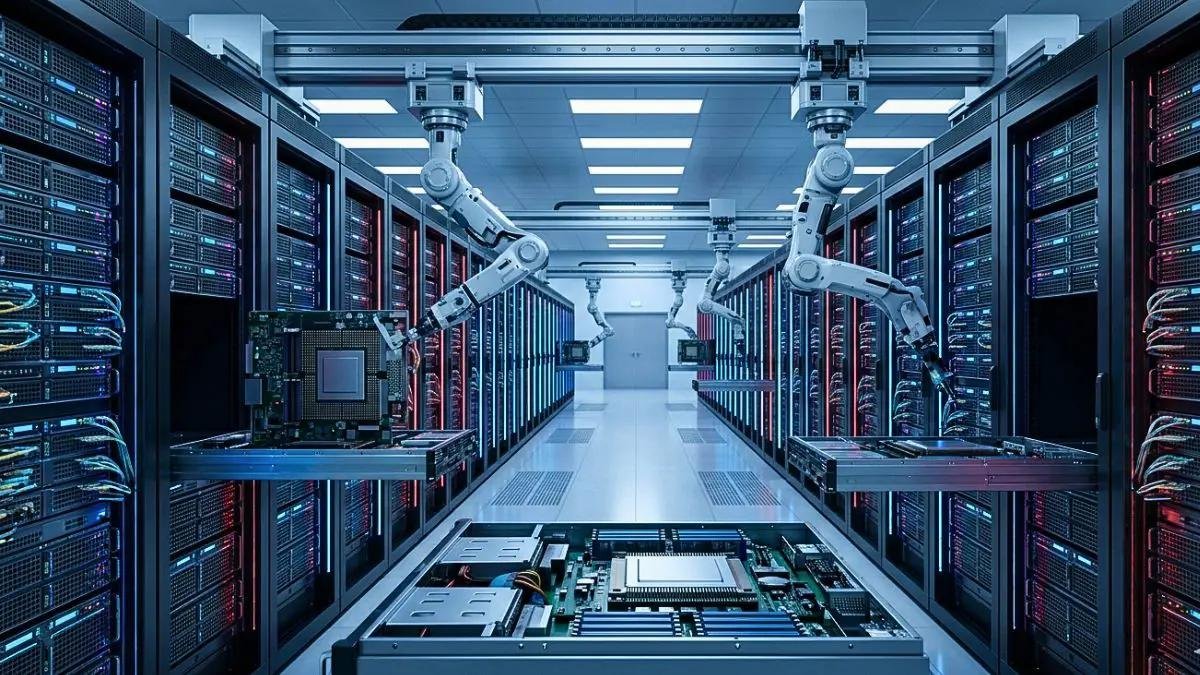
Meta is testing a new generation of robots inside its data centers, moving automation beyond warehouses and factories and into one of the most demanding environments in modern technology infrastructure. The machines are being trained to perform tasks that have traditionally required technicians, including swapping network cables, restarting servers, moving equipment and reseating hardware.
The development is particularly significant because Meta is simultaneously expanding its data-center footprint to support the enormous computing requirements of artificial intelligence. The company is building increasingly large AI infrastructure, including its Prometheus cluster, which Meta says will reach one gigawatt of capacity.


According to reporting based on current and former employees familiar with the projects, Meta is testing robotic hardware from several companies, including Watney Robotics, Kinova and ABB. One experiment involves a Kinova Gen3 robotic arm being evaluated for power-cycling servers, while another system is being tested to replace networking cables. A simpler robotic device can physically press a power button on equipment when instructed remotely by a human.
The idea is not entirely new inside Meta. The company has previously experimented with robots capable of moving heavy server racks and tracking equipment inventories. What is changing now is the ambition: robots are being pushed deeper into the physical maintenance work that keeps AI data centers running.
That distinction matters because the work inside a modern data center is often repetitive but technically demanding. Servers must be replaced, cables have to be connected correctly, components need to be inspected and equipment sometimes has to be restarted manually. As data centers become larger, the amount of physical work increases along with the amount of computing capacity they contain.


Meta’s largest data-center campus in Altoona, Iowa, has become one of the company’s testing grounds for this technology. According to the reporting, the company has been testing dual-armed robots from Watney for cabling work there. The machines are still supervised by humans and currently operate more slowly than people, but the experiments are intended to determine which tasks can realistically be automated.
The limitations are revealing. Robots still struggle with some of the physical complexity of data centers, particularly dense cable installations and environments designed around human technicians. One inventory robot has reportedly had difficulty navigating cables and certain parts of facilities, while battery life and the need for human assistance when moving between buildings remain practical obstacles.
In other words, the technology is not yet at the point where a data center can simply switch off its human workforce and let robots take over.
But the direction of travel is clear.

The timing is closely connected to the economics of AI. Training and operating increasingly sophisticated AI systems requires enormous amounts of computing infrastructure, and companies are racing to build data centers capable of housing hundreds of thousands of processors.
Meta itself has described the scale of this infrastructure in increasingly ambitious terms. Its Prometheus AI cluster is being built across multiple data-center buildings, while the company says its future Hyperion system could eventually scale to five gigawatts.
At that scale, even relatively small improvements in maintenance efficiency can become financially meaningful.

A robot that can perform a repetitive task continuously, without fatigue and under controlled conditions, could eventually reduce the amount of manual labor required for certain categories of work. It could also allow technicians to spend more time on complex troubleshooting rather than routine physical interventions.
That is the argument made by supporters of the technology.
The concern among some workers is different.

Employees familiar with the experiments have expressed concern that automation could eventually reduce the number of people needed for physical data-center operations. One worker estimated that a successful cable-swapping system could potentially eliminate a large portion of the workload associated with some technician roles, although that is an individual estimate rather than a figure provided by Meta.
Meta has pushed back against the idea that its strategy is simply about eliminating workers. A company spokesperson said Meta is investing heavily in hiring and training people to build and operate its data centers, arguing that the United States is facing a shortage of skilled workers. The company has also launched programs intended to train thousands of people each year in electrical, mechanical and plumbing skills, with employment opportunities available to some graduates.
That creates a more complicated picture than the familiar idea of robots simply replacing humans.
The more likely near-term scenario is cooperation.
A technician could supervise several robotic systems rather than physically performing every repetitive task. A robot could handle a cable replacement while a human remains responsible for diagnosing the underlying problem. Another machine could inspect equipment continuously and alert a technician when something appears abnormal.
That model would make the robot a tool rather than a complete replacement for the technician.

There is also a broader reason why companies are interested in removing humans from some data-center tasks.
Data centers are increasingly being built at enormous scale, sometimes in locations where skilled technical workers are difficult to find. Robots could theoretically operate in environments that are uncomfortable, dangerous or simply inefficient for people, while providing a more consistent level of service.
In the longer term, that could open possibilities that are difficult to achieve with conventional human-operated facilities. Industry researchers have already discussed robotic maintenance as a potential requirement for data centers operating in extreme or remote environments, including facilities that could eventually be placed underwater or in space.
For now, however, the technology remains experimental.
The robots are not as fast as humans in many situations. They need supervision. They have difficulty with some cabling configurations, require charging and still struggle with tasks that were designed around the dexterity of human hands.
Those limitations may prove temporary.
Robotics hardware has become cheaper, while AI models capable of controlling physical machines have improved considerably. That combination is making tasks that were previously too expensive or too difficult to automate increasingly realistic.
Meta is therefore testing something much larger than a few maintenance robots.
It is testing whether the physical infrastructure behind the AI revolution can itself become automated.
That could become one of the most important robotics stories of the next several years. The AI industry has spent enormous sums making software more capable. The next step may be making the machines that run that software capable of maintaining themselves.
The irony is difficult to miss: AI is driving the construction of larger data centers, and those same data centers may become one of the first places where AI-powered machines begin replacing some of the physical work required to operate them.
For the workers inside those facilities, the question is no longer whether automation is coming.
The question is how much of their work will remain human when it arrives.
The Tech Spot Editorial Team