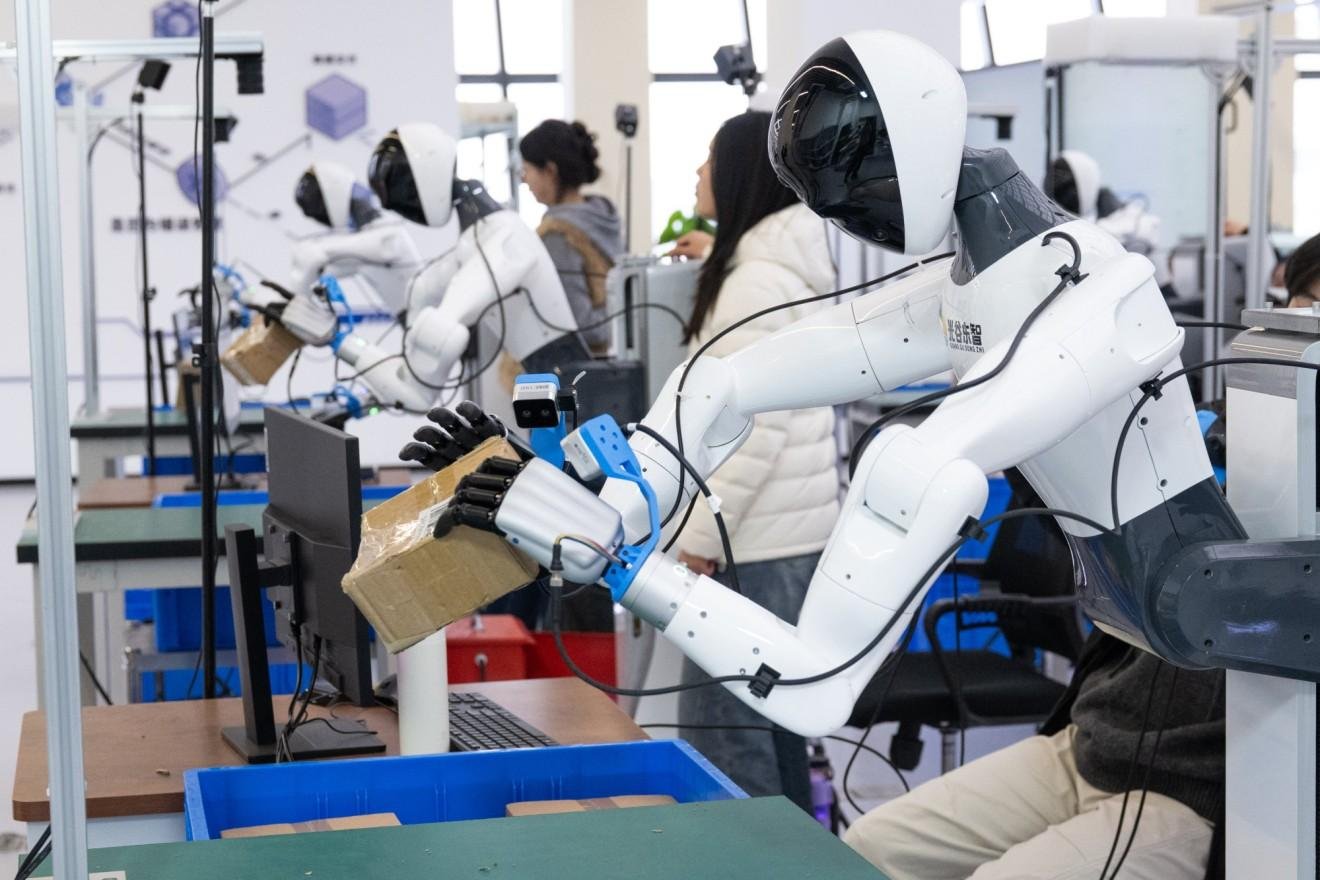
The humanoid robot era may have just entered its next phase
CHINA IS BUILDING THE WORKFORCE OF THE FUTURE
For years, humanoid robots have been one of technology’s favorite spectacles.
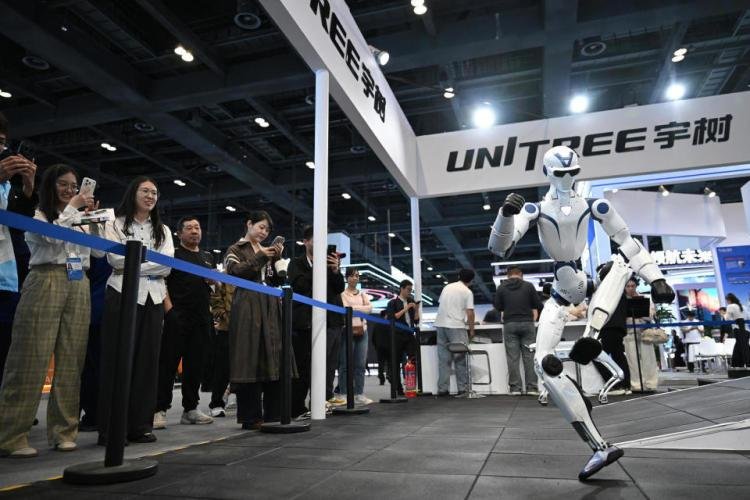
They dance.
They run.
They perform backflips.
They kick.
They interact with people.
And every new demonstration creates another viral video.
But something important is changing in 2026.
The biggest question is no longer “Can a robot do this?”
It is becoming:
Can a robot actually do a useful job?
That shift is now visible in China, where hundreds of robotics companies are demonstrating humanoid machines designed not simply to entertain crowds, but to work in factories, warehouses, logistics centers and eventually homes.
At the 2026 World Robot Conference in Beijing, more than 300 companies are showcasing over 2,000 robotic exhibits, according to Reuters. More than 150 new products are being launched at the event. And the message from the industry is becoming increasingly clear:
Humanoid robots are moving from the laboratory toward the real world.
Robots are no longer just performing tricks
One of the most interesting developments at the Beijing conference is the type of work these robots are being shown doing. Instead of simply walking around a stage, humanoid robots are being demonstrated sorting parcels, moving boxes, packing mobile phones and performing repetitive industrial tasks.
That may sound less spectacular than a backflip.
But from a business perspective, it is much more important. A robot that can reliably move packages for eight hours could potentially be worth far more to a company than a robot that can perform an impressive trick for 30 seconds.
This is why the robotics industry is entering a new phase.
The next battle will be about reliability, cost, speed and productivity.
China is becoming the center of the humanoid robot race
China’s ambitions in robotics are enormous.
According to data cited by Reuters from Morgan Stanley and Smart Analytics Global, worldwide humanoid robot shipments increased 272% during the first half of 2026, reaching approximately 19,000 units.
Even more striking is China’s share.
Chinese companies accounted for approximately 97% of global humanoid robot shipments during that period. That puts China in an extraordinary position.
The country already has enormous manufacturing capacity, a huge electronics supply chain and an increasingly sophisticated artificial-intelligence industry. Now those advantages are being combined with robotics.
The result could be one of the most important technology races of the decade.
Unitree is showing how quickly the industry is moving
One of the companies at the center of this revolution is Unitree Robotics.
The company has become internationally known for its humanoid robots and robotic dogs, but its latest developments show how quickly the market is changing.
Unitree’s stock market debut in Shanghai on Wednesday became another major moment for the company. Its shares surged almost sixfold during the debut after its initial public offering was reportedly more than 8,000 times oversubscribed by retail investors.
That level of investor enthusiasm shows that humanoid robotics is no longer viewed purely as an experimental technology. Investors increasingly see it as a potential industrial growth sector. But the financial excitement also creates pressure.
Now companies have to prove that the robots can actually generate commercial value.
The factory could become the robot’s first home
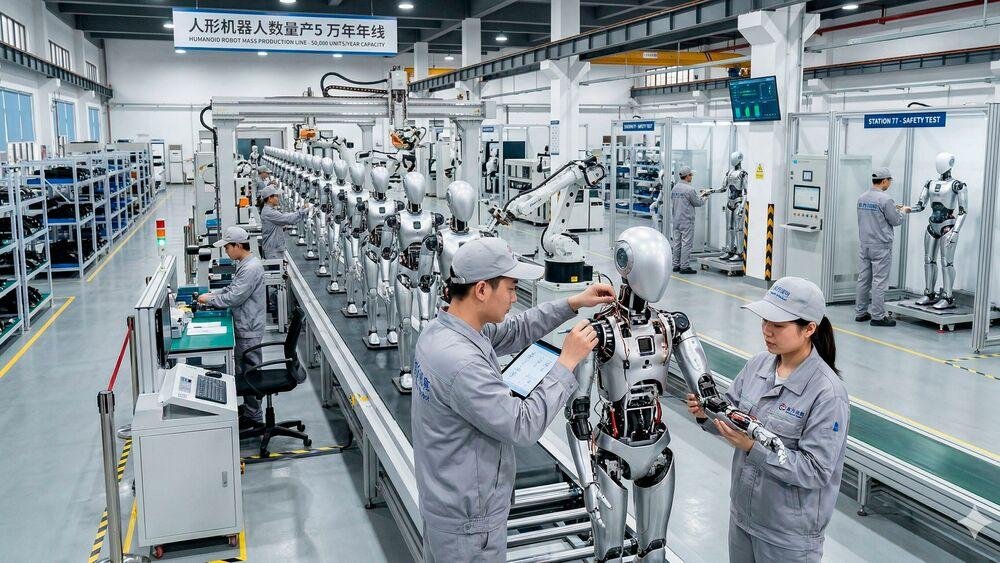
The factory environment may be where humanoid robots become commercially useful first.
Why?
Because factories are relatively controlled environments.
Tasks can be repeated.
Objects have predictable locations.
Production lines are structured.
And companies can carefully monitor robot performance. Reuters reports that DexForce is already demonstrating humanoid robots packing mobile phones into boxes at a Lens Technology factory in China, while other companies are using robots for logistics and moving components.
This is an important step. Instead of asking a robot to understand the entire world, engineers can first teach it to perform a limited number of tasks extremely well.
Once that technology becomes reliable, the number of possible applications can expand.
Warehouses could be another huge opportunity
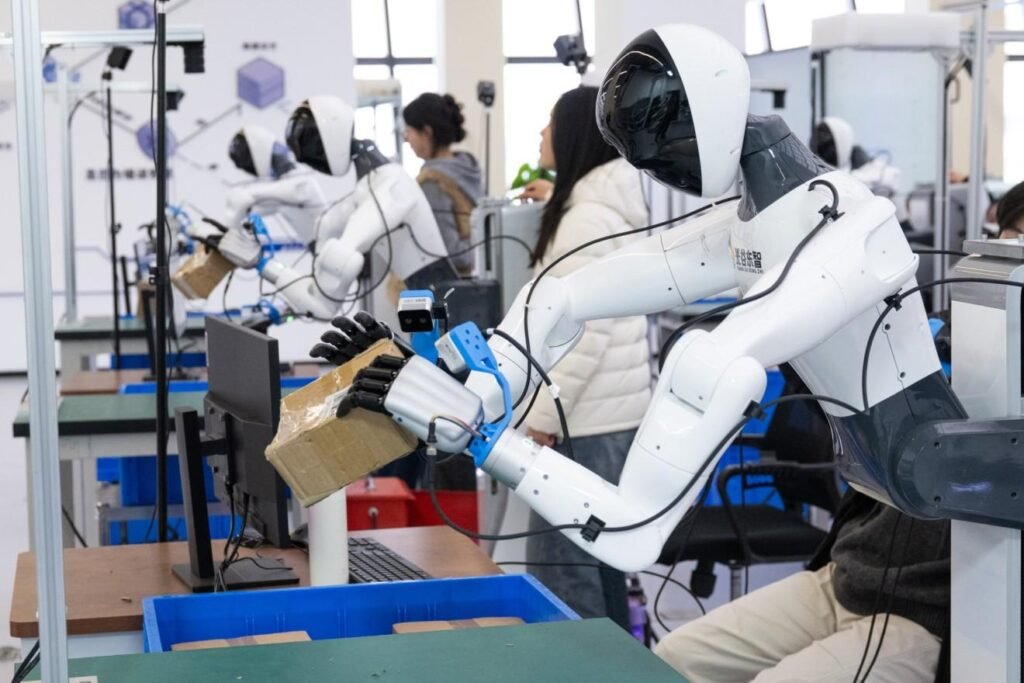
Logistics is another area where humanoid robots could have a major impact.
Moving boxes is repetitive.
Sorting packages is repetitive.
Loading and unloading goods can be physically demanding.
These are exactly the kinds of tasks where automation makes sense. At the Beijing conference, Robotera demonstrated a humanoid torso mounted on a wheeled base that sorts parcels.
The company said more than 100 of its parcel-sorting robots had been deployed across 15 warehouses in China. That is a very different story from a prototype being shown at a technology exhibition.
It suggests that the industry is beginning to move toward actual deployment.
And then comes the home
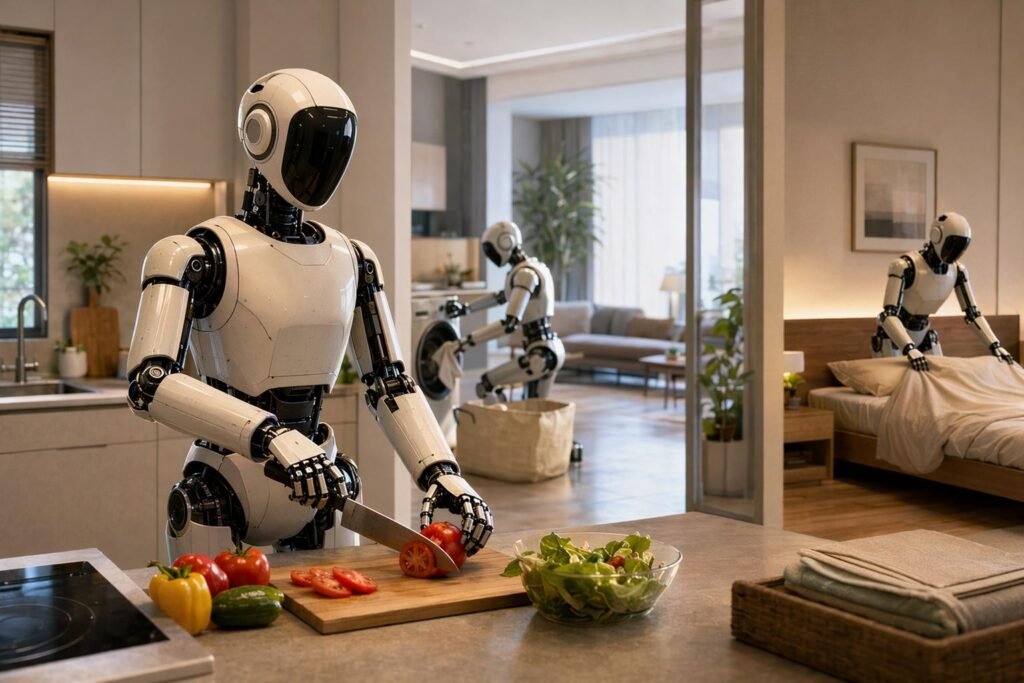
The most difficult environment for a robot may also be the most exciting:
your home.
A factory is predictable.
A house is not.
There could be toys on the floor.
Different furniture.
Pets.
Children.
Stairs.
Hundreds of different objects.
And every home is different.
Yet companies are already experimenting with domestic robots. Reuters reports that X Square Robot, which focuses on household tasks, is testing robots in hundreds of homes during 2026 with the aim of gradual commercialization in 2027.
Imagine a robot that could eventually:
- load a dishwasher;
- carry groceries;
- clean rooms;
- organize objects;
- assist elderly people;
- move heavy items;
- prepare simple meals.
That future is still developing. But the experiments are already happening.
AI is what makes humanoid robots different
A traditional industrial robot usually performs a highly specific operation.
A humanoid robot is supposed to be much more flexible.
This is where artificial intelligence becomes critical.
The robot needs to understand what it sees.
It needs to identify objects.
It needs to understand instructions.
It needs to decide how to move.
And it needs to adapt when something changes.
In other words, the future of robotics isn’t simply about better motors.
It is about combining:
AI + cameras + sensors + computing + batteries + mechanical engineering.
That combination is creating what the industry increasingly calls physical AI.
AI is no longer limited to generating text or images.
It is beginning to interact with the physical world.
🤖 HUMANOID ROBOTS ARE GOING TO WORK
The next big AI revolution has a body.
The biggest challenge isn’t technology
There is still a huge obstacle.
Cost.
A company may be able to build an impressive humanoid robot.
But if the machine costs too much to operate, it won’t replace a human worker economically.
This means the industry has to solve several problems simultaneously.
Robots must become:
cheaper.
more reliable.
more energy efficient.
safer.
easier to maintain.
And, most importantly, they need to work consistently.
Reuters notes that many humanoid deployments remain at the pilot or early-commercial stage, while around 65% of shipments in the first half of 2026 were still going to entertainment, education, research and data collection rather than productive commercial work.
That number is extremely important.
The hype is enormous.
But the mass commercial market is still being built.
The global race is just beginning
China may currently have a major lead in production volume, but the humanoid robot race is global.
American companies are developing increasingly sophisticated robotics systems.
European manufacturers are investing in automation. South Korea and Japan have decades of experience in robotics. And semiconductor companies are building the computing platforms needed to power these machines.
Nvidia is also increasingly focused on what it calls physical AI, and a senior Nvidia executive visited the Beijing robotics conference, according to Reuters.
This shows how closely AI chips, artificial intelligence and robotics are becoming connected.