NVIDIA is backing one of the largest artificial intelligence infrastructure projects ever announced, committing up to $105 billion in guarantees for a massive OpenAI data center campus in Ohio. The project highlights the enormous scale of computing power, energy and infrastructure now required to build the next generation of AI.
By TheTechSpot Digital | August 17, 2026
The artificial intelligence race is entering a new phase, and this time the competition is not only about who can build the smartest AI model.
It is also about who can secure enough chips, electricity, land and data center capacity to run those models.
NVIDIA has now taken a major step in that direction by agreeing to provide up to $105 billion in guarantees connected to a huge AI data center project being developed for OpenAI in Pike County, Ohio.
The project, known as the PORTS-Pike Technology Campus, is being developed by SB Energy, a company backed by SoftBank. OpenAI has agreed to secure approximately 8 gigawatts of IT capacity at the campus, making it one of the largest AI computing projects ever announced.
The first phase is expected to begin coming online in 2028, with approximately 800 megawatts of capacity initially planned. The project is expected to scale substantially over the following years.
A Massive Bet on the Future of AI
The scale of the Ohio project demonstrates just how quickly computing requirements are growing.
Training and operating advanced AI models requires enormous quantities of specialized processors. Unlike traditional software applications, large AI systems depend heavily on data centers packed with high-performance GPUs and networking equipment.
NVIDIA is one of the world’s dominant suppliers of those AI processors.
Under the new arrangement, NVIDIA will provide financial support that helps secure the infrastructure required for the project. The company will also invest approximately $1.5 billion in SB Energy, strengthening its relationship with the company developing the campus.
For NVIDIA, the strategy goes beyond simply selling chips.
The company increasingly wants to participate in the entire AI infrastructure ecosystem, including computing systems, networking, energy and data center capacity.
That approach could help NVIDIA secure long-term demand for its technology as OpenAI and other AI companies dramatically increase their computing requirements.
OpenAI Wants More Computing Power
For OpenAI, access to massive amounts of computing infrastructure is becoming increasingly important.
The company operates ChatGPT and is developing increasingly sophisticated AI models and autonomous systems. As these technologies become more capable, they require significantly more computing power.
OpenAI has agreed to a long-term lease for the Ohio facility, with the campus expected to provide a major source of computing capacity for its future AI operations.
The agreement could also help OpenAI diversify its infrastructure and reduce its dependence on a limited number of external computing providers.
The company has previously announced large-scale infrastructure partnerships through its broader Stargate initiative, reflecting a strategy focused on securing enormous quantities of computing power over many years.
The Ohio project therefore represents another major piece of OpenAI’s long-term infrastructure strategy.
The Numbers Are Extraordinary
The scale of the project is difficult to compare with traditional data centers.
The Ohio campus is expected to eventually provide up to 8 gigawatts of IT capacity.
To put that into perspective, a gigawatt represents one billion watts of power. A facility operating at this scale requires not only enormous computing infrastructure but also a massive supporting energy system.
SB Energy and its partners are planning additional power generation and regional grid investments to support the campus.
Reuters reports that the broader project could involve 10 gigawatts of new power generation and approximately $4.2 billion in regional grid upgrades.
This illustrates a fundamental problem facing the AI industry.
Building AI infrastructure is no longer simply a matter of purchasing more GPUs.
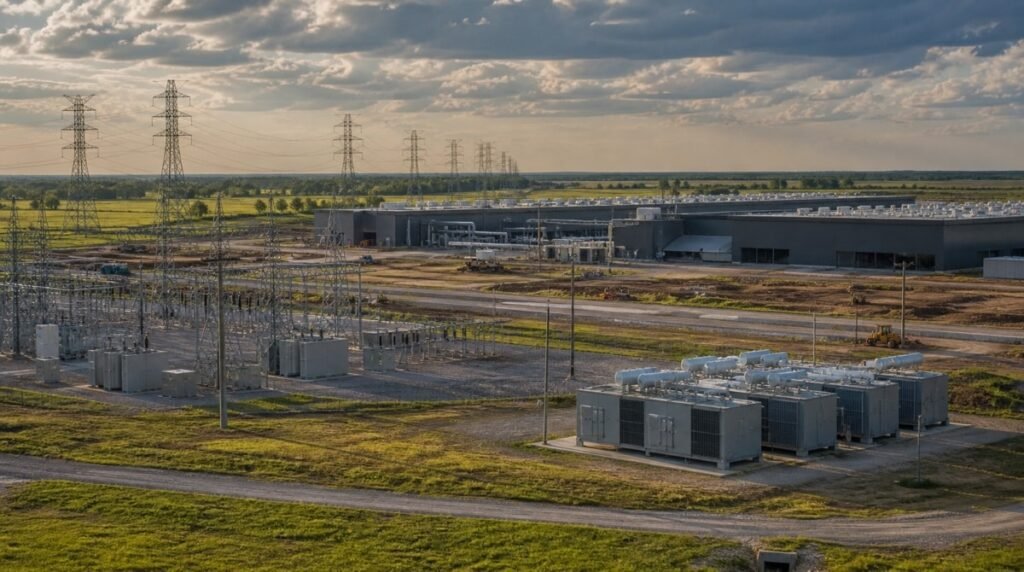
Companies also need enough electricity to operate those GPUs, cooling systems to keep them running, transmission infrastructure to deliver power and physical facilities capable of housing the equipment.

NVIDIA’s Role Is Changing
NVIDIA’s involvement is particularly significant because the company is moving beyond the traditional semiconductor business.
For years, NVIDIA was primarily known for graphics processors used in gaming and professional computing.
The AI revolution transformed the company.
Its GPUs became essential infrastructure for training and running large language models and other AI systems. NVIDIA has since developed an increasingly broad AI platform covering processors, networking, software and complete data center systems.
The Ohio agreement takes that strategy another step forward.
Instead of simply waiting for customers to build infrastructure and purchase GPUs, NVIDIA is helping secure the infrastructure itself.
This could create a powerful feedback loop.
More infrastructure enables more AI computing.
More AI computing creates demand for more NVIDIA hardware.
And increased demand encourages the construction of even larger AI facilities.
Jobs and Economic Impact
The project is also expected to have a significant economic impact on Ohio.
According to Reuters, the development could create approximately 35,000 construction jobs and around 2,500 permanent operational positions by 2032.
That could make the project an important economic development initiative for the region.
However, massive AI data centers can also create challenges for local communities.
They require huge amounts of electricity and infrastructure, and large-scale facilities can place additional pressure on local energy and water resources.
OpenAI has said that it intends to pay project-specific energy and infrastructure costs, use water responsibly and create opportunities for local workers and businesses.
The company and SoftBank have also committed funding for local community initiatives.
The Energy Problem Behind AI
One of the biggest stories hidden inside the Ohio announcement is the growing relationship between artificial intelligence and energy.
AI systems require computing power.
Computing power requires electricity.
As AI models become larger and more widely used, the amount of electricity required by data centers is expected to increase substantially.
This means that the future of artificial intelligence could depend partly on the future of energy infrastructure.
Technology companies are increasingly looking for locations where they can secure large amounts of electricity for decades.
This is changing the traditional geography of the technology industry.
Silicon Valley is no longer the only place that matters.
The next generation of AI infrastructure may be built wherever companies can secure land, power, cooling, networking and favorable infrastructure conditions.
Ohio is becoming one of those locations.
Could This Change the AI Industry?
The NVIDIA-OpenAI project could have implications well beyond Ohio.
If successful, it could become a model for how AI companies finance and build extremely large computing campuses.
Instead of constructing smaller data centers independently, technology companies may increasingly create massive AI campuses capable of supporting multiple generations of hardware.
That could make AI infrastructure more efficient and easier to expand.
It could also increase competition between the world’s largest technology companies.
OpenAI, Google, Microsoft, Meta, Amazon and other major players are all investing heavily in AI infrastructure.
The companies that can secure the most computing power could have an important advantage in the race to develop increasingly capable AI systems.
A New Definition of the AI Race
The most important lesson from the Ohio project may be that the AI race is no longer purely about algorithms.
It is becoming a race for physical infrastructure.
The companies developing tomorrow’s AI need:
- Advanced GPUs
- High-bandwidth networking
- Massive data centers
- Reliable electricity
- Cooling systems
- Semiconductor supply chains
- Land and construction capacity
- Long-term financing
NVIDIA’s decision to provide up to $105 billion in guarantees shows how strategically important these resources have become.
The company is effectively helping create the infrastructure that will consume its own technology.
For OpenAI, meanwhile, the project represents another enormous investment in the computing power required to develop and operate future AI systems.
What Comes Next?
Construction and infrastructure development will determine how quickly the Ohio campus can reach its full potential.
The first major capacity is expected in 2028, with the project eventually targeting approximately 8 gigawatts of IT capacity.
If the development proceeds as planned, it could become one of the world’s largest AI computing campuses.
It could also demonstrate how closely technology, energy and finance are becoming connected in the AI era.
The biggest AI companies are no longer simply building software.
They are effectively building a new global computing infrastructure.
And with NVIDIA, OpenAI and SoftBank now working together on one of the largest projects of its kind, Ohio could become an important part of the next chapter of the artificial intelligence revolution.
The Bottom Line
NVIDIA’s backing of OpenAI’s massive Ohio data center project is a clear sign that the AI industry is entering an infrastructure-intensive era.
The future of AI will depend not only on better models, but also on the physical systems capable of running them.
With billions of dollars in financing, gigawatts of computing capacity and thousands of jobs involved, the PORTS-Pike project could become a defining example of what the next generation of AI infrastructure looks like.
For NVIDIA, it is a bet on continued demand for AI computing. For OpenAI, it is a bet on the future scale of artificial intelligence. And for the technology industry as a whole, it is another reminder that the AI revolution is becoming increasingly physical.