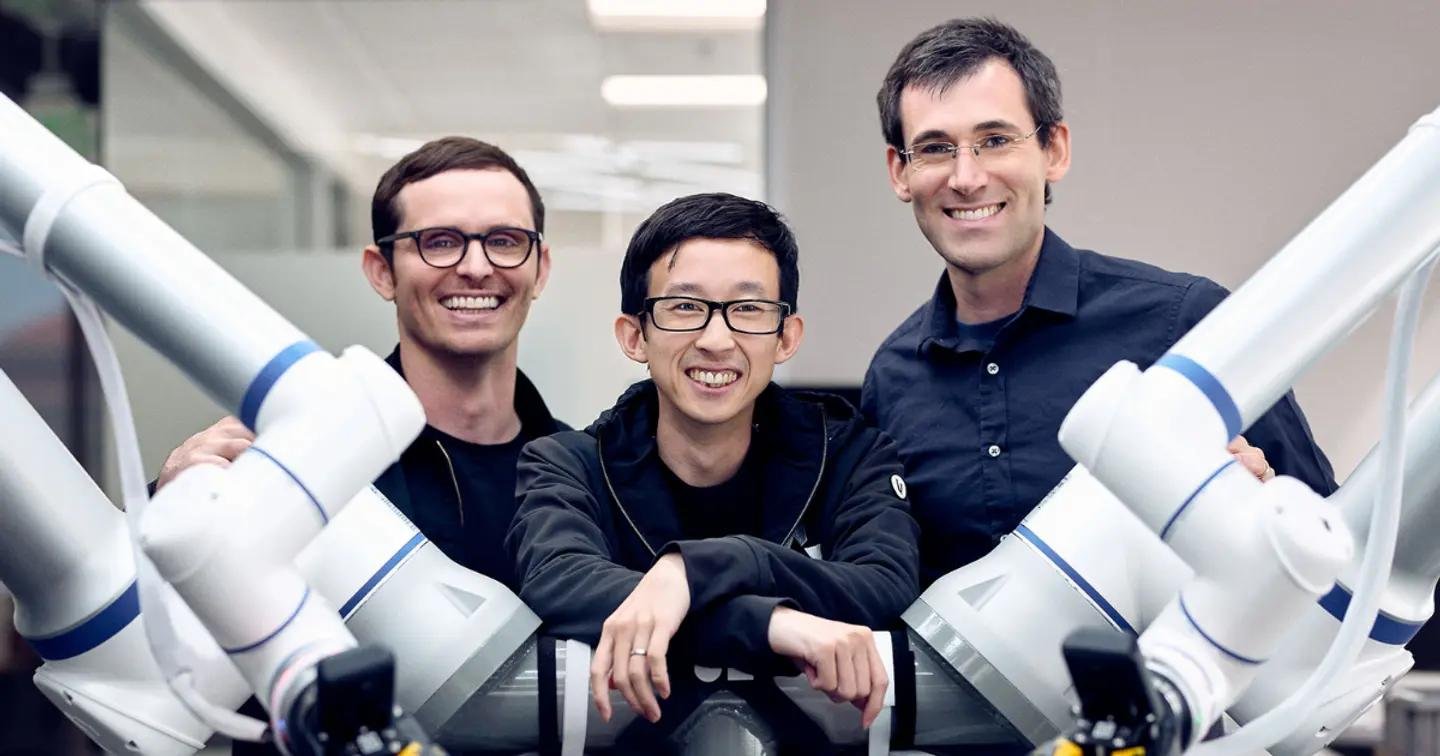
The race to build the next generation of intelligent robots is attracting enormous amounts of capital, and one of the latest winners is Generalist, a young robotics startup that has reportedly reached a $3 billion valuation.
The company secured nearly $200 million in additional funding led by 8VC, according to two people familiar with the deal cited by TechCrunch. The new capital is an extension of Generalist’s $400 million Series B, which was announced in June at a $2 billion valuation. The latest financing brings the total size of the Series B to approximately $600 million.
The numbers are impressive on their own, but the technology Generalist is developing may be even more important.
The startup is building an AI foundation model designed to work across different types of robots, with the long-term goal of creating a more general-purpose intelligence for machines operating in the physical world.
In other words, Generalist is trying to build something that could eventually become a kind of “brain” for robots.
From DeepMind and Boston Dynamics to a $3 Billion Startup
Generalist was founded in 2024 by Pete Florence and Andy Zeng, both former Google DeepMind researchers, together with Andrew Barry, a former Boston Dynamics engineer.
That background is significant.
DeepMind has been one of the world’s most influential AI research organizations, while Boston Dynamics has become synonymous with advanced physical robotics.
Generalist effectively brings expertise from both worlds together:
AI intelligence + physical robotics.
The company has also attracted a notable group of early backers, including 8VC, Radical Ventures, Nvidia, Union Square Ventures, Bezos Expeditions and AI researcher Fei-Fei Li.
Generalist Wants to Build a General-Purpose Robot Brain
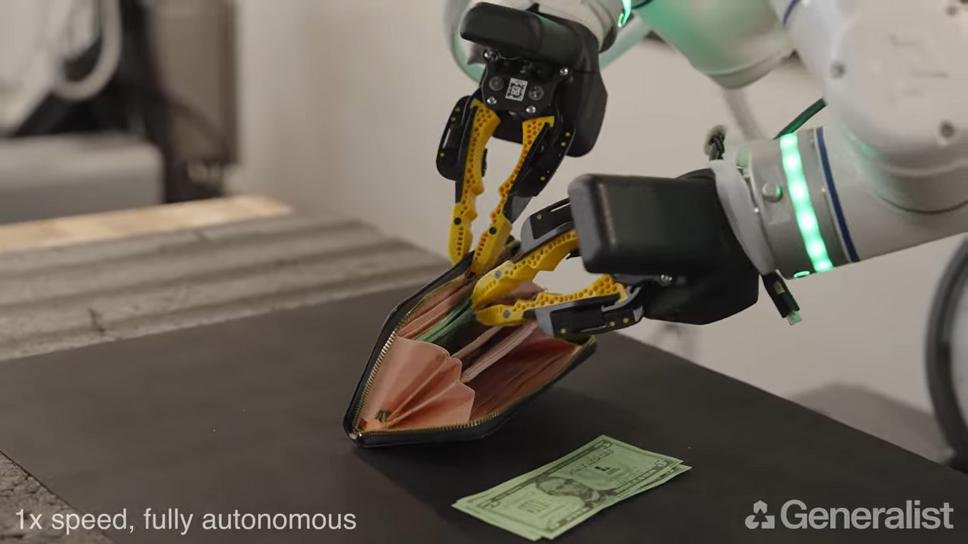
Traditional robots are often designed around specific tasks.
One machine may be programmed to pick up objects.
Another may assemble components.
Another may move products around a warehouse.
Changing the job can require new programming, new training data and extensive engineering work.
Generalist is attempting to move beyond that model.
Its goal is to develop a foundation model that can operate across different robots and different tasks.
The concept is similar, at a high level, to what foundation models have done for software.
Instead of building a completely separate AI system for every application, one large model can provide a common intelligence layer that can be adapted for many different uses.
If that approach works for robotics, it could dramatically change how machines are trained and deployed.
The Model Can Learn From Just Seconds of Video
One of the most interesting claims surrounding Generalist’s technology is its new Gen 1.5 model.
According to the company, robots can learn new tasks from video demonstrations lasting only three to 12 seconds.
That is potentially a major improvement in the way robots learn.
Traditional robotic systems can require large amounts of training data and carefully engineered demonstrations.
A model capable of watching a short demonstration and then generalizing the task could make robot training significantly more efficient.
Imagine a worker demonstrating a simple task:
“Pick up this object and place it here.”
Instead of engineers manually programming every movement, the robot could learn from the demonstration itself.
That idea sits at the center of the growing Physical AI movement.
Robotics Is Searching for Its Own “ChatGPT Moment”
Investors are increasingly comparing the current robotics boom with the early days of generative AI.
ChatGPT demonstrated that one general-purpose AI system could be used for an enormous variety of tasks.
Robotics companies now want to achieve something similar in the physical world.
But the challenge is much harder.
A language model produces text.
A robot has to interact with reality.
It needs to understand objects, space, movement, physics and consequences.
A mistake made by a chatbot may produce a bad answer.
A mistake made by a physical robot can damage equipment, destroy products or potentially injure someone.
That makes reliable general-purpose robotics one of the hardest problems in modern AI.
Generalist Has Plenty of Competition
Generalist is far from the only company pursuing foundation models for robotics.
Physical Intelligence has emerged as one of the largest names in the field and has reportedly reached an $11 billion valuation.
Skild AI, backed by SoftBank, has reportedly reached a valuation of around $14 billion.
Meanwhile, Genesis AI has also been in discussions over a financing round that could value the company at roughly $3 billion.
The growing valuations reveal something important about investor sentiment.
Robotics is no longer being treated simply as a hardware industry.
Investors increasingly see it as a new AI platform opportunity.
Why Is So Much Money Moving Into Robotics?
The answer is partly economic.
AI has transformed software, but much of the real economy still depends on physical work.
Factories need workers.
Warehouses need logistics.
Hospitals need automation.
Construction remains highly physical.
Agriculture requires enormous amounts of manual and repetitive work.
If AI can provide robots with flexible intelligence, the potential market is enormous.
That is why investors are increasingly betting on the combination of:
AI + robotics + automation.
The idea is not simply to build better robots.
It is to create machines capable of adapting to many different environments and tasks.
The Biggest Problem: Robots Don’t Have the Internet
There is, however, a major obstacle.
Large language models can learn from enormous amounts of information available online.
The internet contains billions of pages, documents, images and pieces of text.
Robots do not have an equivalent dataset showing machines performing every physical task humans might want them to perform.
Physical AI therefore requires different kinds of data.
Robots need to learn from:
video demonstrations,
simulation,
human actions,
sensor data,
and real-world experience.
That makes data collection one of the biggest challenges in the industry.
It is also one reason some investors and researchers believe truly general-purpose robots may still be years away.
From Research Labs to Real Factories
Generalist is already working with a small number of customers.
According to TechCrunch, the startup is using customer feedback to tailor its model to specific applications.
That step could ultimately matter more than flashy demonstrations.
The real test for Physical AI will not be whether a robot can perform an impressive action for a few seconds.
The real test will be whether it can perform useful work:
every day, repeatedly, safely and at an economically viable cost.
A robot that performs a spectacular demonstration is interesting.
A robot that can operate for eight hours inside a factory while completing hundreds of tasks with minimal human intervention could be revolutionary.
The Race Toward the Universal Robot
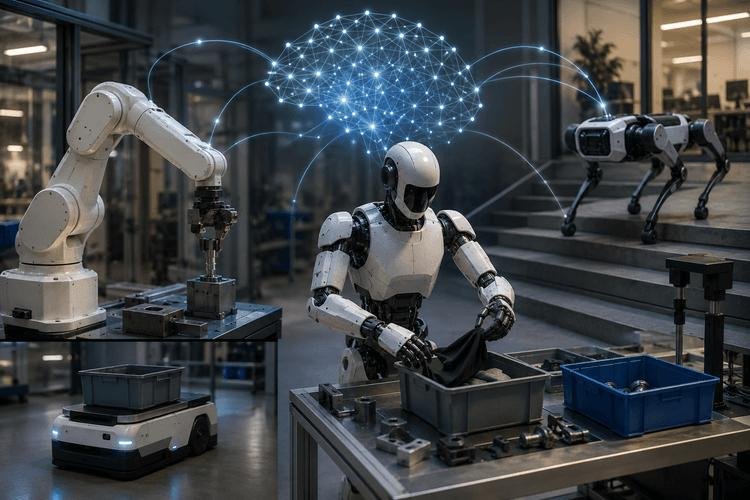
If foundation models for robotics succeed, the industry could eventually move toward a model that looks surprisingly similar to software ecosystems.
Today, companies often purchase specialized robots designed around specific jobs.
In the future, businesses could potentially purchase a robotic platform and deploy different AI models depending on the task.
The hardware becomes the platform.
The AI becomes the brain.
And software determines what the robot can do.
That is one of the reasons investors are pouring so much money into the sector.
Is $3 Billion Only the Beginning?
Generalist’s $3 billion valuation is remarkable for a company founded only two years ago.
But investors are not necessarily paying for the company’s current revenue or current products.
They are betting on the possibility that Generalist could become one of the major infrastructure companies behind Physical AI.
If its technology eventually works across many robot manufacturers and industries, the company’s potential market could be enormous.
But there is also significant risk.
Robotics may prove much harder and slower to scale than software AI.
Hardware is expensive.
Physical environments are unpredictable.
Training data is difficult to collect.
And safety requirements are much higher.
That means today’s huge valuations are ultimately bets on what the robotics industry could become.
The Next AI Revolution May Leave the Screen
The bigger story behind Generalist is the direction of the AI industry itself.
Over the last decade, much of the AI revolution happened inside screens.
Chatbots.
Search engines.
Image generators.
Coding assistants.
Video generation.
Now the industry is trying to take artificial intelligence into the physical world.
Factories.
Warehouses.
Hospitals.
Homes.
Construction sites.
And eventually, almost anywhere humans perform repetitive or physically demanding work.
If Generalist and its competitors succeed in creating general-purpose robotic intelligence, the impact could be enormous.
The next major AI platform may not live inside your phone or computer.
It may walk into the room.