

Google’s parent company disclosed a holding of nearly three million Qualcomm shares, as the chipmaker seeks to reduce its dependence on smartphones and build a larger business supplying data-center processors.
Alphabet, Google’s parent company, has disclosed a stake worth approximately $548 million in Qualcomm, adding a new financial dimension to a long-standing technology partnership between the two companies.
The holding, built during the third quarter, amounts to nearly three million Qualcomm shares, according to a regulatory disclosure reported by Reuters on November 6. The investment comes as Qualcomm attempts to expand beyond its traditional smartphone processor business and establish itself as a supplier of chips for large data centers.
The timing is significant. Qualcomm is pursuing a bigger role in the computing infrastructure market just as major technology companies look for alternatives to Nvidia and seek more control over the processors powering their cloud and AI services.
However, the disclosed investment does not by itself establish that Alphabet has entered a new strategic supply agreement with Qualcomm. It confirms a shareholding, not a new chip-purchasing commitment.
Qualcomm wants to become more than a smartphone chipmaker
Qualcomm is best known for its Snapdragon processors, which power a large share of Android smartphones. Its technology also reaches into connected cars, laptops and Internet of Things devices.
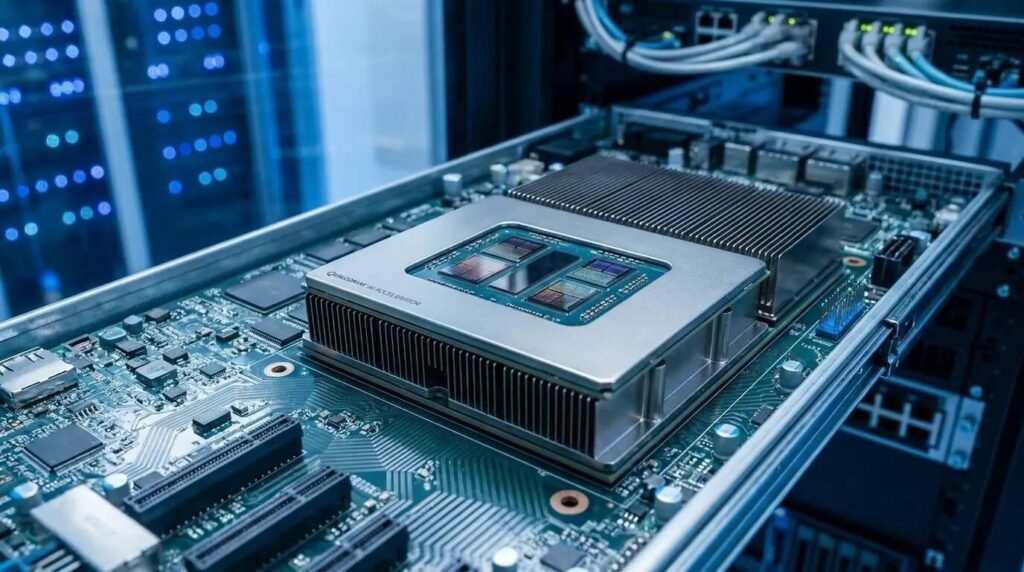
But the company is trying to change the balance of its business. It is developing custom processors for data centers, where demand for computing capacity has increased as cloud providers and technology companies expand their infrastructure.
At its June 2026 investor event, Qualcomm outlined a target of generating more than $15 billion in data-center revenue by fiscal 2029. It also raised its target for revenue from businesses outside smartphones, reflecting a broader diversification strategy.
The company reiterated a $5 billion data-center revenue target for fiscal 2027 in its November 4 earnings announcement. That target is ambitious: Qualcomm must turn development programs and customer commitments into products that can be deployed at scale.
Big technology companies are looking for alternatives
Qualcomm is entering a market dominated by established players, particularly Nvidia, whose accelerators have become central to many AI data centers.
Cloud providers have strong incentives to diversify their hardware supply. Custom processors can help them tailor performance, energy consumption and cost to their own workloads rather than relying entirely on general-purpose products from a small number of suppliers.
Qualcomm has been pursuing this opportunity with custom AI processors and has attracted interest from several major customers.
Reuters reported that Amazon signed an agreement allowing it to purchase up to $60 billion in Qualcomm AI data-center chips and related products. Microsoft and Meta have also placed orders for Qualcomm data-center processors.
Those developments suggest that Qualcomm’s ambitions are not limited to a research project. But large purchase ceilings, orders and revenue targets should not be treated as equivalent to products already shipped or revenue already earned.
Key Takeaways
- Alphabet disclosed a Qualcomm holding worth approximately $548 million.
- The position represents nearly three million Qualcomm shares and was built during the third quarter.
- Qualcomm aims to generate more than $15 billion in data-center revenue by fiscal 2029.
- The company reiterated a $5 billion data-center revenue target for fiscal 2027.
- Amazon, Microsoft and Meta are among the major companies linked to Qualcomm’s data-center push.
- Qualcomm’s handset revenue fell 26% year over year in its latest reported quarter.
- Alphabet’s investment does not prove a new Google data-center chip purchase agreement.
The smartphone business is facing pressure

Qualcomm’s diversification push is also a response to weakness in its traditional market.
In results published on November 4, the company reported fiscal 2026 revenue of $43.1 billion, down from $44.3 billion a year earlier. Fourth-quarter revenue was $10.32 billion, an 8% year-over-year decline.
The handset business was a particularly weak area: Qualcomm’s fourth-quarter handset revenue fell 26% year over year to approximately $5.14 billion. Automotive revenue, by contrast, rose 89% to nearly $1.99 billion.
The figures illustrate why Qualcomm is seeking growth in data centers, automotive computing and connected devices. A business that depends heavily on smartphone replacement cycles is exposed to changes in consumer demand, device prices and manufacturing costs.
What Alphabet’s investment does — and does not — tell us
Alphabet and Qualcomm already have commercial ties. Qualcomm processors power Android devices, and the companies have worked together on Google’s newer laptop efforts and automotive technology.
The newly disclosed shareholding adds another connection between them. It may be viewed as a vote of confidence in Qualcomm’s prospects, but the public information does not establish Alphabet’s precise investment rationale.
It also does not confirm that Google will use Qualcomm processors in its own data centers. A financial stake and a hardware procurement agreement are different things, and there is no basis to treat one as proof of the other.
For the wider chip market, the investment is another indication that major technology companies are closely watching suppliers capable of challenging the current concentration of data-center computing power.
What happens next?
The next major test for Qualcomm is execution. The company must deliver competitive processors, secure long-term customers and turn its announced data-center ambitions into recurring revenue.
Its fiscal 2027 target of $5 billion in data-center revenue will be an important milestone. The longer-term goal of more than $15 billion by fiscal 2029 will depend on customer adoption, product performance and the pace at which new data-center systems are deployed.
For Alphabet, the disclosed stake is a significant financial position, but its future intentions remain unclear. Any new supply agreement or deeper technical partnership would need separate confirmation.
TheTechSpot Take
The significance of Alphabet’s Qualcomm stake is bigger than the headline figure, but it should not be overstated. The investment arrives at a moment when the semiconductor market is changing: the companies that supply processors for smartphones increasingly want a role in servers, cloud infrastructure and AI computing.
Qualcomm has a credible opportunity to diversify, especially as large cloud operators look for more choice in hardware. Its existing relationships with major technology companies give it a route into that market, but competing with established data-center suppliers requires more than ambitious revenue targets.
For Alphabet, the stake creates financial exposure to a supplier already connected to its Android ecosystem. Whether that develops into deeper cooperation in data centers remains an open question.
The real story is not that Google has chosen a new chip supplier. It is that the battle for computing infrastructure is broadening — and Qualcomm wants to be one of the companies shaping it.


