

A new experimental utility called gputaskman provides detailed information about GPU usage, VRAM consumption and local AI workloads, helping users understand exactly which applications are consuming their graphics resources.
A new open-source utility developed by Microsoft executive Scott Hanselman is attracting attention among developers and PC enthusiasts by offering a more detailed look at what is happening inside a computer’s graphics processor.
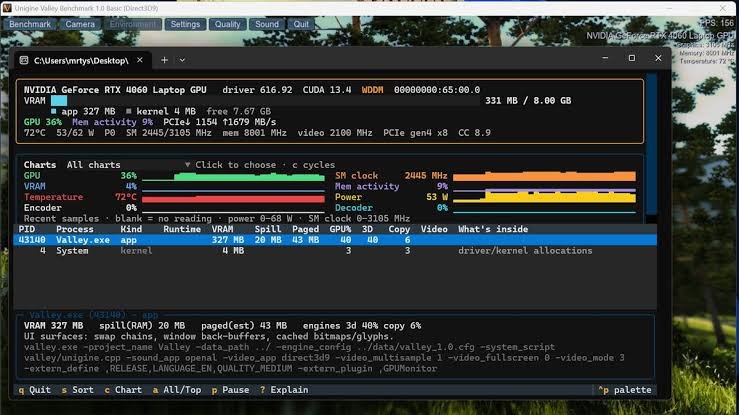
Called gputaskman, the tool is designed to show which applications and processes are using a computer’s GPU, how much video memory they consume and what types of workloads are running.
The project was covered by Tom’s Hardware on November 8, 2026, after Hanselman shared details and demonstrations of the software.
Unlike conventional system-monitoring utilities that provide general GPU usage figures, gputaskman aims to explain where graphics memory is going and which applications are responsible for consuming it.
What makes gputaskman different?
Modern computers increasingly use GPUs for more than gaming and graphics rendering.
Artificial intelligence applications, locally running language models, video editing software and other demanding programs can all consume substantial amounts of VRAM.
Windows Task Manager provides basic GPU statistics, but identifying precisely how individual applications allocate graphics memory can be more difficult.
Gputaskman attempts to address this problem by displaying information such as:
- GPU usage by individual processes.
- Video memory consumption (VRAM).
- Active GPU runtimes.
- Information about local AI and large language model workloads.
- Details about model weights and KV cache memory.
- Additional hardware monitoring information, including GPU temperature.
This can be particularly useful for people running AI models directly on their computers, where memory consumption can determine which models can run efficiently.
Why is VRAM monitoring becoming more important?
Graphics memory has become an increasingly important resource as AI workloads move from cloud infrastructure to personal computers.
Running a local language model requires memory for model weights, intermediate calculations and the KV cache, which stores information used during text generation.
When several applications compete for the same GPU resources, performance can suffer. In some situations, applications may also move data between GPU memory and system RAM, potentially reducing performance.
A tool that identifies exactly which processes are consuming VRAM can help users understand performance problems and make better decisions about their hardware.
Open-source and available across operating systems
Gputaskman is distributed under the MIT open-source license, allowing developers to inspect the source code, contribute improvements and adapt the project.
The project targets Windows, Linux and macOS, although the exact hardware and feature support may vary between platforms and releases.
Tom’s Hardware reported that version 0.3.0 includes portable Windows downloads and live monitoring capabilities.
The project remains experimental, meaning users should not assume that every feature is fully mature or that hardware compatibility is universal.
Could Windows eventually offer similar features?
Hanselman has also suggested that expanded GPU-monitoring capabilities could become part of Windows in the future.
For now, gputaskman is an independent project rather than an official Windows feature.
Its development reflects a broader change in personal computing: as AI applications become more common on desktop computers, users increasingly need better tools to understand how those applications use hardware resources.
For gamers, developers and AI enthusiasts, knowing not just how much GPU memory is being used, but which application is using it, could make troubleshooting considerably easier.
Source: Tom’s Hardware, November 8, 2026; project information from the gputaskman GitHub repository.


