


The European Chip Design Platform aims to help startups access expensive design tools, intellectual property and manufacturing capabilities as Europe seeks a stronger position in the global semiconductor industry.
Europe is making another move to reduce its dependence on foreign semiconductor technology. On 4 November 2026, the European Commission launched the European Chip Design Platform, backed by €525 million in planned investment to support a new generation of European chip-design companies.
The initiative addresses a structural weakness in Europe’s semiconductor industry: its relatively limited presence in commercial chip design.
According to the European Commission, European chip-design companies currently account for less than 1% of global revenue in this segment.
What does the €525 million initiative include?

The funding package has two main components, according to Reuters’ reporting on the announcement.
Some €440 million will be provided through grants to help startups develop chips for commercial use. Another €85 million will support the European Chips Design Platform.
The platform is intended to give startups and smaller companies access to specialised chip-design software, technical support, intellectual property blocks and manufacturing capacity.
These resources are particularly important for early-stage companies. Designing a competitive semiconductor requires expensive software licences, highly specialised engineers, testing infrastructure and access to fabrication partners.
Without that ecosystem, promising research can struggle to become a commercially viable product.
Why chip design matters to Europe’s technology ambitions
Semiconductors underpin smartphones, cars, telecommunications equipment, industrial systems and artificial intelligence infrastructure.
Europe has established strengths in areas such as semiconductor manufacturing equipment, automotive chips and industrial electronics. However, the global chip-design market is dominated by companies based elsewhere.
That imbalance creates strategic risks. A region that depends heavily on external suppliers for processor architectures and specialised chip designs has less control over important parts of its technology supply chain.
The EU’s Chips Act and its wider technology-sovereignty agenda aim to strengthen research, design, production and supply-chain resilience.
What could change for startups?
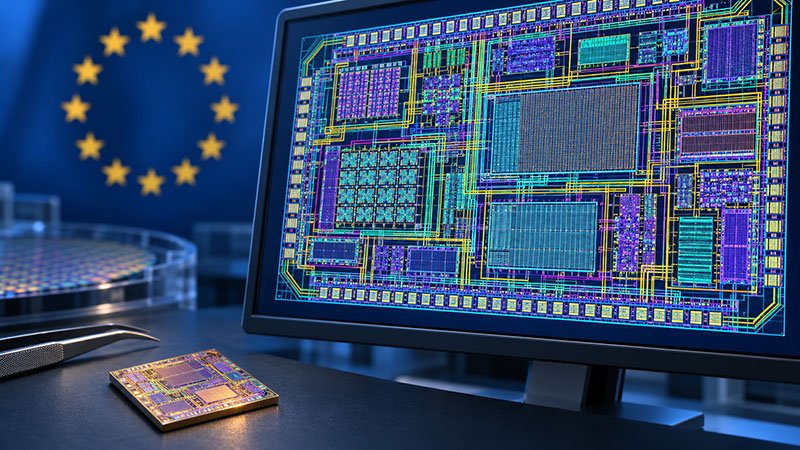
The new platform could reduce some of the financial and technical barriers facing European chip startups.
Instead of building every part of the design process independently, smaller companies may be able to use shared tools, technical expertise and access to manufacturing resources.
That could help research teams move from prototypes to products that can be tested and sold.
However, access to infrastructure does not automatically create successful semiconductor companies. Startups will still need customers, experienced engineering teams, investment and a realistic route to mass production.
What happens next?
The important test will be how quickly the platform becomes accessible to companies and whether the funding produces commercially successful products.
The EU will also need to demonstrate that support for chip design can translate into stronger demand for European manufacturing capacity.
The Commission’s announcement establishes the initiative and its financial commitment, but it is too early to assess the number of companies that will benefit or the commercial results it will generate.
TheTechSpot Take
Europe’s semiconductor challenge is not simply about building more factories. It is also about developing the companies that decide what those factories manufacture.
The €525 million initiative addresses an important gap between research and commercial chip development. Its success should not be measured by the amount of funding announced, but by how many competitive products, sustainable startups and European intellectual-property assets emerge from it.
In the AI era, chip design is an increasingly important part of technological independence.


