





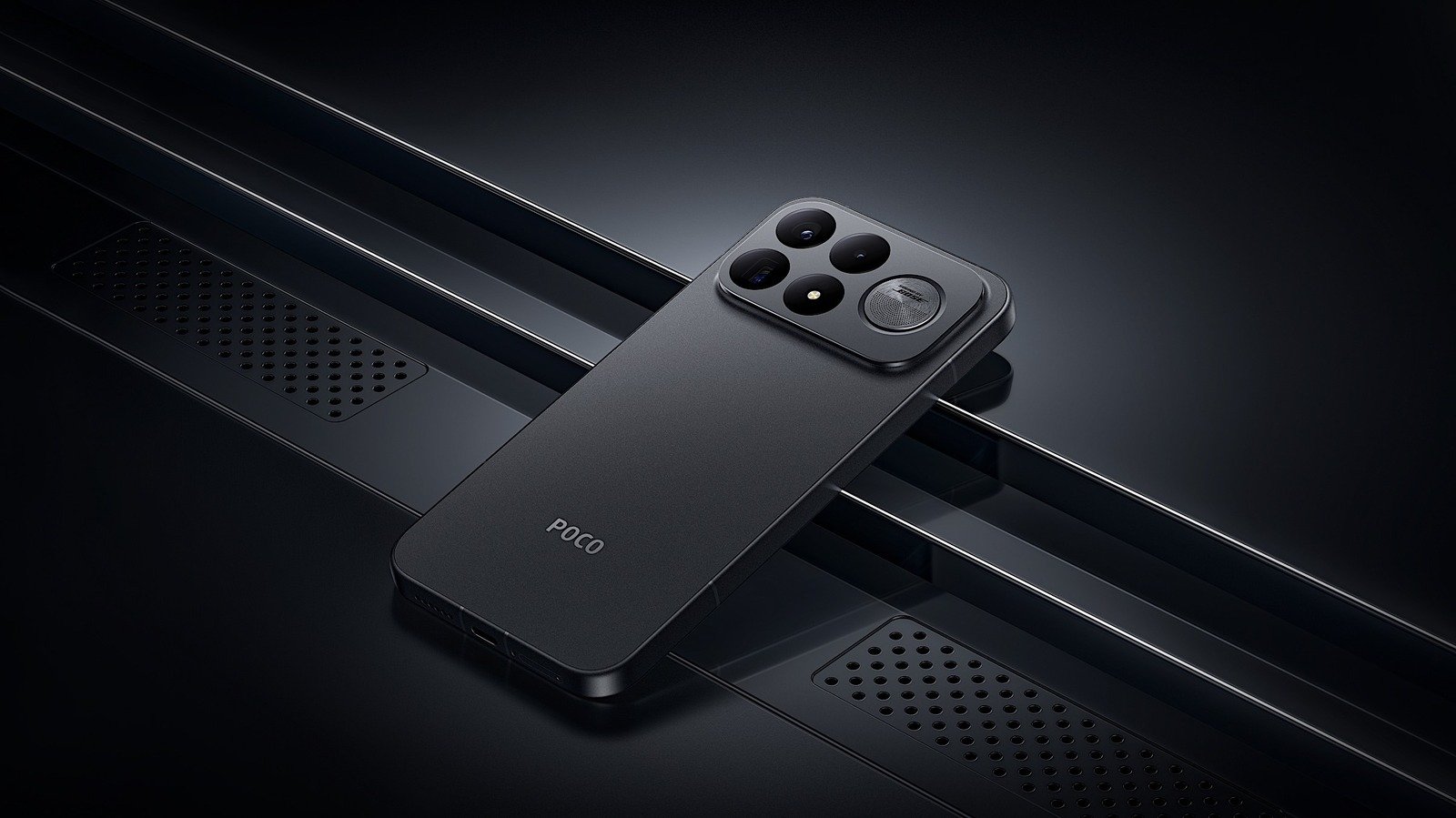
The new POCO flagship packs a huge silicon-carbon battery, Snapdragon 8 Elite Gen 5, a 185Hz display and Bose-tuned 2.1 audio — but its price shows POCO is no longer playing only in the budget flagship market.
POCO has officially launched the F9 Ultra, and the company is making a much more serious push into the premium smartphone market this time around.
The new flagship combines Qualcomm’s Snapdragon 8 Elite Gen 5 with a 6.9-inch 185Hz AMOLED display, a 200MP main camera, an 8,050mAh silicon-carbon battery and a Bose-developed 2.1-channel audio system with a dedicated subwoofer. POCO is also claiming an internal AnTuTu score of 4,165,108, although that figure comes from the company’s own testing rather than an independent benchmark.
That hardware puts the F9 Ultra in a very different position from the POCO phones of a few years ago. The brand built its reputation around offering flagship performance for considerably less money. With the F9 Ultra, POCO is still trying to keep that formula alive, but the phone itself is now packed with features normally associated with much more expensive devices.
A massive battery meets flagship performance


The most striking specification may be the battery.
The F9 Ultra carries an 8,050mAh silicon-carbon cell, considerably larger than what is found in most mainstream flagship smartphones. It supports 100W wired charging and 50W wireless charging, along with reverse charging. POCO says the battery is exclusive to the Ultra model; the F9 Pro gets a smaller 6,330mAh unit.
The phone is powered by Qualcomm’s Snapdragon 8 Elite Gen 5, paired with up to 16GB of LPDDR5X RAM and 1TB of UFS 4.1 storage.
POCO has also added a dedicated VisionBoost D8 display processor and its 3D IceLoop cooling system. The company says the combination can deliver up to 185 frames per second in supported games, with more than 20 titles supporting the highest frame rate under the company’s testing conditions.
That gaming focus is obvious throughout the device. The F9 Ultra has a 4,800Hz instant touch sampling rate, a 200Hz gyroscope sampling rate and software features designed to combine frame generation with AI-based resolution enhancement.
In other words, this isn’t simply a phone with a fast processor. POCO is building the Ultra around sustained gaming performance.
The 185Hz screen is one of its biggest weapons


The F9 Ultra uses a 6.9-inch 1.5K AMOLED display with a maximum refresh rate of 185Hz.
The panel can reach up to 4,500 nits under specified peak-brightness conditions, while HDR content can reach a claimed 10,000-nit peak. It also supports HDR10+ and Dolby Vision and is protected by Corning Gorilla Glass 7i.
The 185Hz figure is particularly interesting because refresh rates that high remain relatively uncommon on flagship phones. POCO is targeting gamers here rather than simply chasing a specification record.
The company says the maximum refresh rate is available in selected games, so users should not expect the entire interface to operate permanently at 185Hz. Actual performance will depend on the game, graphics settings, software and temperature.
Still, for a phone designed around mobile gaming, the combination of the Snapdragon chip, dedicated display hardware, fast touch response and high-refresh panel gives the F9 Ultra a very clear identity.
POCO’s camera hardware finally looks serious
POCO has also taken a major step forward with photography.
The F9 Ultra introduces the company’s first 200MP primary camera with optical image stabilization, using a 1/1.56-inch sensor. It is joined by a 50MP ultrawide camera and a 50MP 5x periscope telephoto. The phone can also record 8K video.
That telephoto camera is an important upgrade because POCO has traditionally prioritized processing power and gaming over camera hardware.
The 5x periscope gives the F9 Ultra a much more credible long-range photography setup, while the 200MP main sensor provides plenty of resolution for cropping and computational photography.
Whether it can actually compete with the best camera phones will require proper testing, however. Megapixel count alone does not determine image quality, and POCO still has something to prove against Samsung, Apple and Google’s image-processing systems.


And then there is the Bose subwoofer
Perhaps the strangest feature is on the audio side.
POCO has again worked with Bose, but the F9 Ultra goes further with a 2.1-channel speaker system that includes an independent subwoofer. The subwoofer even has a small white LED ring that can be used for calls, notifications and lighting effects during games or music.
It sounds like a gimmick, but the audio system is actually one of the more unusual hardware choices on the phone. The larger speaker setup is designed to make gaming, video and music playback more immersive without requiring external speakers.
Bose also contributes audio profiles and a game audio mode designed to emphasize directional sounds such as footsteps in first-person shooters.
That combination of a huge battery, large display and dedicated audio hardware makes the F9 Ultra physically closer to a portable gaming/media device than a conventional slim flagship.
The trade-off is weight: the phone comes in at about 235 grams, before accounting for the size of the camera module.
The price tells a bigger story about POCO
The F9 Ultra starts at $799 for 12GB of RAM and 256GB of storage, with higher configurations reaching $949 for 16GB/512GB and $1,199 for 16GB/1TB. An early-bird offer lowers the entry price by $50 in selected markets.
That is where the F9 Ultra becomes particularly interesting.
POCO is still offering aggressive hardware for the money, but the company is no longer positioning the phone as an ultra-cheap alternative to flagship devices. At $799 before promotions, the F9 Ultra is entering territory occupied by major premium Android phones.
POCO appears to be betting that buyers will accept the higher price in exchange for hardware that is difficult to find elsewhere: an 8,050mAh battery, 185Hz AMOLED panel, 200MP camera, 5x periscope, flagship Snapdragon processor and a built-in subwoofer.
The company is also promising four years of OS updates and six years of security support, giving the F9 Ultra a longer software runway than some previous POCO models.
The result is a phone that feels like a turning point for the brand. POCO is still chasing performance, but the F9 Ultra is clearly trying to be more than a “flagship killer.”
It wants to be a flagship.
And for the first time, the hardware makes that argument seriously.
by The Tech Spot Editorial Team