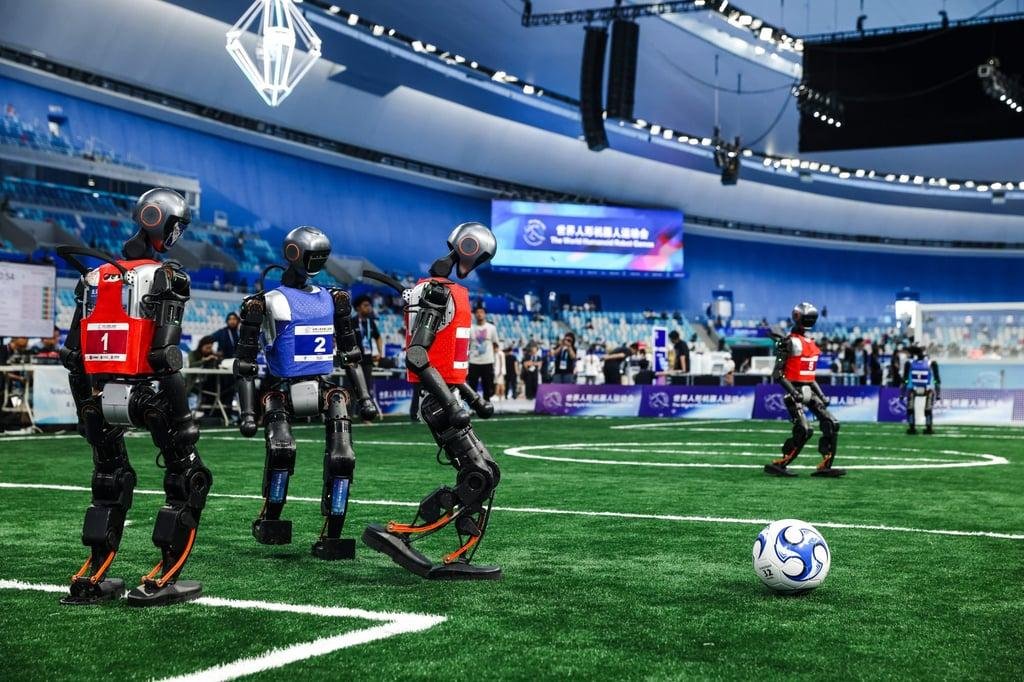
Something unusual is happening in Beijing this weekend.
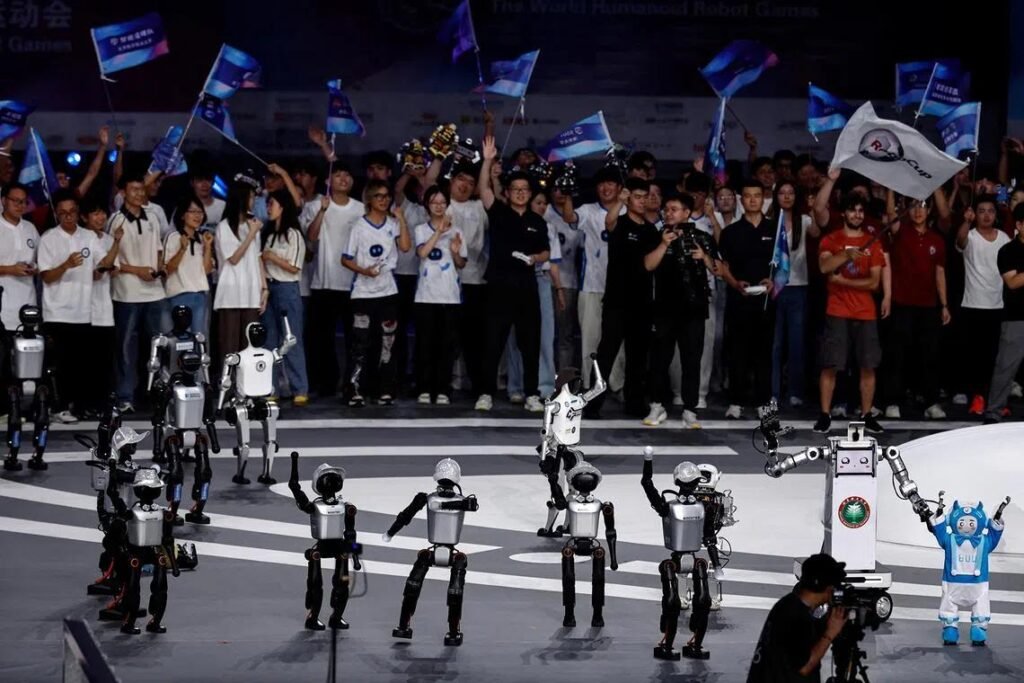
Thousands of humanoid robots are gathering for a competition that looks, at first glance, like a futuristic version of the Olympics. They will run, jump, play football, lift weights, compete in table tennis and even pull against each other in tug-of-war.
But behind the spectacle is a much bigger technology story.
The second World Humanoid Robot Games opens in Beijing on August 22, bringing together 2,056 robots from 666 teams across 16 countries and regions. The five-day event will feature 51 events and more than 1,300 competition sessions.
And this year, the robots have something more important to prove than who can run the fastest.
They need to show that humanoid machines can actually operate in the real world.
This is no longer just a robot show
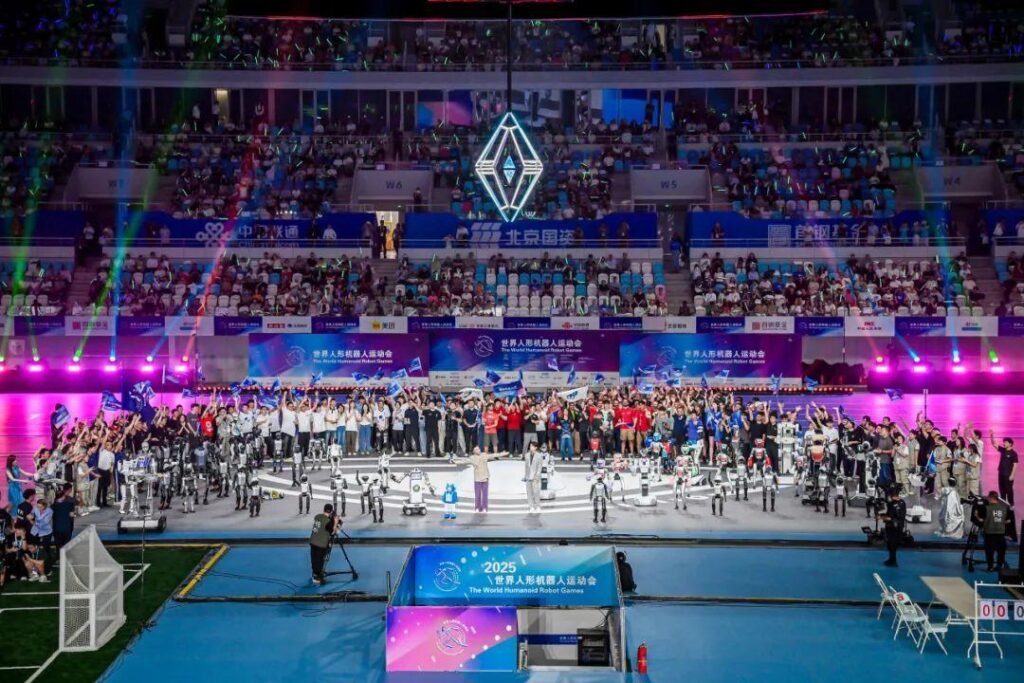
The first generation of humanoid robot demonstrations was built around spectacle.
A robot could dance.
Another could perform a backflip.
Another could run down a track.
Those demonstrations were impressive, but they didn’t necessarily answer the question businesses and consumers care about most:
What can the robot actually do for me?
That question is becoming central to the robotics industry.
This year’s games are expanding beyond standardized sporting events into real-world environments where robots must interact with objects, adapt to changing surroundings and perform practical tasks. Beijing says the competition is designed to test how well humanoid machines can adapt to different environments and manipulate objects with their hands.
That is a much harder problem than simply following a predefined route.
More than 2,000 machines, but not all are created equal
The scale of this year’s competition is striking.
The event has grown dramatically from its inaugural edition in 2025, when roughly 500 humanoid robots competed across 26 events.
Now the field has expanded to more than 2,000 machines and hundreds of teams.
The majority of participants are Chinese, reflecting China’s enormous push into humanoid robotics. But teams from multiple countries and regions are also taking part.
For the robotics industry, that makes Beijing something more than an unusual sporting venue.
It is becoming a giant public testing ground.
The real race is autonomy
One of the biggest changes this year is the emphasis on autonomous operation.
That matters because a robot controlled remotely by a human is fundamentally different from a robot that can perceive its surroundings, make decisions and execute movements on its own.
The latter is what the industry is ultimately trying to build.
For autonomous humanoids, the challenge involves several layers of technology working together.
The robot has to understand its environment.
It has to identify objects.
It needs to maintain balance.
It must plan movement.
It needs to understand instructions.
And then it has to turn a digital decision into physical movement.
That entire process is known as embodied AI—AI that doesn’t simply generate text or images, but interacts with the physical world.
Running is impressive. Picking something up is harder.
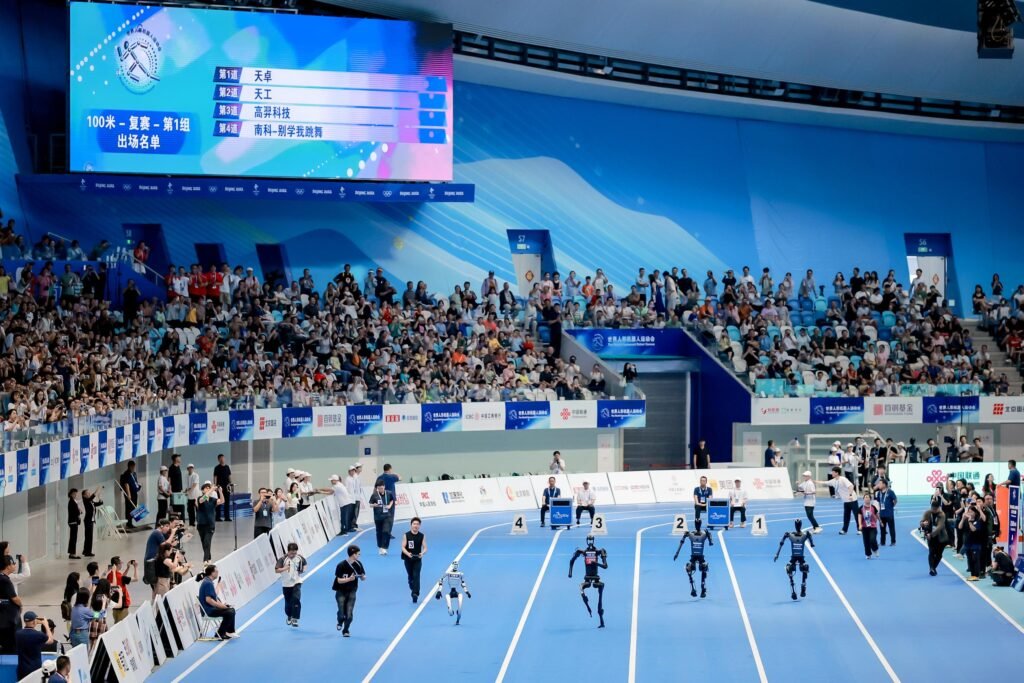
A humanoid robot running 100 meters looks spectacular.
But imagine asking that same robot to walk into a hotel room, identify a bed, pick up sheets, make the bed and recognize when the job is finished.
That is a completely different challenge.
And it is exactly where the robotics industry is heading.
Real-world scenario competitions surrounding the games have included tasks such as hotel room preparation, shelving books and household organization.
These tasks may look ordinary to humans.
For robots, they are extremely complicated.
Humans naturally understand how objects behave. We know that a book can be picked up by its cover, that a bedsheet can fold unpredictably and that furniture can block a robot’s path.
An AI system has to learn these concepts through data, sensors, models and physical experience.
Why China is pushing so hard into humanoids
China has become one of the world’s most aggressive markets for humanoid robotics.
At the 2026 World Robot Conference in Beijing, more than 300 companies were showcasing thousands of robotic products, with manufacturers increasingly focusing on logistics, manufacturing, household assistance and other practical applications.
The strategy is becoming increasingly clear.
The goal isn’t simply to build robots that look human.
The goal is to build machines that can eventually perform tasks designed around human environments.
That distinction is crucial.
Factories, warehouses, hotels and homes were built for human bodies.
A humanoid robot can potentially use the same doors, stairs, shelves, tools and workspaces without requiring companies to redesign their entire infrastructure.
That is one of the strongest arguments for the humanoid form factor.
The business question is getting louder
Investors are already paying attention.
But the robotics industry is approaching a point where impressive demonstrations will no longer be enough.
The next question is economics.
Can a humanoid robot perform a useful job for less than the cost of paying a human worker to do the same task?
Can it work for hours without expensive maintenance?
Can it operate safely around people?
Can a company deploy hundreds or thousands of robots and manage them efficiently?
Reuters recently reported that China’s humanoid robotics industry is increasingly focused on commercial viability, with companies under pressure to demonstrate real productivity rather than simply impressive demonstrations.
That may ultimately determine which robotics companies survive.
The robot that wins may not be the fastest
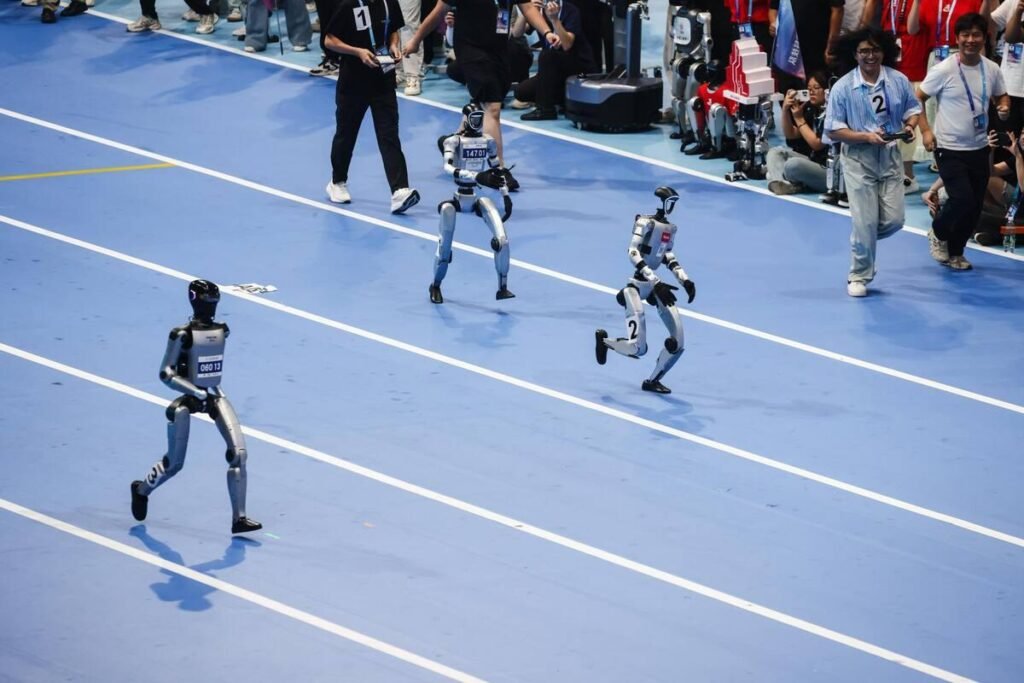
This is where the World Humanoid Robot Games become particularly interesting.
A robot that wins a race gets attention.
A robot that can reliably complete a difficult industrial task could make money.
Those are very different achievements.
The future leader in humanoid robotics may therefore not be the company with the fastest machine.
It may be the company whose robot can work safely, learn efficiently and operate reliably for thousands of hours.
In other words, the real competition is moving from performance to usefulness.
AI is becoming physical
For years, artificial intelligence existed primarily inside computers.
It wrote text.
Generated images.
Analyzed documents.
Created software.
Humanoid robots represent a major change.
Now AI can have a physical body.
That means an AI model can potentially see a room, understand an instruction, manipulate an object and physically move through an environment.
This creates an entirely new category of computing.
The smartphone revolution put computers into everyone’s hands.
Generative AI put powerful reasoning systems into everyday software.
Humanoid robotics could eventually put AI into the physical world.
That is why this technology deserves attention far beyond the robotics community.
There will be failures — and that’s part of the story
The robots will not be perfect.
Some will fall.
Some will lose balance.
Some will misunderstand their environment.
Some will simply fail at tasks that look trivial to a human.
That isn’t necessarily a sign that the technology is failing.
In fact, failures can be some of the most valuable data available to robotics engineers.
A robot operating in the real world encounters situations that are difficult to reproduce in a laboratory.
Every unexpected movement, collision or failed task can provide information that helps improve the next generation.
The challenge is turning those failures into better systems.
The humanoid decade may be starting
The most interesting thing about Beijing’s robot games isn’t the medals.
It’s the direction of travel.
Only a few years ago, humanoid robots were largely research projects and futuristic demonstrations.
Now companies are talking seriously about factories, logistics, retail, healthcare and household applications.
The technology still has enormous problems to solve.
Battery life remains important.
Hardware is expensive.
Reliable manipulation is difficult.
Safety is critical.
And general-purpose autonomy is still far from solved.
But the industry is moving.
And Beijing’s robot games offer a rare opportunity to watch that progress happen in public.
From robot Olympics to robot workforce
The most important race isn’t happening on the track.
It is happening inside factories, warehouses, hotels and laboratories.
The winner won’t necessarily be the robot that runs 100 meters the fastest.
It could be the robot that can work an eight-hour shift without needing constant human intervention.
It could be the machine that sorts thousands of packages.
It could be the robot that helps an elderly person at home.
Or it could be something nobody has imagined yet.
That is why the World Humanoid Robot Games 2026 matter.
They are entertaining, certainly.
But underneath the running, football, table tennis and tug-of-war is a much more serious experiment.
Can we teach machines to live and work in the human world?
Beijing is about to give us another glimpse of the answer.
And this time, there are more than 2,000 robots ready to show us what they can do.