
A bizarre new piece of technology is turning mosquito control into something that looks like science fiction: a system using LiDAR, radar, computer vision and a precision laser to detect and eliminate mosquitoes in mid-air.
Mosquito control has traditionally meant sprays, traps, chemicals and electric zappers.
Now a Chinese technology startup is proposing something far more futuristic.
A new mosquito-defense system called Photon Matrix uses sensors and automated targeting technology to identify flying mosquitoes and eliminate them with a precision laser.
The concept has already attracted attention online, with one robotics commentator describing the technology as an “Iron Dome for mosquitoes.”
The comparison sounds ridiculous.
But the technology behind it is surprisingly sophisticated.
Instead of filling an area with chemicals or relying on a simple electric trap, the system attempts to identify individual flying insects, track their movement and direct a laser toward the target.
And it is designed to distinguish mosquitoes from other flying insects.
How Does a Laser Know It Is Looking at a Mosquito?
That is the most interesting part of the system.
Photon Matrix says its outdoor mosquito-defense device combines LiDAR detection, radar and AI-powered vision to identify flying insects.
LiDAR can measure the position and movement of objects in three-dimensional space.
Radar provides another method of detecting movement.
Computer vision can then analyze the target.
Together, these technologies can create a constantly updated picture of what is flying around the device.
The system can reportedly detect insects as small as 2 millimeters and track targets moving at speeds of up to approximately 3.3 feet per second.
Once the system identifies a mosquito, it attempts to direct a laser at the insect.
That is where the “Iron Dome” comparison comes from.
Instead of intercepting missiles, however, this system is attempting to intercept mosquitoes.
The Goal Is Precision, Not More Chemicals
Mosquito control can create a difficult environmental problem.
Chemical insecticides can kill mosquitoes, but they can also affect other insects and contribute to broader ecological concerns.
Photon Matrix is promoting its system as a chemical-free alternative.
The idea is simple:
Don’t spray an entire area.
Don’t kill everything flying nearby.
Find the mosquito.
Track it.
Then eliminate it.
That is a very different approach to pest control.
The Technology Is Surprisingly Precise
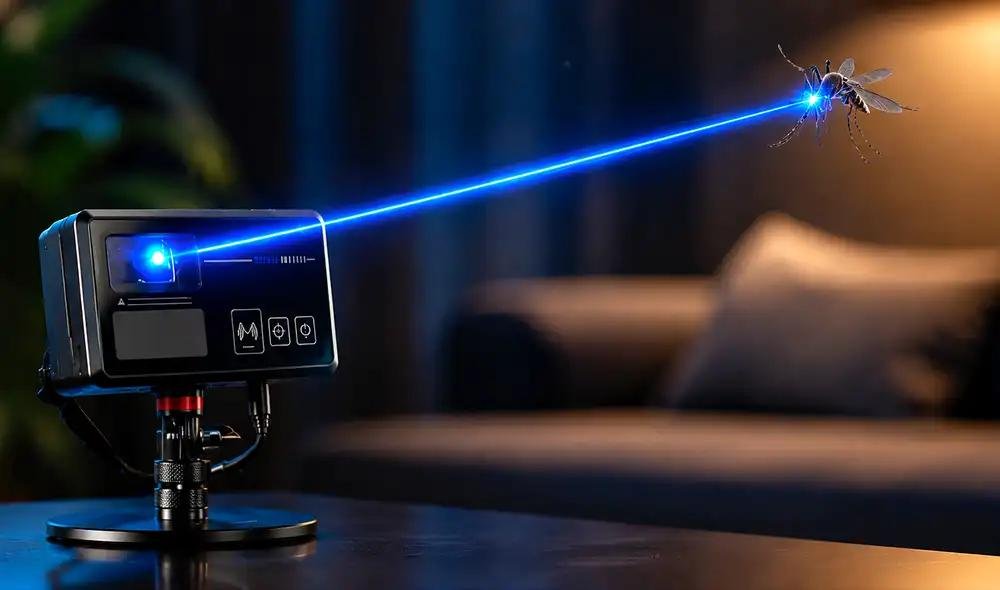
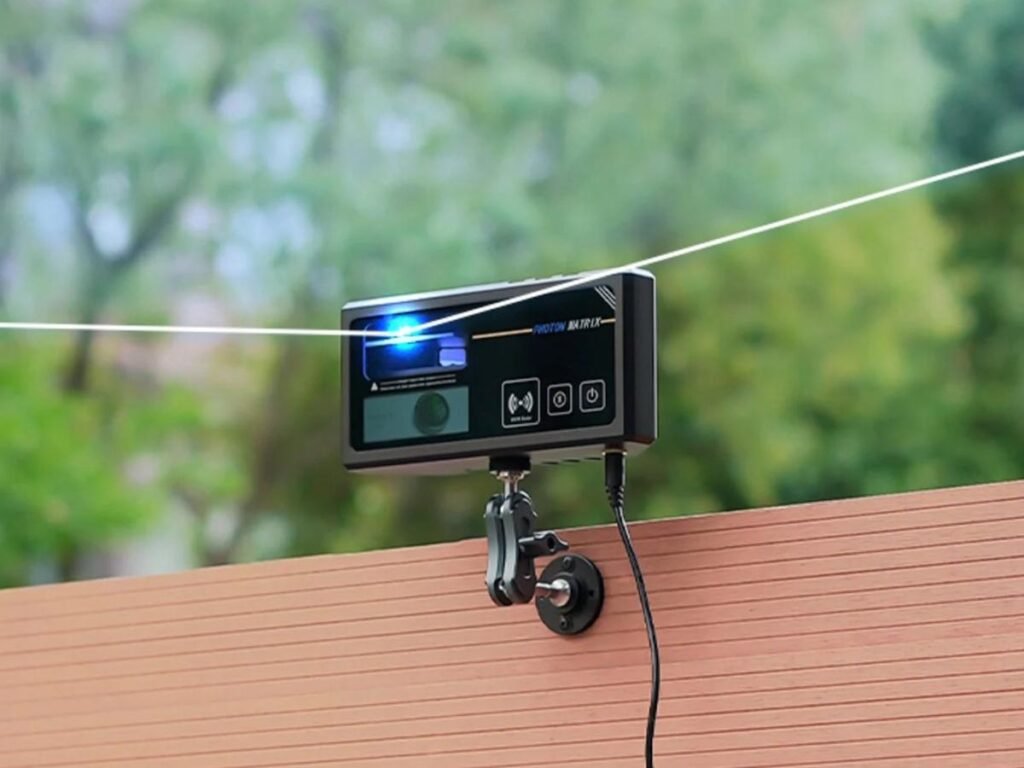
According to the company, its outdoor system uses a LiDAR scanner with a detection range of approximately 20 feet.
The laser targeting system then attempts to engage mosquitoes within that detection zone.
The company says the system can identify different types of mosquitoes while avoiding insects such as butterflies.
That distinction is extremely important.
A device that simply fires a laser at every moving insect would be dangerous and environmentally questionable.
The real technological challenge is determining what the target actually is.
That requires recognizing tiny objects while they are moving through the air.
It Looks Like Something From a Science-Fiction Movie
Videos of the system show something that looks very different from conventional mosquito traps.
The device scans its surroundings and tracks flying insects.
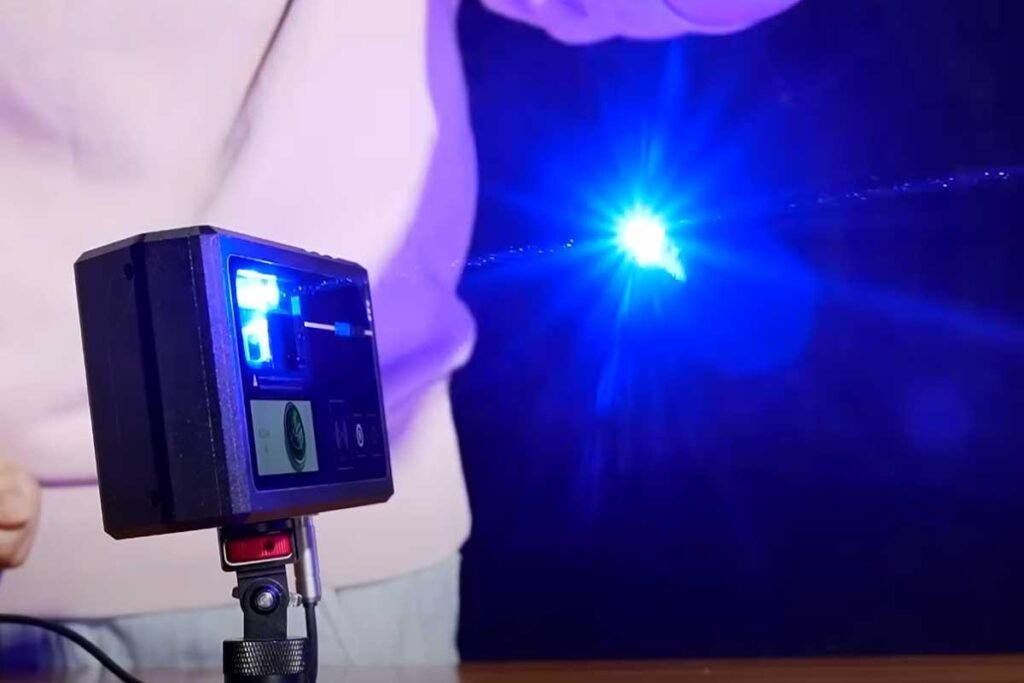
When it engages a target, a bright blue laser can be seen firing toward the insect.
The result looks less like pest control and more like a miniature defense system.
That visual quality is one reason the technology has attracted attention online.
It is an unusual combination of robotics, sensors, automation and lasers.
And unlike many futuristic demonstrations, the company is actually selling the device.
There Are Indoor and Outdoor Versions
Photon Matrix reportedly offers different versions of its mosquito-defense technology.
The outdoor model is designed for larger spaces such as gardens, patios and outdoor areas.
The indoor version uses infrared detection and a laser that is not visible to the human eye.
That creates different engineering challenges.
Outdoor environments contain far more variables.
Wind can change insect movement.
Sunlight can affect sensors.
Other insects may enter the detection area.
People and animals may also be nearby.
An indoor system operates in a much more controlled environment.
It Is Not Cheap
The futuristic technology comes with a futuristic price.
The reported price is approximately $1,088 for the outdoor version and $988 for the indoor model.
That is significantly more expensive than a traditional mosquito trap.
For most consumers, spending around $1,000 to eliminate mosquitoes may sound excessive.
But the company is effectively selling a completely different technology category.
The product combines sensors, computing, tracking software, optics and a laser system.
It is closer to a small autonomous defense robot than a conventional insect trap.
Why Mosquitoes Are Such an Important Target
The technology is arriving at a time when mosquito-borne diseases remain a major concern.
Mosquitoes can transmit diseases including West Nile virus, dengue, malaria and several other infections.
In California, concerns about West Nile virus have increased as mosquito populations have grown.
The Times of India reported that California had recorded 30 human West Nile cases earlier this month, with the number representing a five-year high, while a second death had also been reported.
That gives mosquito-control technology a potential public-health application.
If systems like Photon Matrix become sufficiently reliable and affordable, they could eventually be used in environments where reducing mosquito populations is particularly important.
Could This Technology Scale?
That is the big question.
Detecting one mosquito in a controlled environment is one thing.
Protecting an entire property from thousands of insects is another.
Mosquitoes are extremely small.
They move unpredictably.
They can appear from many directions.
And outdoor environments are full of other moving objects.
The system therefore has to continuously identify targets while avoiding false positives.
That is an extremely difficult engineering problem.
The AI Has to Make Decisions in Real Time
This is where the technology becomes more interesting from a computing perspective.
The system cannot analyze a mosquito after the fact.
It needs to identify the insect while it is flying.
That means the detection system has to process sensor information in real time.
The software needs to determine:
Is this an insect?
What type of insect is it?
Where is it moving?
How fast is it moving?
Where will it be in the next fraction of a second?
Is it safe to activate the laser?
Those decisions have to happen extremely quickly.
In that sense, the device is effectively a small autonomous robotics platform.
The Hardest Problem May Be Identification
Tracking a flying object is difficult.
Identifying it correctly is even harder.
A mosquito can be only a few millimeters long.
The system must distinguish it from dust, leaves, other insects and other small objects.
It also needs to avoid targeting insects that are beneficial to ecosystems.
That makes the computer-vision component particularly important.
A system that accidentally targets bees or butterflies would defeat much of the environmental argument behind the technology.
What Happens If It Becomes Cheaper?
The technology could become much more interesting if the price falls.
Sensors such as cameras, radar modules and processors are becoming increasingly affordable.
Computer vision is becoming more capable.
Compact laser systems are also becoming easier to integrate into consumer products.
If manufacturers can reduce the cost of the technology, autonomous mosquito control could become a new category of smart-home equipment.
Imagine buying a device that automatically protects your backyard without spraying chemicals.
That could be far more attractive to consumers.
It Could Become Part of the Smart Home
The same technology could eventually connect to smart-home systems.
A mosquito-defense device could monitor outdoor conditions.
It could activate automatically during periods when mosquitoes are most active.
It could send alerts to a smartphone.
It could record how many insects it has detected.
Multiple devices could potentially work together to cover larger properties.
That would turn mosquito control into another automated home service.
The Idea Could Go Beyond Mosquitoes
There is another interesting possibility.
The technology developed to track mosquitoes could potentially be adapted to other tiny flying insects.
The challenge would be classification.
Different insects have different shapes, flight patterns and sizes.
If the system can reliably distinguish them, it could theoretically become a broader automated insect-monitoring platform.
That could have applications in agriculture, environmental research and pest management.
In other words, the laser is the flashy part.
The real technology may be the sensor and recognition system behind it.
Farmers Could Be Interested
Agriculture is one area where automated insect detection could have major value.
Farmers spend enormous amounts of money controlling pests.
Traditional pesticides can affect the environment and may become less effective as pests develop resistance.
A system capable of identifying individual insects could potentially allow much more targeted intervention.
Instead of treating an entire field, future systems could theoretically identify specific pests and eliminate or monitor them individually.
That is still a long way from commercial reality.
But the underlying concept is fascinating.
Safety Will Be Critical
Any consumer device using a laser also raises obvious safety concerns.
The system has to prevent the laser from firing when people or animals are in unsafe positions.
It must also ensure that the beam does not accidentally reach reflective surfaces or other objects.
That means autonomous safety mechanisms are just as important as the insect-detection technology.
A mosquito trap can be annoying if it fails.
A laser system can become dangerous if it fails.
This is one reason automated laser targeting requires significantly more engineering than conventional pest-control products.
The Viral Appeal Is Obvious
There is also a reason this technology has become such an attention-grabbing story.
It sounds absurd.
A homeowner spending nearly $1,000 on a miniature defense system to shoot mosquitoes sounds like something from a futuristic comedy.
But the underlying technology is real.
Sensors are becoming smaller.
Computer vision is becoming more capable.
Robotics is becoming cheaper.
And autonomous targeting systems are increasingly appearing in consumer products.
The mosquito problem simply provides an unusual application for technologies that are normally associated with much more serious industries.
A Tiny Example of a Much Bigger Technology Trend
Photon Matrix is an interesting example of a broader shift happening across consumer technology.
Systems that once required large industrial machines are becoming smaller and more accessible.
Sensors that were previously expensive are now available in consumer devices.
Machine vision is moving into everyday products.
Robotics is moving from factories into homes.
And autonomous decision-making is becoming part of ordinary hardware.
The mosquito laser may sound like a novelty.
But the technology behind it represents a much bigger trend.
TheTechSpot Take
The idea of an “Iron Dome for mosquitoes” sounds ridiculous until you look at what is actually inside the machine.
LiDAR.
Radar.
Computer vision.
Real-time tracking.
Autonomous targeting.
Precision lasers.
Together, those technologies create a system capable of detecting tiny flying insects and attempting to eliminate them individually.
The most interesting question is not whether people are willing to spend $1,000 to fight mosquitoes.
It is whether this technology can become cheaper, safer and reliable enough to create an entirely new category of automated pest control.
If it does, today’s strange-looking backyard gadget could become the early version of something much bigger.
The future of pest control may not be another stronger chemical.
It may be a tiny autonomous defense system that hunts the pests itself.