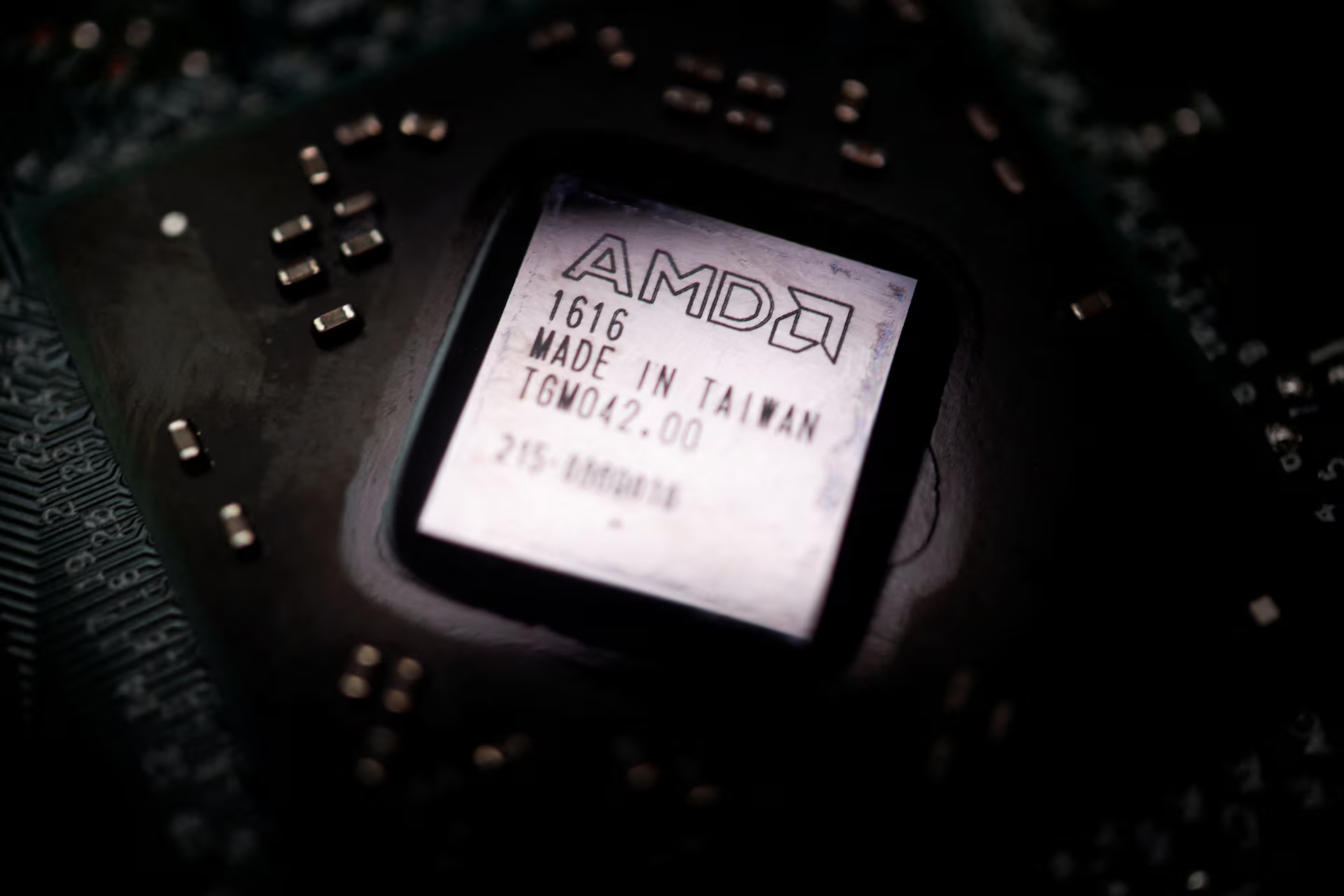
Standfirst: French cloud provider Scaleway plans to deploy an AI supercomputer in Sweden using AMD Instinct MI355X accelerators, giving European startups and businesses another option for accessing high-performance AI computing.
French cloud provider Scaleway plans to build an artificial intelligence supercomputer in Sweden powered by AMD chips, expanding its infrastructure footprint beyond France as competition over AI computing capacity intensifies.
The company announced the project on October 13 at its annual AI conference in Paris. According to Reuters, Scaleway intends to make the system available to startups, AI developers and businesses across Europe. The machine will use AMD’s Instinct MI355X accelerators, which compete in the high-performance AI computing market with NVIDIA’s Blackwell platform.
The announcement is significant because access to computing infrastructure has become a major factor in developing and operating modern AI systems. Training large models and serving AI applications to users can require substantial computing resources, making the availability, cost and software compatibility of accelerators important decisions for companies building AI products.
An alternative to NVIDIA-centred infrastructure

NVIDIA has a strong position in AI computing, supported not only by its GPUs but also by its CUDA software ecosystem. AMD is seeking to compete with its own hardware and ROCm, an open-source software platform intended to support AI development and computing workloads.
Reuters reports that ROCm supports widely used AI programming tools that can also work with NVIDIA hardware. That compatibility could give developers more flexibility when choosing where to run workloads, although moving applications between platforms may still require testing, optimisation and engineering work.
The distinction matters for businesses that want to avoid becoming too dependent on a single hardware and software supplier. A wider range of infrastructure providers can create more options for capacity and pricing, but the real benefits will depend on performance, availability, support and the total cost of running AI workloads.
Scaleway describes itself as a European cloud and AI provider, with a focus on open technologies and digital independence. Its Swedish project would extend that strategy into another European market.
Why Sweden?
Scaleway said it chose Sweden because of its largely low-carbon electricity supply and its growing AI sector. The company entered the Swedish market in May through a partnership with telecommunications operator Tele2 to offer cloud and AI services, Reuters reported.
Electricity is an increasingly important consideration for AI infrastructure. Large computing facilities require power not only for processors and servers but also for cooling and supporting equipment. A location with relatively low-carbon electricity may help reduce the carbon intensity of operations, although the actual environmental impact will depend on the facility’s energy use, cooling design and the electricity it consumes over time.
The project will involve several technology suppliers. Reuters reports that Bull will assemble and maintain the system, with servers supplied by Giga Computing, networking equipment from HPE, storage from VAST Data and cooling liquid from Motul.
What it could mean for European AI companies

For startups and smaller AI teams, access to computing capacity can determine how quickly they can train, test and deploy models. A new commercial supercomputer could add another potential supplier to the European market, particularly for organisations evaluating alternatives to NVIDIA-based systems.
However, an announcement is not the same as a service that customers can use today. The project’s practical value will depend on when the infrastructure becomes operational, how much capacity will be available, what it costs and which software frameworks and services are supported.
The announcement also does not mean that European AI computing will become independent of global suppliers. The project relies on an international supply chain of processors, servers, networking, storage and cooling components. Its significance is better understood as an expansion of European-hosted infrastructure and customer choice, rather than a complete break from overseas technology.
What we know — and what we don’t
What we know
- Scaleway announced plans on October 13, 2026, to build an AI supercomputer in Sweden.
- The planned system will use AMD Instinct MI355X accelerators.
- Scaleway says it intends to make the system available to startups, AI companies and businesses across Europe.
- Bull and several specialist suppliers are expected to contribute to building and operating the system.
What remains unclear
- The exact opening or customer-availability date.
- The final number of accelerators, total computing capacity and performance benchmarks.
- Pricing, reservation arrangements and service-level commitments.
- Which AI models, frameworks and managed services will be available at launch.
TheTechSpot Take

Europe needs more than ambitious AI strategies; it needs practical access to the computing resources required to build and run AI products. Scaleway’s planned Swedish supercomputer is a meaningful step toward broadening the region’s infrastructure choices, especially if AMD’s hardware and ROCm software prove competitive for real-world workloads.
Still, the headline announcement is only the beginning. Customers will judge the project on performance, reliability, software compatibility, price and how quickly the promised capacity becomes available. Until those details are confirmed, the strongest conclusion is that Europe may be gaining another option in the AI infrastructure market—not that the competition has already been settled.
Sources and verification: This article is based primarily on Reuters’ report published October 13, 2026, with Scaleway’s official website used for company background and context. Claims about the planned system and supplier roles are attributed to the reporting; launch timing, capacity and pricing have not been independently confirmed in the cited material.