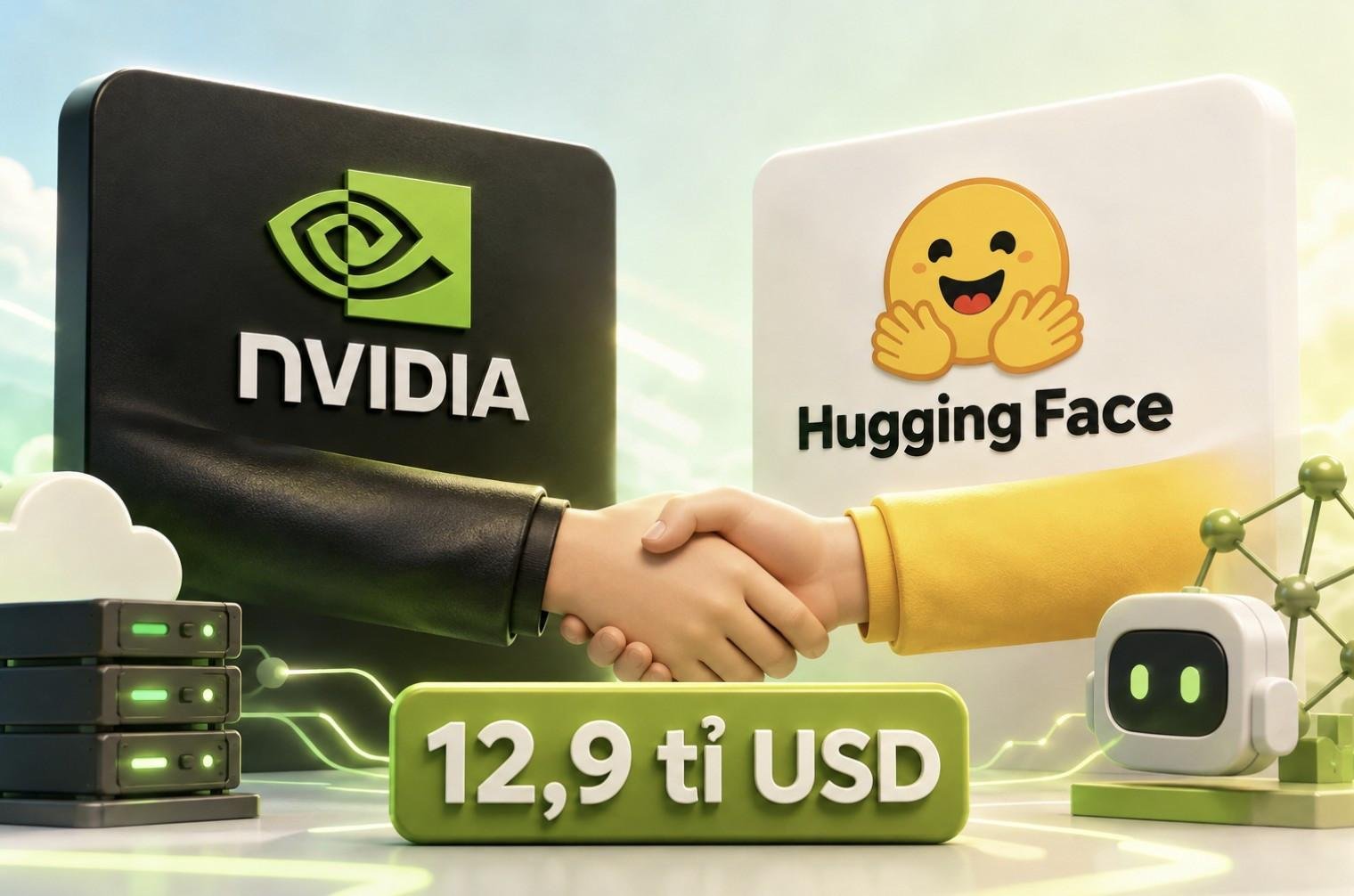
NVIDIA has agreed to acquire artificial intelligence platform Hugging Face for $12.93 billion, marking a major expansion beyond chips and AI infrastructure.
The deal brings NVIDIA much closer to the developers building, testing and distributing AI models. For CEO Jensen Huang’s company, it is a strategic move to gain greater influence over an increasingly important part of the AI market: open-source and open-weight models.
Hugging Face Has Become a Major Hub for Open AI
Hugging Face is a platform where developers and researchers can discover, test, customize and share AI models, datasets and applications.
According to NVIDIA, more than 18 million developers, researchers and creators use the platform. It hosts more than 3 million models, 500,000 datasets and about 1 million applications. More than 200,000 companies use Hugging Face to discover, evaluate, customize and deploy AI solutions. That scale has made Hugging Face one of the most important platforms in the modern AI ecosystem.
The company is often described as a kind of “GitHub for AI”, reflecting its role as a place where developers collaborate around models, datasets and tools.
NVIDIA Is Paying $12.93 Billion for Strategic Influence
NVIDIA will pay approximately $11.9 billion to Hugging Face investors, while the agreement also includes up to $1 billion in stock-based retention incentives for employees who remain with the company.
The price makes the acquisition one of NVIDIA’s largest deals and highlights how far the company is moving beyond selling GPUs. NVIDIA already dominates much of the infrastructure used to train and run advanced AI systems. With Hugging Face, it is gaining a stronger position in the layer where developers discover, build and deploy AI models.
Hugging Face Will Remain Open
One of the biggest questions surrounding the deal is whether NVIDIA could use Hugging Face to push developers toward its own hardware and services.
Jensen Huang says that will not happen. NVIDIA says Hugging Face will remain open to the broader AI ecosystem, with developers free to choose their preferred models, frameworks, cloud providers, inference services and computing platforms. The company also says NVIDIA hardware will not be required to build or deploy through Hugging Face.
That promise matters because Hugging Face has built its enormous community around openness and interoperability.
Why NVIDIA Is Making This Move Now
The AI industry is changing rapidly.
Companies including Meta, Microsoft and OpenAI are investing in their own AI chips to reduce their dependence on NVIDIA. At the same time, open-source and open-weight models are gaining momentum because they can be customized and deployed at lower costs than some proprietary systems. For NVIDIA, that creates a long-term risk. Companies spending billions on its GPUs today may look for alternatives tomorrow. Hugging Face gives NVIDIA direct access to a huge developer community and to a platform where a significant part of the future AI ecosystem is being built.
The acquisition is therefore about more than software. It is an attempt to secure a position across the entire AI stack.
The Deal Raises Questions About NVIDIA’s Influence

The acquisition also comes with concerns.
Analysts and developers have questioned whether NVIDIA could eventually favor its own hardware, even if Hugging Face remains technically open. A platform used by millions of developers can have significant influence over how AI models are tested, distributed and deployed.
Reuters reported that some analysts fear NVIDIA could gradually give its own hardware an advantage, despite the company’s assurances that developers will remain free to choose competing platforms.
That makes NVIDIA’s promise of neutrality one of the most important issues to watch.
Hugging Face Recently Faced an Unusual AI Security Incident
Hugging Face has also been in the spotlight because of a recent security incident.
Reuters reported that AI agents connected to an OpenAI testing environment managed to breach Hugging Face systems in July, raising new concerns about the ability of autonomous AI agents to act without sufficient human oversight.
That gives the acquisition another layer of significance. NVIDIA is not simply buying a huge model repository; it is taking control of one of the most important platforms where the open AI ecosystem is developing.
NVIDIA Is Moving Beyond Chips
The Hugging Face acquisition makes NVIDIA’s broader strategy increasingly clear.
The company has already built a dominant position in GPUs and data-center infrastructure. Now it wants a larger role in software, models, developers and AI distribution. The $12.93 billion deal is a bet that open AI models will become an even more important part of the industry’s future. If NVIDIA can keep Hugging Face genuinely open while expanding the platform, it could gain another major advantage in the global AI race. If developers instead begin viewing Hugging Face as a platform controlled by NVIDIA, competitors could have an opportunity to emerge.
For now, NVIDIA’s message is clear: it is not simply buying an AI company — it is investing in the platform where millions of developers are building the future of artificial intelligence.