
The European Union is preparing a sweeping new framework that could restrict children under 15 from using social networks, video-sharing services, AI chatbots and online games. The proposal would introduce different levels of access by age and put greater responsibility on technology companies to verify users and reduce harmful or addictive design. It is not yet law and still has to go through the EU legislative process.
Europe wants a new digital age limit
Brussels is moving toward a far more interventionist approach to children’s online lives.
A European Commission proposal reported by Reuters would create a common framework for limiting access to several categories of digital services for people under the age of 15.
The scope is unusually broad. It would cover social networks, video platforms, online games and AI chatbots, potentially affecting services such as Instagram, TikTok, YouTube and ChatGPT.
Rather than relying entirely on individual countries to establish their own thresholds, the initiative would attempt to create a more consistent European standard.
Access would depend on the child’s age
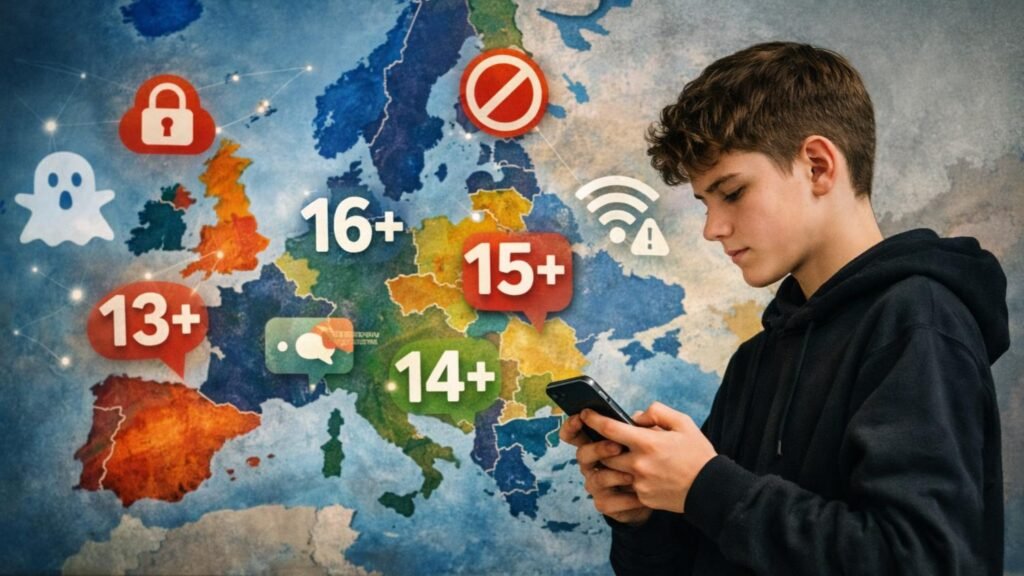
The proposed system is not designed as a simple blanket ban.
Children below three would face the strictest restrictions. Those between three and 12 would be directed toward child-oriented services and stronger parental supervision.
For 13- and 14-year-olds, the proposal envisages more limited accounts under tighter parental controls. More independent access would begin at 15.
The result would be a graduated digital environment in which the services available to a child increasingly expand with age.
Age verification becomes the critical technology
The biggest practical challenge may not be the age limit itself, but proving that users actually meet it.
The European Commission has already been developing an age-verification framework based on privacy-preserving proof-of-age technology. Its stated goal is to allow services to establish whether someone meets an age threshold without unnecessarily exposing their identity information.
That could eventually mean a platform receiving a signal that a person is over 15, rather than receiving a complete identity document.
Whether that can be implemented at European scale without creating new privacy risks will become one of the central arguments around the legislation.
AI is now part of the child-safety debate
The inclusion of AI chatbots is perhaps the most forward-looking part of the proposal.
Children are increasingly interacting with conversational systems rather than simply consuming posts or videos. Those interactions can be longer, personalized and sometimes emotionally framed.
European AI policy already recognizes concerns around systems that could exploit young users’ vulnerabilities or encourage unhealthy emotional attachment.
That gives the proposed chatbot restrictions a broader context: Brussels is no longer treating AI as a separate issue from children’s online safety.
Tech companies would face additional obligations
The proposal would also increase pressure on platforms themselves.
According to Reuters, companies could be required to verify ages, provide stronger parental controls, introduce reporting mechanisms and avoid design choices that encourage addictive use. Platforms would also face supervisory fees under the proposed framework.
This follows an existing European regulatory direction.
Under the Digital Services Act, major online services already have obligations to assess and mitigate systemic risks, including risks affecting minors and users’ physical and mental well-being.
TikTok and Meta are already under scrutiny
The Commission’s latest initiative comes after a series of investigations involving major platforms.
In July, the Commission issued preliminary findings that TikTok was failing to provide adequate protection for minors, including concerns around public accounts and the recommendation of minors’ content.
Earlier in the year, regulators also raised concerns about Meta’s Instagram and Facebook, saying existing measures were not sufficiently effective at preventing children under 13 from accessing the services.
The new proposal therefore represents an escalation of an enforcement trend that is already underway.
The EU is targeting platform design, not just content

Another important element is the focus on how services are designed.
European guidance already recommends reducing features that can encourage excessive use, including autoplay, push notifications, streaks and other engagement-driven mechanisms. It also calls for stronger safeguards around AI chatbots integrated into online platforms.
If the new legislation moves forward, these principles could become part of a much broader regulatory framework.
That would shift the debate from simply asking whether content is appropriate for children to asking whether the entire product experience is appropriate for them.
The proposal still has a long way to go
For now, there is no EU-wide ban taking effect.
The reported framework still has to be formally presented and then negotiated with EU member states and the European Parliament. Its details could therefore change substantially before any final legislation is adopted.
The timing of enforcement would also depend on the final legal text and implementation rules.
Still, the direction is becoming increasingly clear.
Europe wants technology companies to take greater responsibility for determining who is using their services, how those services affect younger users and which design choices are allowed to keep children engaged.
The next major battle may therefore not be over whether children can access the internet at all, but what kind of internet they are allowed to enter — and how technology companies prove that the rules are being followed.