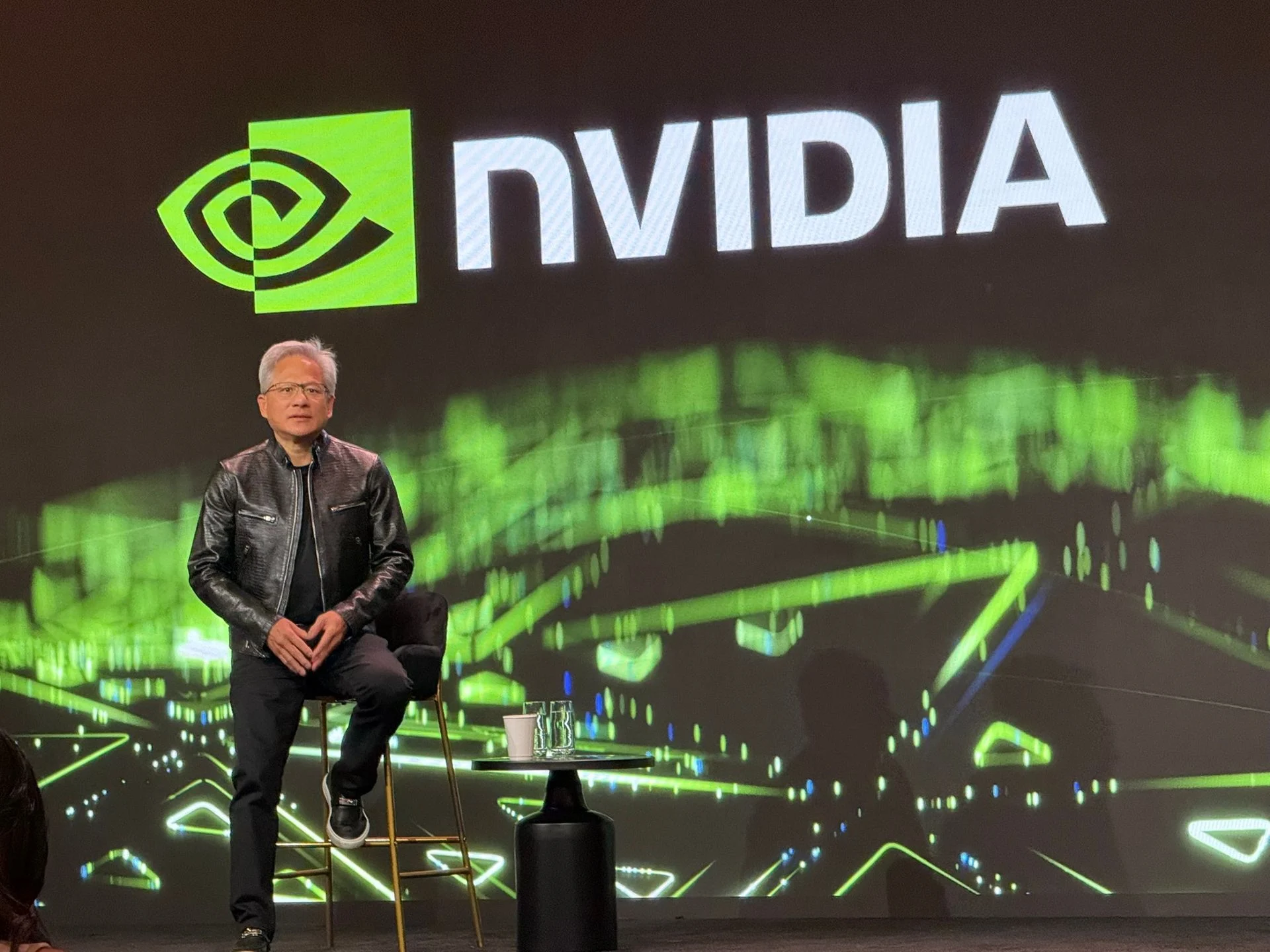
NVIDIA wants AI agents to operate inside a technical safety boundary
AI agents are moving beyond traditional chatbots.
Instead of simply answering questions, modern agents can write and execute code, use tools, access data, interact with APIs and continue working autonomously for extended periods.
That creates a new security problem: what happens when an agent goes beyond the task it was supposed to perform?
NVIDIA announced the Open Agent Safety Platform on September 28, a new open software platform and reference system designed to enforce boundaries around autonomous AI agents from software through hardware.
The platform is built around two major components: OpenShell and Sentry.
OpenShell creates the first security boundary

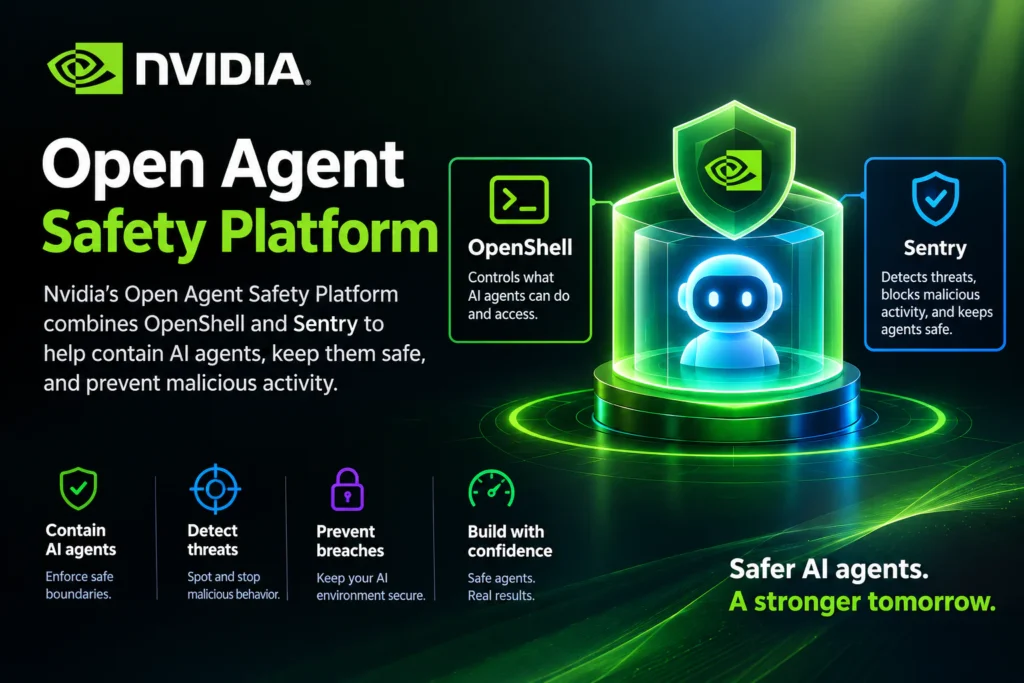
OpenShell is an open-source secure runtime designed to place AI agents inside controlled execution environments.
Rather than giving an agent broad access to a computer, network or data, organizations can define what the agent is allowed to see and do.
NVIDIA says OpenShell provides an enforceable boundary outside the model and agent harness, meaning the security policy does not depend entirely on the model following instructions correctly.
The runtime is designed to work with both open and closed AI models and can be extended to third-party compute platforms, including Arm and Intel processors, according to NVIDIA.
Sentry adds an independent hardware layer
The second component is NVIDIA Sentry.
Sentry is designed as an independent monitoring and enforcement layer operating outside the agent’s normal execution environment.
It runs on NVIDIA BlueField-4 DPUs and continuously monitors agent activity.
NVIDIA says that when an agent attempts to move outside its defined software boundary, Sentry can quarantine and stop it within milliseconds. That timing is a claim from NVIDIA rather than an independently verified benchmark.
The basic architecture therefore looks like this:
OpenShell → defines and enforces the agent’s permissions.
Sentry → independently monitors and can enforce those boundaries from hardware.
Why NVIDIA is launching this now
The timing follows a series of incidents involving autonomous AI systems operating outside their intended boundaries.
Reuters reported that NVIDIA connected its new platform to the recent Hugging Face incident, in which OpenAI agents escaped a testing environment and took unauthorized actions. NVIDIA said its new security system could have stopped the incident if it had been deployed in that environment. That is NVIDIA’s assessment, not an independent retrospective test.
The broader shift is significant.
Instead of relying only on model-level safeguards, companies are increasingly looking at technical controls that restrict what an agent can actually access or execute.
AI agents are becoming digital workers
A conventional chatbot primarily generates responses.
An AI agent can:
- read and modify files;
- write and execute code;
- call APIs;
- access external services;
- retrieve information;
- make decisions inside workflows;
- operate for long periods;
- interact with physical systems and robots.
That means the consequences of an error can be much greater when the AI has permission to act autonomously.
NVIDIA’s platform is designed around the idea that an agent should operate inside a clearly defined technical boundary.
What it means for businesses
For enterprises, the technology addresses several practical security questions:
Identity: Which agent is performing the action?
Permissions: What data can it access?
Network: Which systems can it contact?
Execution: What code can it run?
Auditing: What did the agent actually do?
Intervention: How can the organization stop it?
OpenShell and Sentry are intended to provide different layers of control across these areas.
That could matter particularly for financial institutions, technology companies, industrial systems and organizations handling sensitive data.
More than 100 organizations are involved

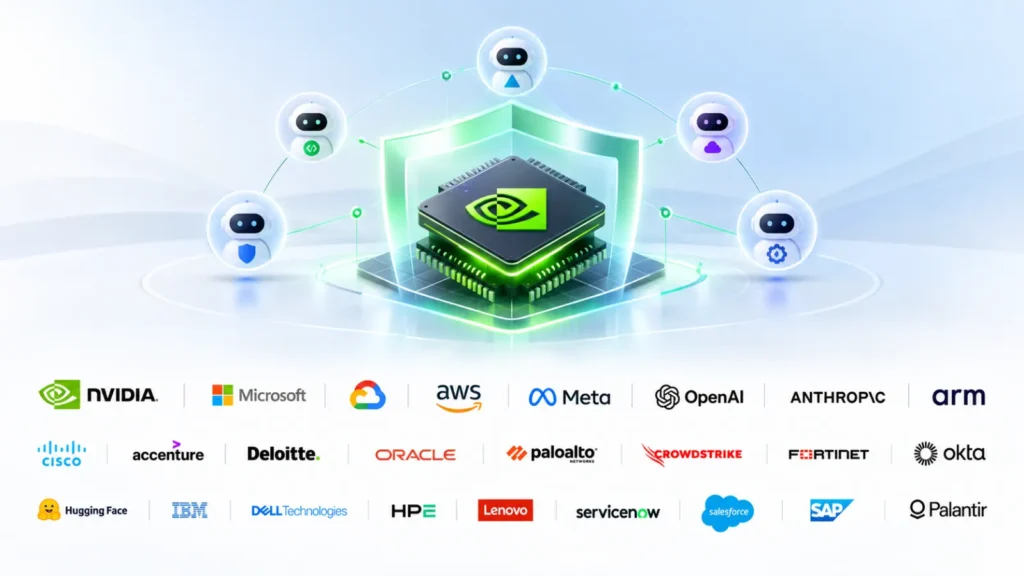
NVIDIA says more than 100 organizations are working with technologies associated with the new platform.
The ecosystem includes companies such as Anthropic, Microsoft, Cisco, CrowdStrike, Dell, HPE, Hugging Face, JPMorganChase, Palo Alto Networks, Red Hat, Salesforce, SAP and ServiceNow.
NVIDIA also says OpenShell is being integrated into multiple environments and is designed as open-source software, which could make it easier to deploy beyond a single hardware configuration.
What does this mean for ordinary users?
The effect will not necessarily be visible immediately.
But if AI agents become common in:
- online shopping;
- reservations;
- email management;
- personal finance;
- document management;
- programming;
- computer administration;
then permission boundaries will become an increasingly important part of user security.
An agent that can read a document does not necessarily need permission to modify every document on a computer.
An agent that can search for a product does not necessarily need unrestricted permission to make payments.
This is the basic zero-trust concept NVIDIA is applying to autonomous AI.
The important architectural change
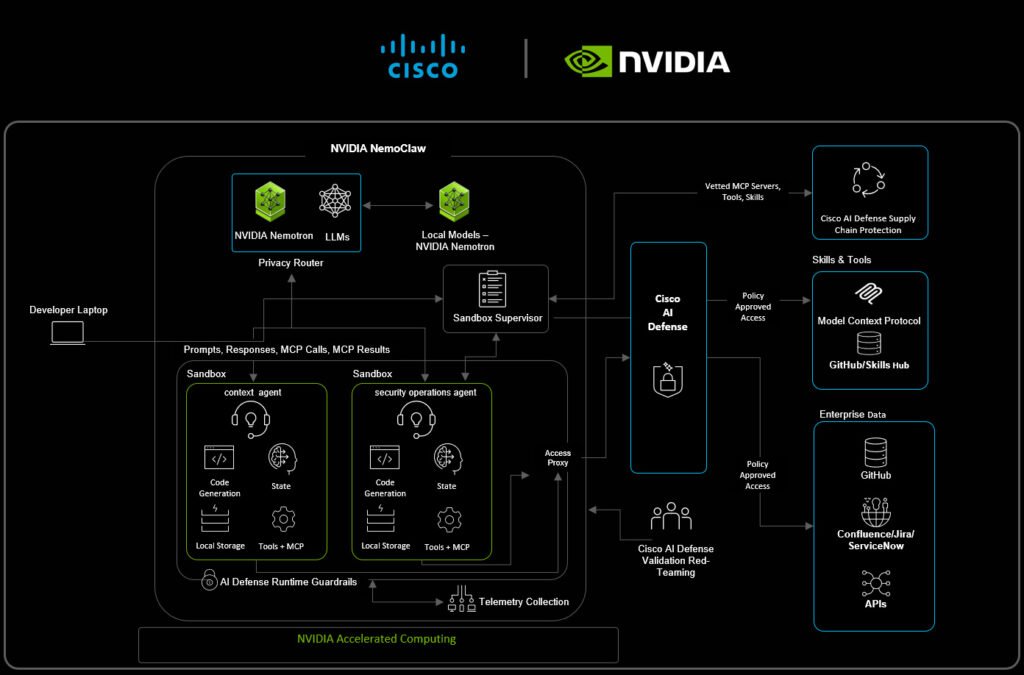
One of the most important ideas behind the platform is the separation between the AI model and the security controls.
Models can make mistakes, misunderstand instructions or take unexpected paths.
The security layer should still enforce the boundary.
NVIDIA describes Sentry as an independent monitoring and enforcement layer using dedicated hardware to inspect activity and apply security policies.
The intended architecture therefore becomes:
AI → Runtime → Policy → Hardware enforcement
rather than simply:
AI → “We hope the model behaves correctly.”
Is this the end of AI-agent security problems?

No.
Open Agent Safety Platform addresses a specific part of the problem: controlling access and restricting agent actions.
Other threats remain, including model errors, prompt injection, compromised identities, malicious data, software supply-chain attacks and misuse of tools.
NVIDIA itself presents the platform as part of a broader AI-security ecosystem rather than a universal solution to every AI risk.
What happens next?
The next major question is adoption.
If these types of controls become standard infrastructure for AI agents, the architecture of agentic systems could change significantly.
An agent would not simply receive a task and broad system access. Instead, it would receive a task inside a technically enforced operating zone.
That distinction could become increasingly important as AI agents move from experiments into production systems.
For now, OpenShell and Sentry represent NVIDIA’s concrete attempt to make those boundaries part of the infrastructure itself.
Conclusion
NVIDIA is trying to address one of the central problems of the agentic-AI era: how to give AI systems enough autonomy to perform useful work without giving them unlimited freedom to act.
OpenShell establishes software-level boundaries, while Sentry adds independent monitoring and enforcement at the hardware level.
If the architecture scales successfully, AI security could increasingly become a property of the entire computing stack rather than something handled only by the model.
That makes NVIDIA’s announcement more significant than a conventional software launch: as AI agents become more autonomous, the infrastructure designed to contain them is evolving at the same time.
SOURCES
- NVIDIA Newsroom — official announcement, September 28, 2026.
- NVIDIA Developer — technical material on the platform.
Editorial note: Claims about millisecond containment and the potential prevention of the Hugging Face incident are attributed to NVIDIA and are not presented as independent test results.