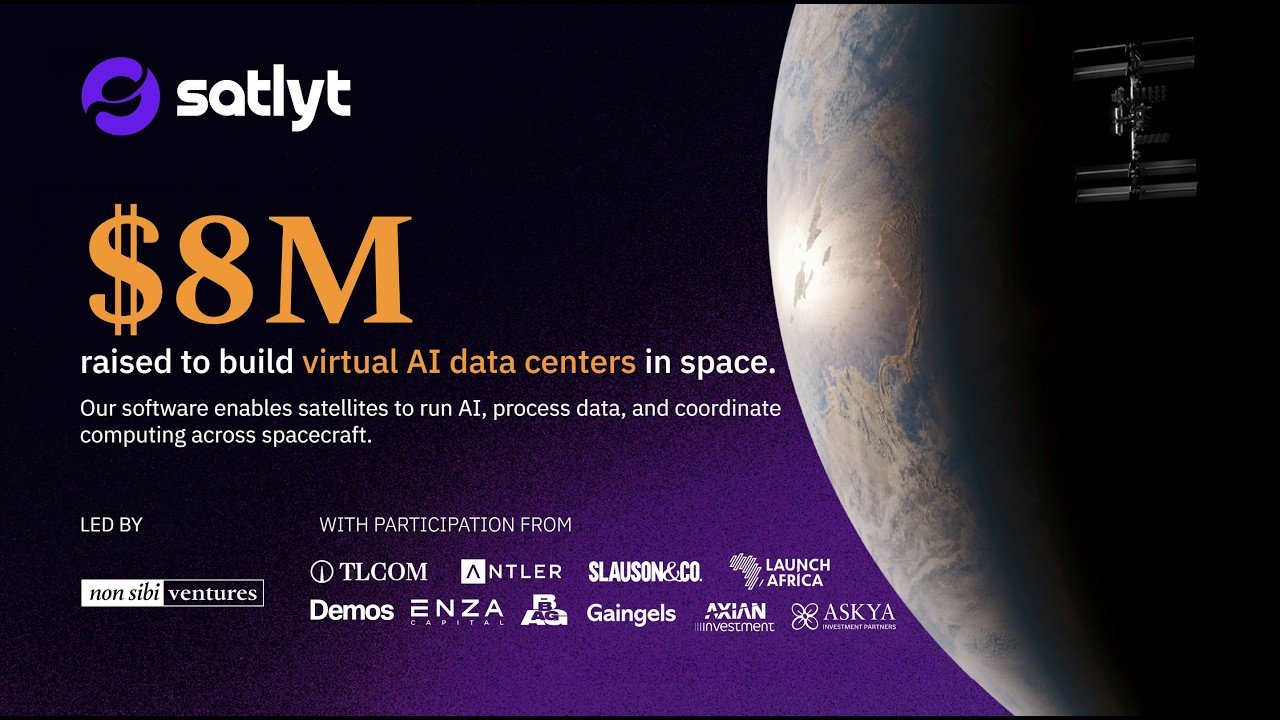
A startup founded by a former Google and SpaceX professional is developing software that could let satellites process information in orbit, reducing the need to send every piece of data back to Earth.
Satellites do much more than take pictures of Earth or relay communications. As spacecraft collect increasing amounts of information, the next challenge is processing that data quickly and efficiently — and a growing number of technology companies are exploring whether some of that computing can happen directly in space.
Satlyt, a startup with operations in Sunnyvale, California, and Nairobi, Kenya, is developing software designed to run artificial intelligence models on satellites and coordinate computing tasks across spacecraft. The company has raised $8 million in seed funding, according to reporting by TechCrunch published on October 13.
Rather than building its own fleet of satellites, Satlyt wants to supply the software layer that allows different spacecraft and operators to run computing workloads on compatible orbital hardware.
Why run AI on a satellite?
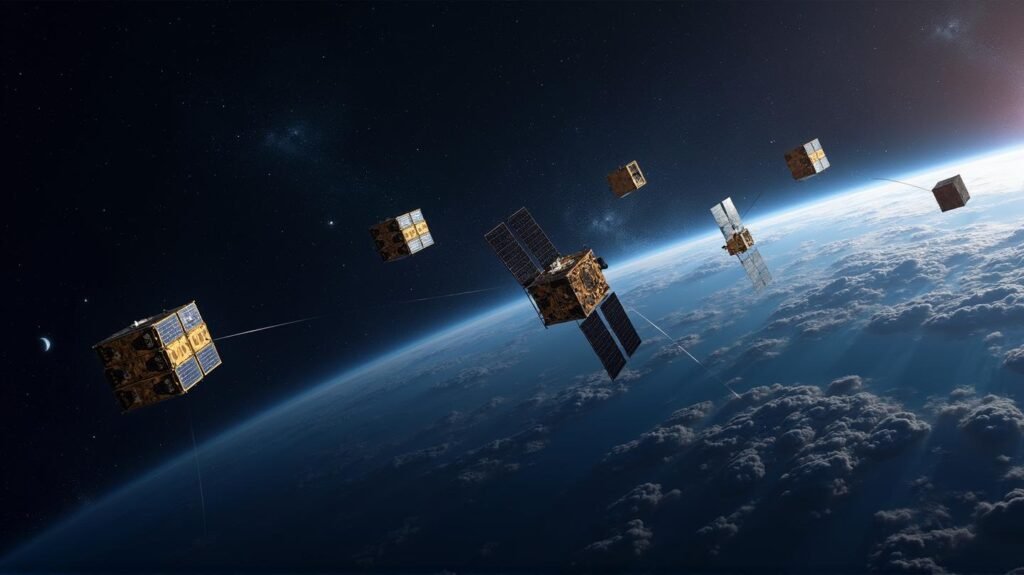
Today, satellites often send observations, sensor readings and diagnostic information to ground stations for processing. That process can consume communications capacity, introduce delays and create operational costs.
Running selected workloads in orbit could help spacecraft analyze information before transmitting it. A satellite monitoring the Earth’s surface, for example, might identify relevant changes in an image and send only the most useful information to the ground.
According to TechCrunch, Satlyt has already tested its software on demonstration missions. The company also deployed Google’s Gemma AI model aboard a spacecraft operated by Momentus. Satlyt says the model reduced the size of a transmission related to onboard software errors by more than 60%.
That figure is a company-reported result, not a guarantee that all satellite workloads will achieve similar savings. Performance will depend on the task, onboard computing resources, communications conditions and the reliability of the software.
From isolated spacecraft to a shared computing network
Satlyt’s longer-term ambition is to help multiple satellites share computing workloads, moving beyond the traditional model in which each spacecraft operates largely as an independent system.
The startup is pursuing a software-first strategy. That distinction matters because launching spacecraft requires substantial capital, specialized engineering and access to launch services. A platform that works across compatible satellites could potentially expand without requiring its developer to manufacture every piece of hardware.
TechCrunch reported that the company’s software was scheduled to fly on a SpaceX rocket alongside a prototype connected to Google’s Project Suncatcher initiative. The mission was intended to test computing capabilities aboard a spacecraft built by Indian startup TakeMe2Space.
The reported mission involved several participants with different objectives: NASA was paying for tests of space-based cloud-computing protocols, while space-surveillance startup Stellerian planned to test image-processing workloads. TakeMe2Space was also seeking to demonstrate that its satellite could host software from other organizations.
The planned flight is an important technical step, but it should not be confused with a fully operational commercial cloud spanning many satellites.
What the funding means

The $8 million seed round was led by Non Sibi Ventures, with participation from additional investors, according to TechCrunch and the company’s own announcements.
The capital is intended to help Satlyt expand its team and software deployments. The company’s business model depends on persuading satellite operators and spacecraft developers that onboard computing can deliver measurable benefits without adding unacceptable complexity or risk.
The opportunity is broader than artificial intelligence alone. Spacecraft could potentially use onboard processing for equipment diagnostics, image analysis, anomaly detection and other tasks where transmitting every raw data point is inefficient.
However, orbital computing faces constraints that terrestrial data centers do not. Satellites have limited power, thermal-management capacity and hardware resources. Communications between spacecraft can be intermittent, and software updates or troubleshooting may be more difficult than on Earth.
What happens next?
A major milestone for Satlyt will be demonstrating that its software can coordinate computing across two separate satellites, a capability the company has said it hopes to pursue next year.
If successful, that would provide evidence for a more distributed model of orbital computing. It would not, by itself, prove that large-scale space-based data centers are economically viable.
For now, the most practical opportunities may involve targeted processing tasks rather than moving conventional data-center workloads into orbit. The technology will need to demonstrate reliability, cost savings and compatibility across different spacecraft before widespread adoption becomes realistic.
Key takeaways
- Funding: Satlyt raised $8 million in seed financing.
- Technology: Its software is designed to run AI models and coordinate computing on satellites.
- Potential benefit: Processing selected data in orbit could reduce communications requirements and delays.
- Next milestone: Demonstrating computing coordination across multiple satellites.
- Important caveat: The broader orbital-cloud vision remains under development; commercial scale and economics are not yet established.
TheTechSpot Take
The most interesting part of orbital computing may not be the idea of launching giant data centers into space. It may be the ability to make existing satellites more useful through software.
If companies can process more information where it is collected, they could reduce unnecessary transmissions and respond more quickly to events on Earth. But the business case will depend on real-world performance, energy limits, reliability and the cost of operating hardware in orbit.
For Satlyt, the next challenge is turning promising demonstrations into a dependable platform that satellite operators can use at scale.