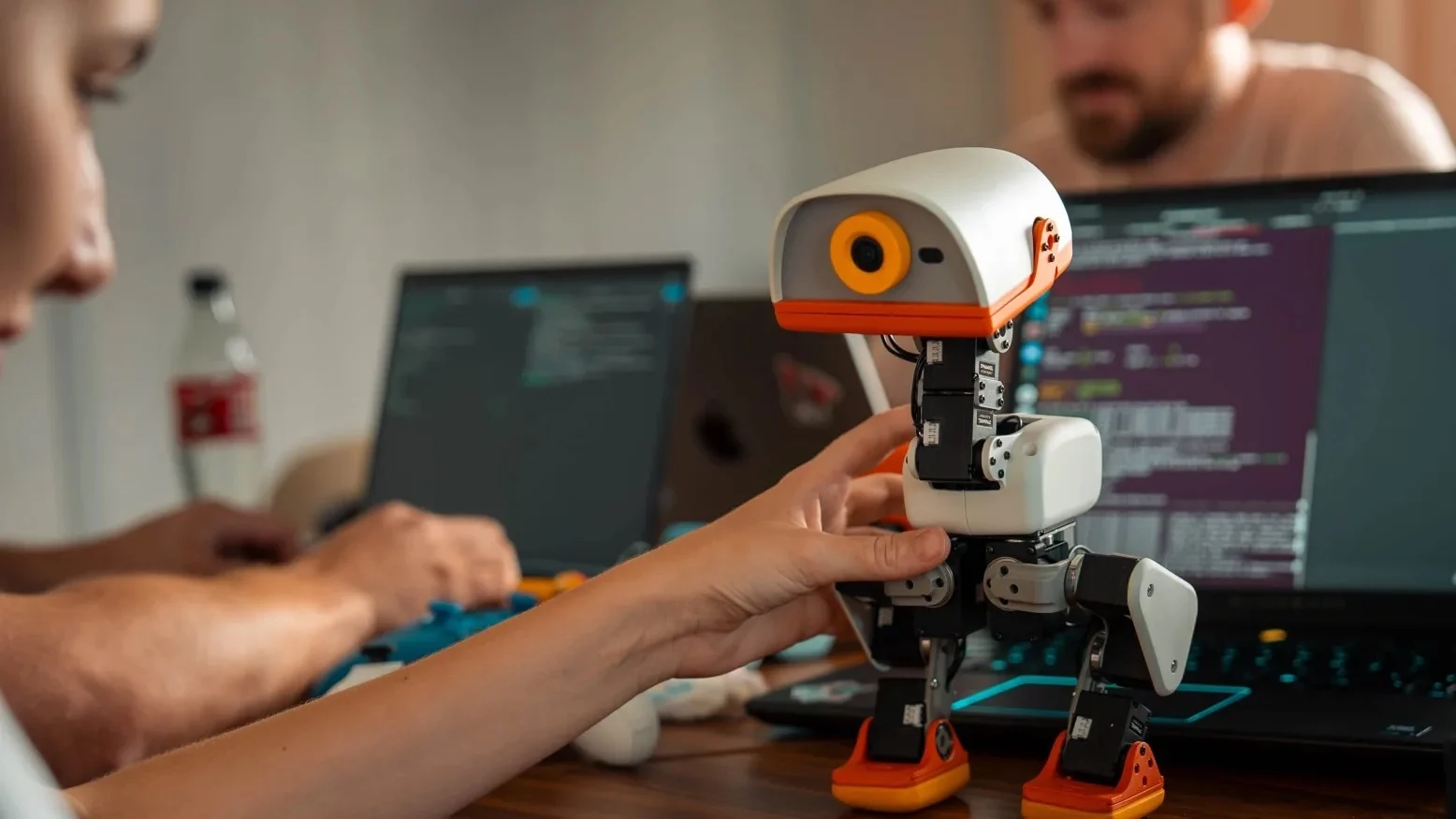
Hugging Face is taking physical AI in a surprisingly affordable direction.
The company has unveiled Microduck, a small duck-shaped robot priced at $399 and designed to give developers, researchers and robotics enthusiasts an accessible platform for experimenting with artificial intelligence in the physical world.
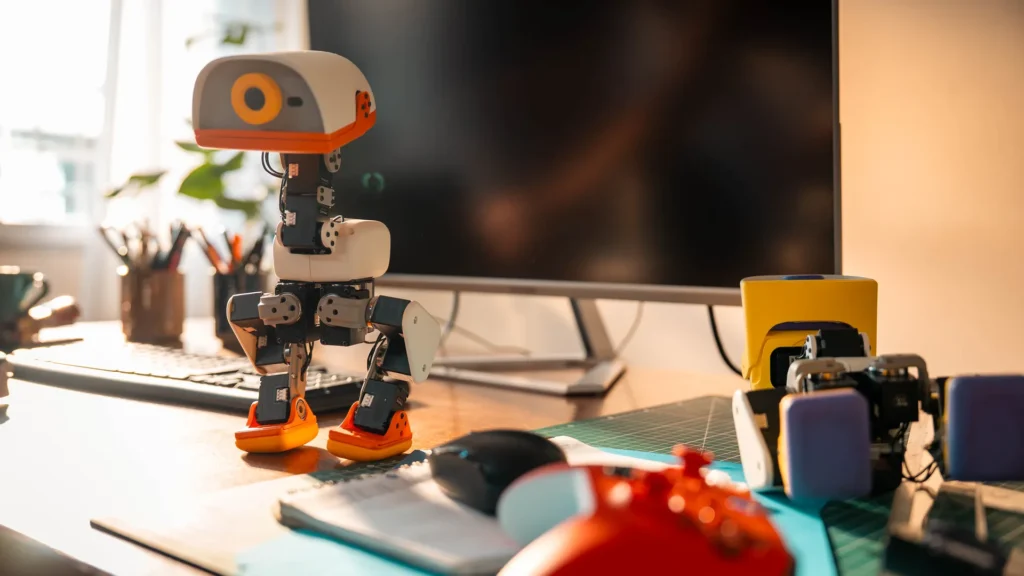
Standing just 25 centimeters tall, Microduck may look more like a playful gadget than a serious robotics platform.
But the little robot can already do far more than simply move around.
It can waddle, crouch, pick up objects with its beak, recover after falling and even roller-skate. More importantly, Hugging Face describes Microduck as an open-source robot that can be taught new behaviors through reinforcement learning.
That combination of low cost, open software and physical AI could make Microduck one of the more interesting robotics products of 2026.
A Robot Built for Physical AI
Microduck was developed by Hugging Face together with Pollen Robotics, the French robotics company acquired by Hugging Face in 2025.
The goal is not to compete directly with large industrial robots or expensive humanoid machines.
Instead, Microduck is designed as an accessible platform for experimentation.
That distinction matters.
Robotics research has traditionally required expensive hardware, specialized laboratories and significant engineering resources.
Microduck aims to lower that barrier.
A developer can purchase a robot for $399 and begin experimenting with reinforcement learning, simulation and physical behavior.
That could open robotics research to a much wider community.
The $399 Price Is the Big Story
The most important number in the announcement may not be the robot’s height or number of sensors.
It is the price.
$399.
That is dramatically cheaper than many advanced robotics platforms.
The price makes it realistic for universities, independent developers, students and robotics communities to purchase multiple units.
Instead of one expensive robot being shared between dozens of researchers, a laboratory could potentially have several robots running experiments simultaneously.
That could accelerate experimentation.
It could also create a larger community of developers building software and behaviors for the platform.
Microduck Uses Cameras, LiDAR and Motion Sensors
Despite its small size, Microduck includes a surprisingly sophisticated collection of sensors.
The robot uses a camera, LiDAR sensors and two inertial measurement units, or IMUs, to perceive its surroundings and understand its own movement.
These sensors allow the robot to do more than follow a predetermined sequence of movements.
They provide information that can be used by AI systems to understand what is happening around the robot.
That becomes particularly important when reinforcement learning is involved.
The AI needs feedback.
It needs to know whether a movement worked.
It needs to understand when the robot falls.
And it needs to determine whether a new behavior actually improves performance.
Microduck is designed to provide that physical environment for experimentation.
Reinforcement Learning Is at the Center
One of the most interesting aspects of Microduck is the ability to train behaviors in simulation and then deploy them on the physical robot.
Pollen Robotics says the platform allows developers to train behaviors, fine-tune them and redeploy the resulting models. The SDK, simulation environment and reinforcement-learning stack are available as open-source resources.
This approach can dramatically reduce the cost of experimentation.
Training directly on a physical robot can be slow.
A robot can fall.
Motors can wear out.
Hardware can break.
Experiments can require constant supervision.
Simulation provides a safer and faster environment for testing thousands of variations.
Once a behavior works well in simulation, developers can transfer it to the physical robot and evaluate how it performs in the real world.
Why Simulation Matters for Robotics
The gap between simulation and reality is one of the biggest challenges in modern robotics.
A simulated environment is predictable.
The real world is not.
A robot that walks perfectly in a virtual environment may behave differently when confronted with uneven floors, unexpected objects, changing lighting or small differences in friction.
That is why physical testing remains essential.
Microduck provides a relatively inexpensive way to close that gap.
Developers can use simulation for large-scale experimentation and then use the robot to validate the results.
That combination is increasingly important as AI models become capable of learning complex physical behaviors.
Open Source Could Change the Equation
The open-source philosophy may be even more important than the hardware itself.
Hugging Face has built much of its reputation around open AI models and developer communities.
Microduck extends that philosophy into robotics.
Instead of creating a closed robot with proprietary software, Hugging Face and Pollen Robotics are making the development stack available to the community.
Developers can inspect the software, modify it, create new behaviors and experiment with different AI models.
That could create a robotics ecosystem similar to what happened with open-source software and AI models.
A developer who discovers a better walking policy could potentially share it.
Another developer could modify it.
A university could use it for research.
A student could learn from it.
And the entire community could benefit from the results.
Microduck Could Become a Physical AI Playground
This is where the product becomes particularly interesting.
Microduck is not necessarily intended to be a household robot that cleans your home or carries heavy objects.
It is closer to a physical AI playground.
Developers can experiment with how AI perceives the world, learns behaviors and interacts with hardware.
That makes it potentially useful for research into:
- Reinforcement learning
- World models
- Robot control
- Computer vision
- Sim-to-real training
- Autonomous behavior
- Multimodal AI
- Physical AI
The low price could make these experiments accessible to far more people.
The Robot Can Learn New Behaviors
The phrase “teach it new tricks” is more than marketing.
Because Microduck supports reinforcement-learning workflows, developers can create new behaviors and train the robot to perform them.
The robot already comes with several behaviors, including walking, recovering after falling and skating.
But the real potential is what developers build next.
Imagine a community sharing thousands of learned behaviors.
One developer could teach Microduck to navigate a particular environment.
Another could teach it object manipulation.
Someone else could develop a new balancing system.
Over time, the robot could become much more capable than the hardware alone suggests.
That is one of the major advantages of an open platform.
Privacy Still Matters
There is also a less comfortable side to consumer robotics.
Microduck includes cameras and sensors, which means the robot can potentially collect information about its surroundings.
Hugging Face has argued that open-source systems can offer stronger transparency and user control than closed “black box” platforms.
That can certainly be an advantage.
But open source does not automatically guarantee privacy.
Third-party applications installed on the robot could potentially access cameras or microphones and send information to external services, depending on how those applications are designed.
That means users will still need to understand exactly what software is running on the robot and where its data is going.
As robots become more common inside homes, privacy could become one of the industry’s biggest challenges.
Microduck Arrives at the Right Time
The launch comes as Physical AI is becoming one of the most important areas of technology.
AI companies are increasingly moving beyond models that only generate text and images.
They are building systems that can interact with machines, control robots and understand physical environments.
Anthropic has recently demonstrated AI agents interacting with scientific equipment.
Robotics companies are building increasingly capable humanoid machines.
NVIDIA is investing heavily in the infrastructure required for Physical AI.
And Hugging Face is taking a different approach:
Make the hardware affordable and the software open.
That could be a powerful combination.
Hugging Face Wants to Democratize Robotics
The company’s broader vision is clear.
Clem Delangue, Hugging Face’s CEO, described Microduck as part of an effort to democratize physical AI and world models.
That is an ambitious goal.
If successful, robotics development could begin to look more like software development.
Instead of a small number of companies controlling the technology, thousands of developers could experiment with physical AI.
That could produce unexpected applications.
Some could be serious research projects.
Others could be educational tools.
And some could simply be fun.
But all of them could contribute to the development of better physical AI systems.
The important question is what happens when thousands of people can afford to experiment with AI-powered physical machines.
OLSI FEÇI
Microduck Is Small — But the Idea Is Big
The Microduck itself is not going to replace a factory worker.
It is not going to clean your house.
And it is not competing with advanced humanoid robots on raw capability.
That is not really the point.
A $399 robot can become a research tool.
It can become an educational platform.
It can become a developer kit.
And it can become a physical interface for testing the next generation of AI models.
That makes Microduck more than a cute gadget.
It is a bet on the idea that the future of AI will be physical.
🔥 Why It Matters
Microduck may look like a small, playful robot, but its significance goes far beyond its appearance.
The AI industry is moving from systems that generate information toward systems that perceive and act in the physical world.
Until recently, experimenting with that technology required expensive hardware and specialized laboratories.
Microduck challenges that model.
At $399, an individual developer can potentially own a physical AI platform.
An academic lab can buy several.
A student can learn reinforcement learning using a real robot.
And an open-source community can collectively improve the software.
That could accelerate the development of Physical AI in a way that closed, expensive robotics platforms cannot.
The biggest opportunity is not that Microduck will become the world’s most capable robot.
It is that it could become one of the easiest robots in the world to experiment with.
And if thousands of developers begin teaching small machines how to perceive, learn and act, the next generation of robotics may emerge from communities rather than only from the world’s biggest technology companies.
Microduck is small. The movement behind it is not.