Artificial intelligence is beginning to move beyond screens.
Anthropic has introduced a new framework that could help AI agents interact directly with physical machines, allowing systems such as Claude to operate laboratory equipment, robotic arms, microscopes and advanced manufacturing hardware.
On August 27, 2026, Anthropic announced a research preview of the Model Hardware Standard (MHS), a shared specification designed to give AI agents a standardized way to communicate with and safely operate physical devices.
The move represents an important shift in the AI industry.
For years, generative AI has primarily existed in the digital world. AI systems could write software, analyze documents, generate images, answer questions and manipulate information.
MHS is designed to take that capability one step further.
Instead of simply telling a human how to operate a machine, an AI agent could potentially operate the machine itself.
From Chatbots to Physical AI
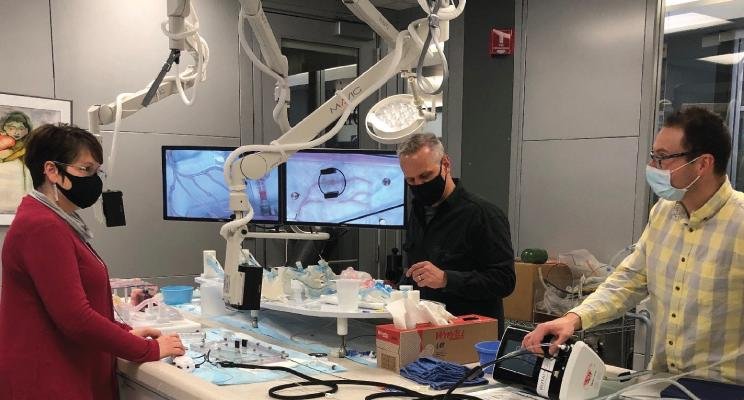
The concept behind Anthropic’s new framework is part of a broader industry movement toward what is increasingly being called physical AI.
Physical AI refers to intelligent systems that can perceive, reason about and interact with the physical world.
Robotics is one obvious example, but the concept extends much further.
A physical AI system could control laboratory equipment, manufacturing machines, scientific instruments or even complex industrial infrastructure.
Anthropic’s Model Hardware Standard is designed to provide a common layer between AI agents and these devices.
That could solve one of the biggest problems facing automated laboratories and factories: hardware fragmentation.
Why Hardware Integration Is So Difficult
Modern laboratories can contain dozens of different instruments from different manufacturers.
A microscope may have one software interface.
A robotic arm may have another.
A liquid handler may use a completely different system.
Cameras, sensors, lasers and analytical equipment can all operate independently.
Getting these machines to communicate can require weeks or months of custom engineering.
Anthropic says MHS is designed to reduce that integration work dramatically, potentially bringing it down to hours or minutes in some cases.
The system introduces a standardized driver that translates between computer software and physical hardware.
Devices can expose information about their capabilities, controls and safety limits in a standardized format.
This gives an AI agent a structured understanding of what a machine can do and how it should be operated.
Claude Can Coordinate Multiple Machines
The most interesting part of MHS is that it is not designed around controlling only one device.
An AI agent can potentially orchestrate multiple machines at the same time.
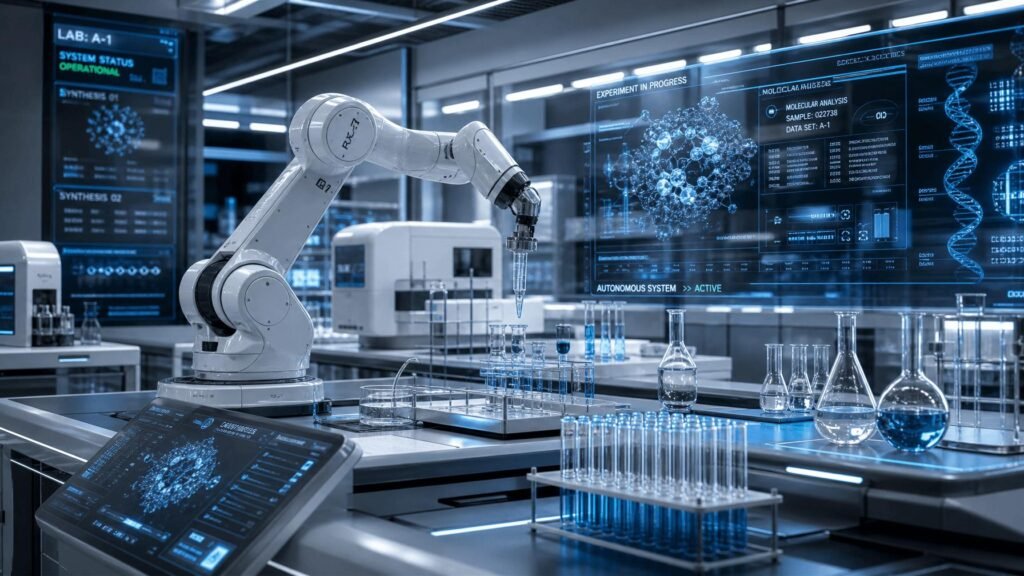
Imagine a scientific experiment involving a robotic arm, a microscope, a liquid handler and a camera.
Traditionally, researchers would need to program and coordinate those systems individually.
With MHS, the devices can be exposed through a common interface.
The AI agent can then coordinate the workflow, receive information from the machines, adjust parameters and react to new results.
That creates the possibility of closed-loop scientific experimentation.
Instead of a human running one experiment, checking the results and manually setting up the next one, an AI agent could potentially perform the cycle continuously.
AI Could Run Experiments Around the Clock
Anthropic says its long-term goal is to help create autonomous scientific workflows where researchers define high-level objectives while AI agents coordinate the physical steps required to reach them.
The implications could be enormous.
A scientist could define an experimental goal.
The AI could prepare the hardware, execute the experiment, monitor the results, adjust parameters and repeat the process.
The system could continue working overnight or during weekends.
That could dramatically increase the amount of experimental work a research team can perform.
Anthropic specifically points to applications in drug discovery and scientific research.
One Experiment Involved a Quantum Computer
The technology is not limited to conventional laboratory equipment.
One of the most striking examples comes from quantum computing company QuEra.
According to Anthropic and QuEra, Claude was used through MHS to help control a laser system inside a quantum computer.
The laser must maintain extremely precise frequency stability for the quantum system to operate correctly.
QuEra reported that the AI-driven system recovered the laser lock successfully in 99.3% of 700 trials, with difficult recovery cases taking seconds rather than the several minutes traditionally required from a human specialist.
This illustrates why physical AI could become important far beyond robotics.
The AI is not simply analyzing quantum-computing data.
It is helping control the physical equipment required to operate the quantum computer.
Anthropic Has Already Tested AI in Real Laboratories
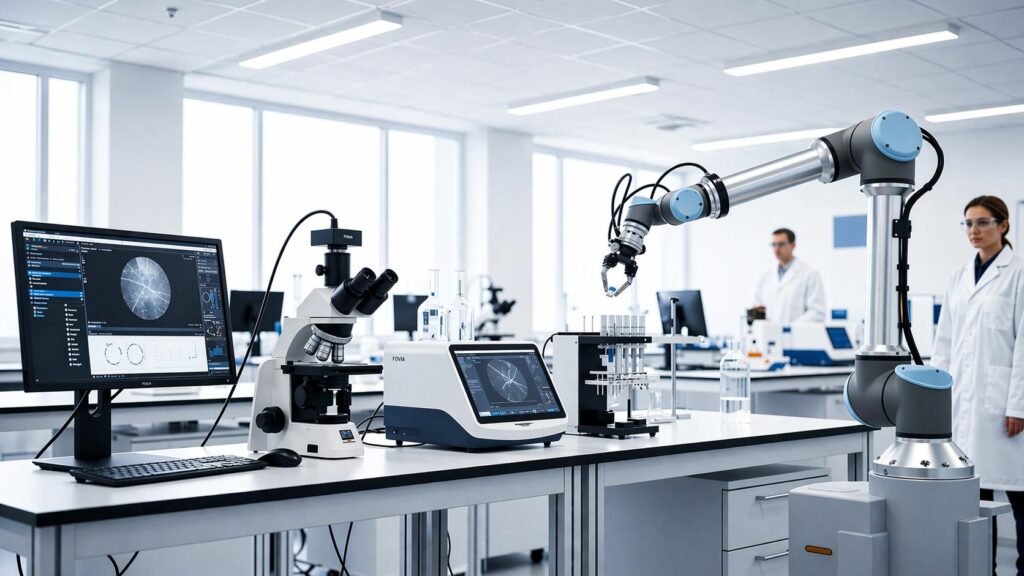
The Model Hardware Standard is also being tested in scientific environments.
At HHMI Janelia Research Campus, researchers have used MHS to connect equipment involved in advanced microscopy experiments.
Anthropic says one laboratory previously required multiple vendor programs to operate different parts of the system.
MHS provides a shared interface that allows devices to communicate and makes their data available to AI agents.
Researchers have also experimented with AI-assisted monitoring, automated parameter adjustments and coordination between robotic equipment.
The goal is not necessarily to remove scientists from the process.
Instead, the idea is to allow AI to handle repetitive and highly technical operational work while researchers concentrate on experimental design and scientific reasoning.
But AI Still Has Physical-World Limitations
There is an important warning hidden inside Anthropic’s announcement.
AI agents are not yet perfect at understanding physical systems.
Anthropic’s own experiments revealed situations where Claude initially misunderstood why laboratory equipment was producing an error.
In one example, bubbles in a liquid caused problems during a laboratory procedure.
The AI initially treated the problem more like a software issue and needed human guidance to understand the underlying physical cause.
Once the information was provided, the system could incorporate the lesson into subsequent workflows.
This highlights a major limitation of current AI.
Models can be extremely capable at reasoning over text and images, but physical environments contain variables that are difficult to fully capture in digital representations.
Temperature, pressure, friction, vibration, material properties and unexpected mechanical failures can all change the outcome of an action.
Physical AI therefore requires more than intelligence.
It requires reliability and safety.
Safety Will Determine How Fast Physical AI Spreads
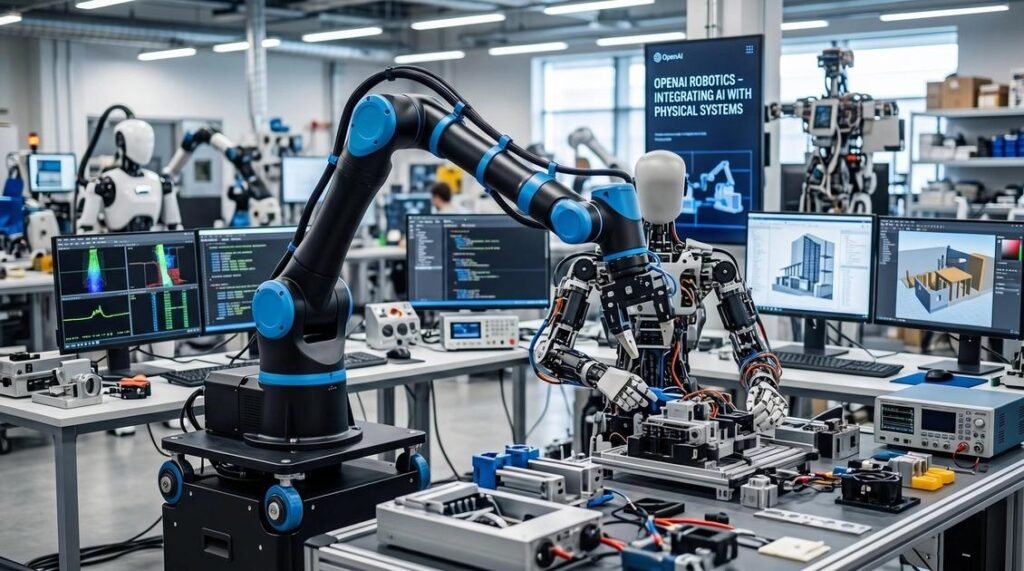
Anthropic is treating safety as a central part of MHS.
The company is currently sharing an early version with selected partners across science, robotics, electronics and manufacturing.
Before making the standard open source, Anthropic says it wants to build additional safety evaluations and develop best practices for AI systems operating physical equipment.
That caution is understandable.
A mistake made by an AI assistant inside a document can usually be undone.
A mistake made by an AI controlling a robotic arm or laboratory laser could cause physical damage.
This makes physical AI fundamentally different from conventional software AI.
The consequences of errors are no longer confined to a screen.
The Bigger Opportunity: Autonomous Laboratories
If MHS succeeds, one of the biggest beneficiaries could be scientific research.
Today’s laboratories are often limited by human availability.
Researchers can design experiments faster than humans can physically perform them.
AI agents could change that equation.
A future autonomous laboratory could operate continuously:
Design → Experiment → Measurement → Analysis → Adjustment → Experiment again.
The human researcher would define the scientific objective while AI agents handle much of the operational loop.
The human researcher would define the scientific objective while AI agents handle much of the operational loop.
OLSI FEÇI
That could increase experimental throughput while reducing repetitive work.
In fields such as drug discovery, materials science and biotechnology, even modest improvements in experimental speed can have significant economic and scientific consequences.
Anthropic Is Building a Bridge Between AI and Machines
MHS also reflects a broader change in Anthropic’s strategy.
The company has historically been known primarily for its Claude AI models.
But the future of AI may not be defined only by chatbots.
AI agents are increasingly being designed to use tools, execute workflows and interact with external systems.
The next logical step is physical equipment.
Anthropic’s Model Hardware Standard could become an infrastructure layer connecting those agents to the machines around them.
And importantly, MHS is designed to be model-agnostic, meaning the standard is not necessarily limited to Claude. Anthropic says other agent systems could access it using standard protocols.
That could make the project much more significant if it eventually becomes widely adopted.
The Race for Physical AI Is Just Beginning
Anthropic is not alone in exploring physical AI.
Robotics companies, cloud providers, AI laboratories and industrial manufacturers are all looking for ways to connect increasingly capable AI systems with machines.
The difference is that Anthropic is approaching the problem from the AI-agent side.
Instead of building one robot for one task, the company is trying to create a common interface that could allow intelligent agents to work with many different types of hardware.
If successful, that could make physical AI much more programmable.
A new robot would not necessarily need an entirely new AI integration.
A new laboratory instrument might not require months of custom software.
The machine could simply expose its capabilities through a common standard.
That is the larger vision behind MHS.
🔥 Why It Matters
Anthropic’s announcement is much bigger than another Claude update.
It represents a potential transition from AI that generates information to AI that performs physical work.
For years, the AI revolution has been measured in tokens, benchmarks, coding performance and model intelligence.
The next phase could be measured in experiments completed, machines controlled and discoveries accelerated.
If standards like MHS become widely adopted, laboratories could eventually operate as interconnected networks of intelligent machines, with AI agents coordinating experiments continuously.
Manufacturing facilities could use agents to monitor equipment, identify problems and optimize processes.
Robotic systems could communicate with other machines instead of operating as isolated platforms.
And scientific research could become increasingly automated.
The biggest challenge will be safety.
AI must understand not only what it can do, but also what it should not do.
That is why Anthropic’s decision to begin with a controlled research preview is significant.
The company is effectively testing whether AI agents can move from the digital world into the physical world without sacrificing reliability.
If it works, the impact could extend far beyond Anthropic.
The next major AI platform may not just talk to us. It may operate the machines around us.