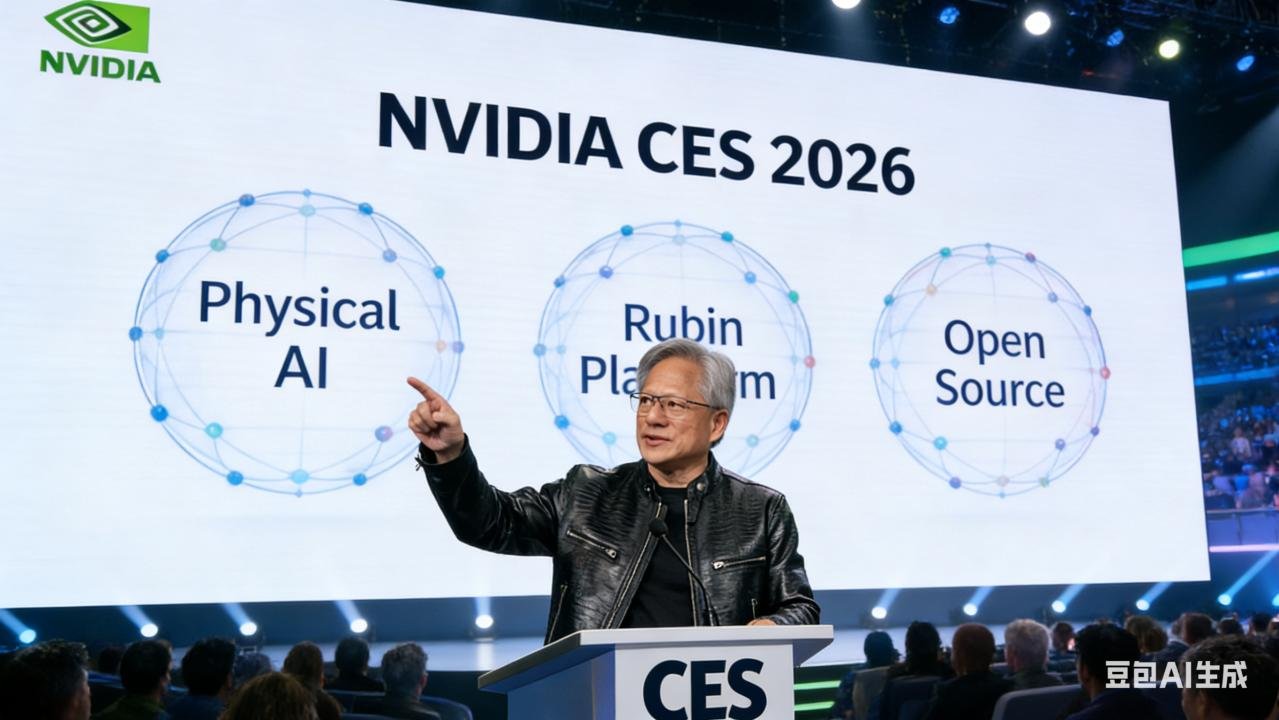
Nvidia Physical AI: Evolution and Expansion
Nvidia has evolved from a company best known for computer graphics.
It is now a central force behind the global artificial intelligence boom.
According to a report published today by The Wall Street Journal, Nvidia is expanding aggressively.
These systems perceive and act in the real world through robots and drones.
According to the report, the business generates roughly $10 billion a year for Nvidia.
Moreover, this transition embodies Nvidia Physical AI in the company’s broader strategy.
CEO Jensen Huang sees potential for significantly larger growth over the coming decade.
Rather than just supplying processors for training AI, Nvidia plans to enable models to operate machines in the real world.
From Chatbots to Machines That Can Act
Much of the recent AI revolution has taken place inside the digital world. Generative models learned to produce text, images, video and software, while Nvidia’s processors became a critical part of the infrastructure supporting them.
The next stage is considerably more difficult.
A robot cannot simply generate a correct answer on a screen. It has to understand its surroundings, identify objects, anticipate human movement and react to situations it may never have encountered before. Autonomous vehicles face a similar challenge, continuously processing information from cameras and sensors while making decisions in real time.
Nvidia is attempting to provide the technology layer connecting these capabilities. The company describes Physical AI as systems capable of perceiving, understanding, interacting with and navigating the physical world, while its robotics platform covers everything from training and simulation to running AI models on physical devices.
Humanoid Robots Are a Major Bet
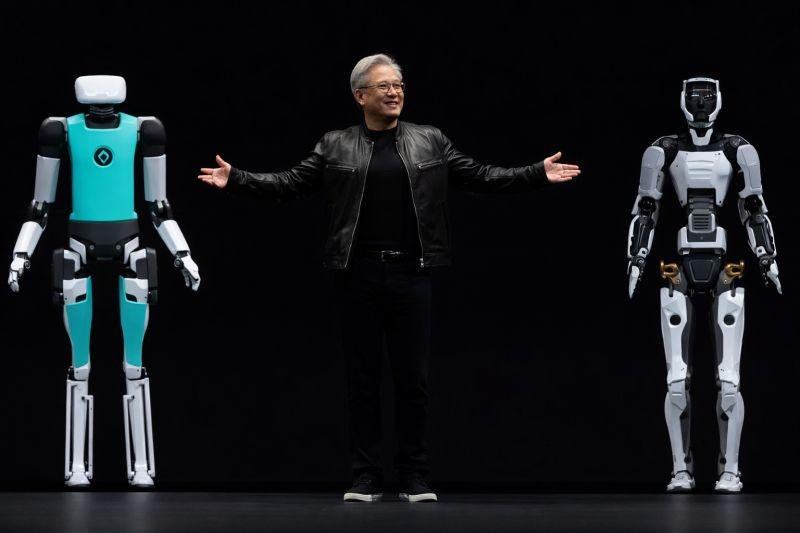
Humanoid robotics is one of the clearest examples of where Nvidia’s strategy is heading. Rather than manufacturing the robots itself, Nvidia is building the computing hardware, AI models and software tools that robotics companies can use to develop them.
The company’s ecosystem includes specialized edge-computing hardware, AI models and simulation platforms. A major part of the approach is the ability to train robots in virtual environments before transferring their capabilities to physical machines. Nvidia argues that simulation and digital twins can help developers train and validate robotic systems before deploying them in factories, warehouses and other real-world environments.
That matters because physically training a robot is expensive and time-consuming. If a machine can experience millions of scenarios inside a simulated environment before facing them in the real world, development could become dramatically faster.
The challenge, however, remains substantial. Robots must maintain balance, understand their surroundings and respond reliably when real-world conditions differ from their training data.
China Is Becoming Critical to the Race
China occupies a particularly important position in Nvidia’s physical AI strategy. According to The Wall Street Journal, China accounted for roughly 90% of global humanoid robot shipments during the first half of the year, while its manufacturing capacity makes it one of the world’s most important centers for the emerging industry.
That creates a complicated situation for Nvidia Physical AI.
U.S. export restrictions have limited the company’s ability to sell some of its most advanced AI processors to China.
Nevertheless, Chinese companies remain important potential customers and partners in robotics and autonomous vehicles.
Nvidia is therefore expanding its presence in the Chinese ecosystem through partnerships, research and local development, while Chinese companies are simultaneously investing in domestic alternatives.
The result is a technology market shaped by both commercial opportunity and geopolitics.
Autonomous Vehicles Are Another Major Front
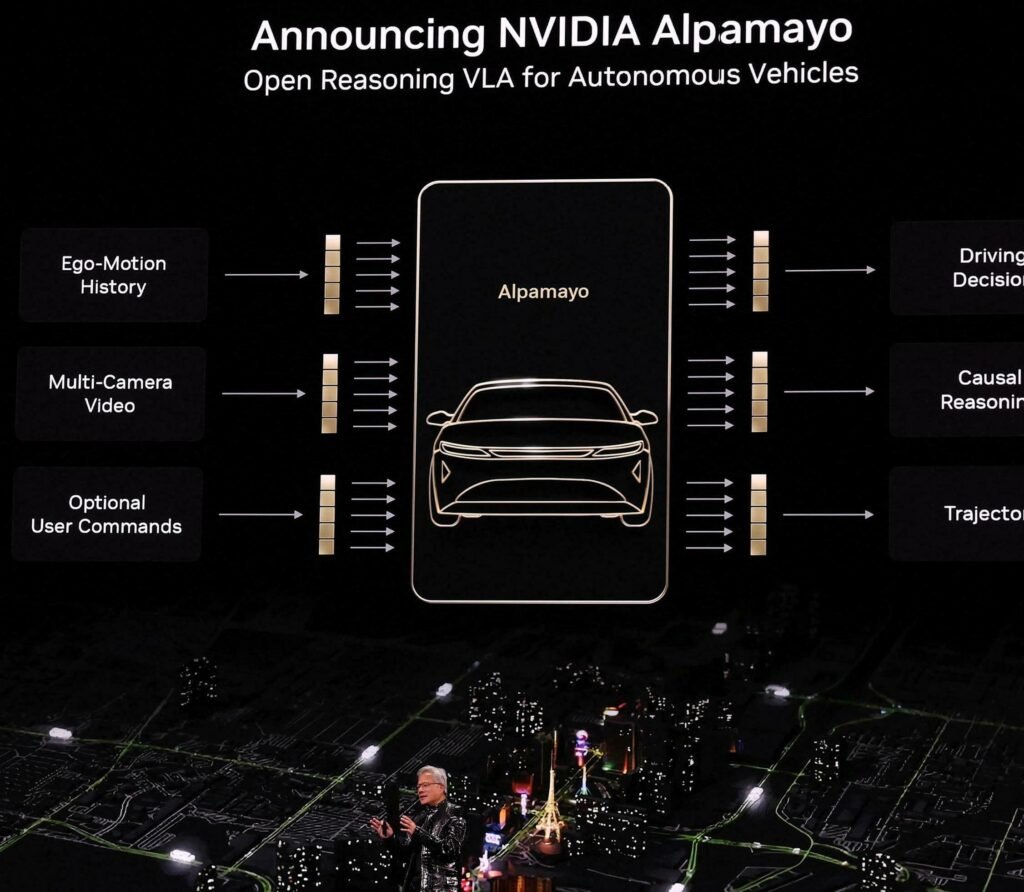
Robotics is only one part of Nvidia’s physical AI strategy. Autonomous vehicles are another.
Nvidia already provides platforms designed to support autonomous vehicle development, combining computing hardware, software and AI models across development, simulation and deployment.
The company’s objective is similar to its robotics strategy: become more than a component supplier and instead provide part of the underlying platform used to build the vehicle’s intelligence.
That could become increasingly important as vehicles evolve into software-defined machines. The defining technology of a future car may not simply be its engine, battery or design, but its ability to understand its surroundings and make decisions independently.
Drones and Edge AI Expand the Opportunity
Physical AI extends beyond humanoid robots and autonomous cars.
Drones, industrial robots, intelligent cameras and other machines that need to process information locally are also becoming part of the market.
Nvidia is pushing its strategy deeper into edge computing, where AI can run directly on a device rather than sending every request to a remote cloud server. The company has expanded its Jetson platform with the Jetson Orin Nano 2, targeting robots, inspection drones and vision AI systems.
This matters because an autonomous machine cannot always wait for a remote server to respond. In many applications, decisions have to be made locally, immediately and with minimal latency.
The Tech Spot Editorial Team
Nvidia Is Building More Than a Chip
This is ultimately what makes Nvidia’s strategy so significant.
The company is no longer competing only on processor performance. It is building an ecosystem in which hardware, AI models, simulation, software and infrastructure work together.
A robotics company could potentially use Nvidia technology to train a model, simulate a robot in a virtual environment and then deploy that model onto the physical machine. The same broader platform can be adapted for autonomous vehicles, drones and industrial systems.
That shifts the competitive question from who has the fastest chip? to something much larger:
Who controls the platform on which intelligent machines are built?
The Next Era of AI Could Be Physical
Physical AI remains an emerging technology. Humanoid robots still face major challenges involving cost, safety and reliability, while autonomous vehicles continue to encounter technical and regulatory obstacles.
But the direction of the industry is becoming increasingly clear. AI is moving beyond screens and into factories, roads, warehouses and other environments where machines must perceive their surroundings and act in the real world.
Nvidia is positioning itself directly at that transition.
If the company can maintain its technological advantage as this market develops, its next battle will not be limited to data centers. It will be about becoming part of the computational brain behind the machines that work, move and make decisions in the physical world.
And that could become one of the defining technology markets of the next decade.
- The Tech Spot Editorial Team