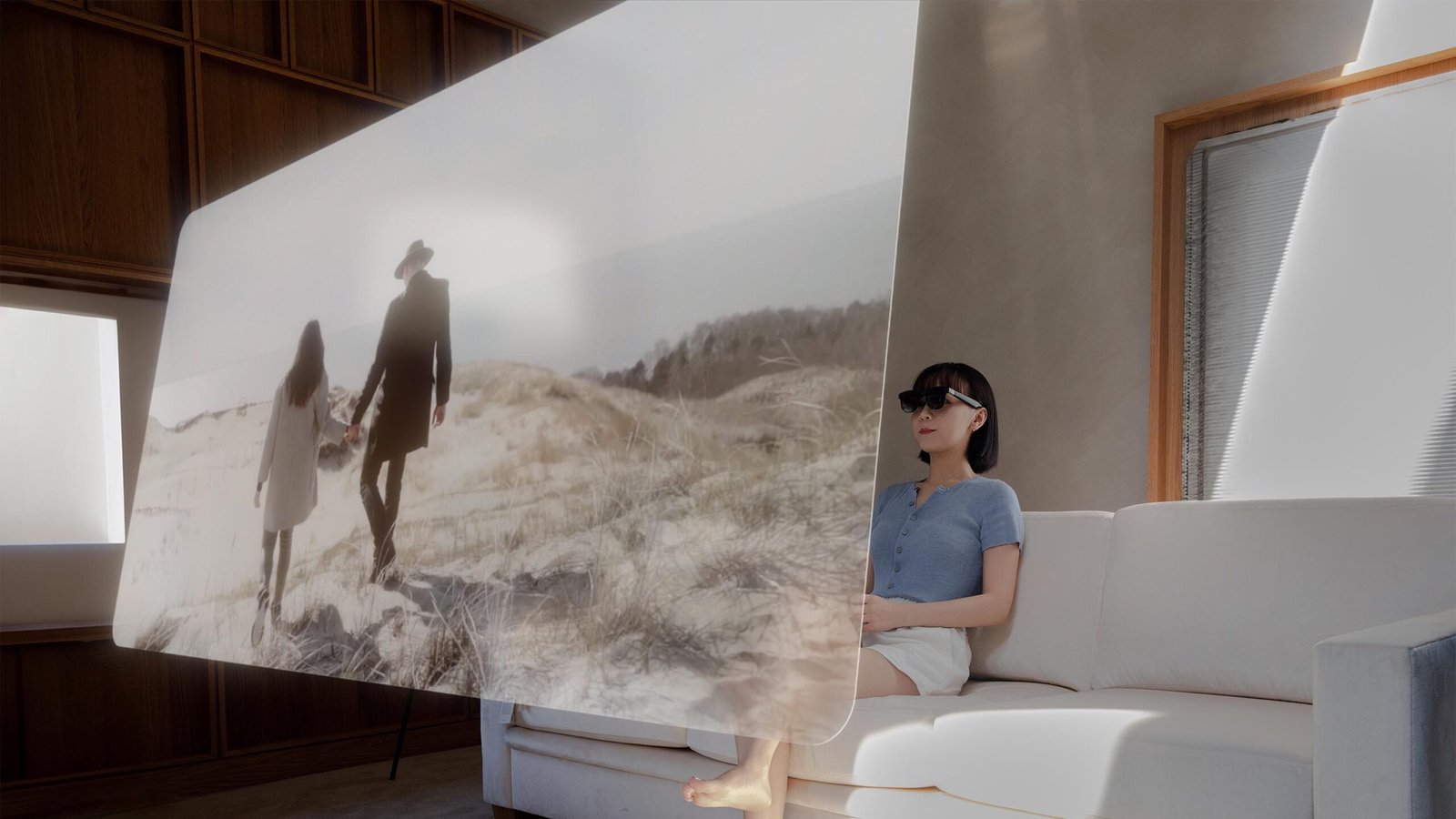
Smart glasses are no longer just experimental gadgets. New devices are turning a pair of glasses into a private giant screen, raising an unexpected question: do we really need a television to watch movies anymore?
For decades, watching a movie at home meant sitting in front of a television.
Then came laptops.
Then smartphones and tablets.
Now, the next screen may not be a screen at all.
It could be a pair of glasses.
The latest generation of smart glasses is beginning to blur the line between traditional displays and wearable technology. Instead of placing a large television in front of the user, these devices can create the impression of watching a large virtual screen floating directly in front of the viewer.
One of the companies pushing this idea is XREAL, which has been developing glasses designed to turn everyday devices into large personal displays.
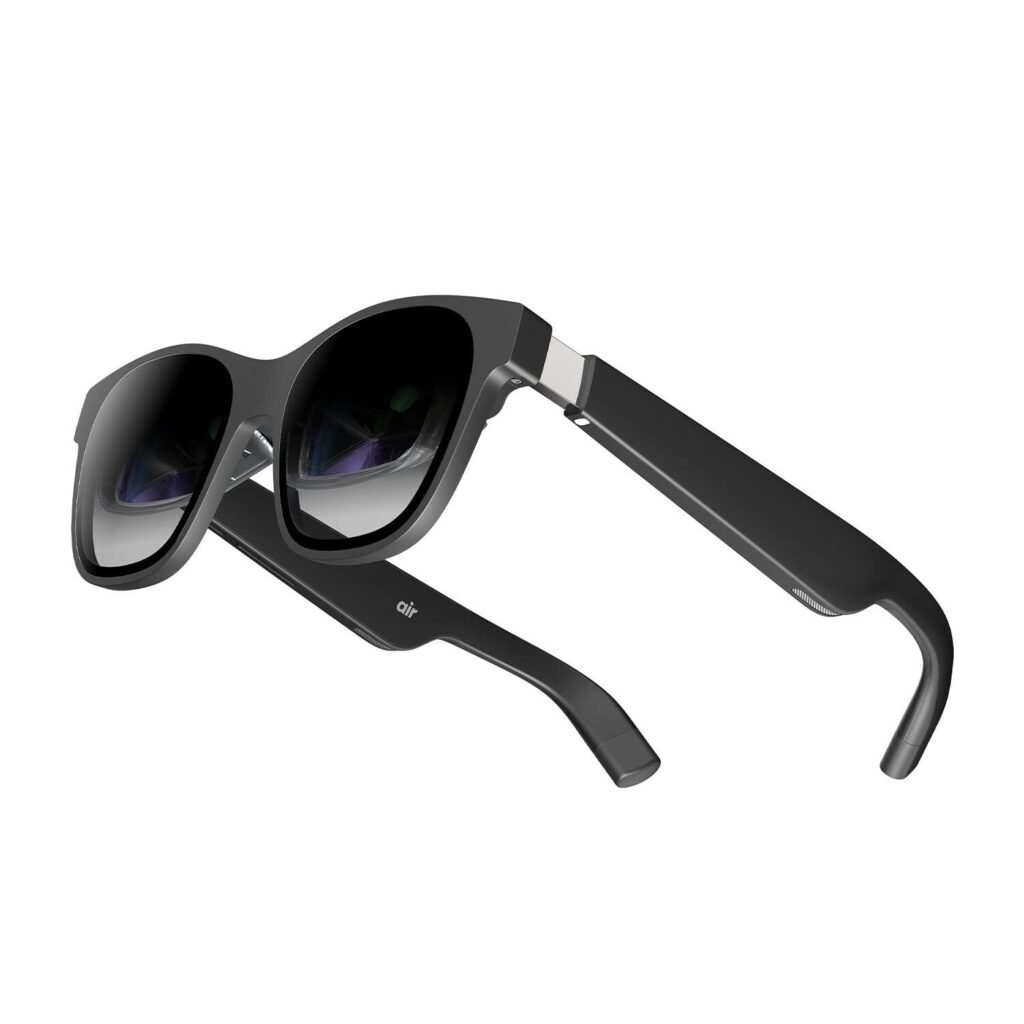
Its newer XREAL A1 is a particularly interesting example of where this category is heading. The glasses are designed primarily as an external display rather than as a fully autonomous augmented-reality computer. They connect to another device through USB-C and use that device as their power and content source.
At around the $300 price range, the concept is also becoming considerably more accessible than many people might expect.
A Television You Can Carry in Your Pocket
The biggest appeal of display glasses is simple:
You can carry a huge screen without carrying a huge screen.
Instead of buying a 65-inch television, mounting it on a wall and dedicating part of your living room to it, the display exists inside the glasses.
From the user’s perspective, the experience is designed to resemble watching content on a large virtual screen.
That could make the technology particularly attractive for people who travel frequently.
Imagine sitting on an airplane with a pair of glasses connected to a smartphone and watching a movie on what appears to be a much larger display.
The same concept could work in a hotel room, on a train, at an airport or even while sitting in bed.
The hardware is portable.
The screen is not.
But These Are Not Yet Full AR Glasses
There is an important distinction between modern display glasses and the futuristic augmented-reality glasses often shown in science-fiction movies.
A device like the XREAL A1 is not necessarily trying to replace your entire computing environment.
It is closer to a wearable external monitor.
The glasses do not have to independently run every application.
Instead, the connected smartphone, computer or other compatible device provides the content.
That makes the technology considerably simpler.
It also helps keep the glasses lighter and less complicated.
This approach could ultimately be one of the most practical ways for wearable displays to become mainstream.
Instead of trying to build a complete computer into a pair of glasses, manufacturers can focus on doing one thing extremely well:
putting a large, high-quality display directly in front of your eyes.
Why Would Anyone Want This?
The obvious question is:
Why not just use a television?
For many people, a television will remain the better option.
A TV is comfortable for watching with family or friends.
It does not require wearing anything.
And large televisions have become increasingly affordable.
But smart display glasses offer something a television cannot:
privacy.
Two people can be sitting in the same room while one person watches a movie through the glasses without filling the room with sound and light from a television.
That could be particularly useful for people living in small apartments or shared homes.
It also opens up new possibilities for gaming and personal entertainment.
Gaming Could Be Another Major Use Case
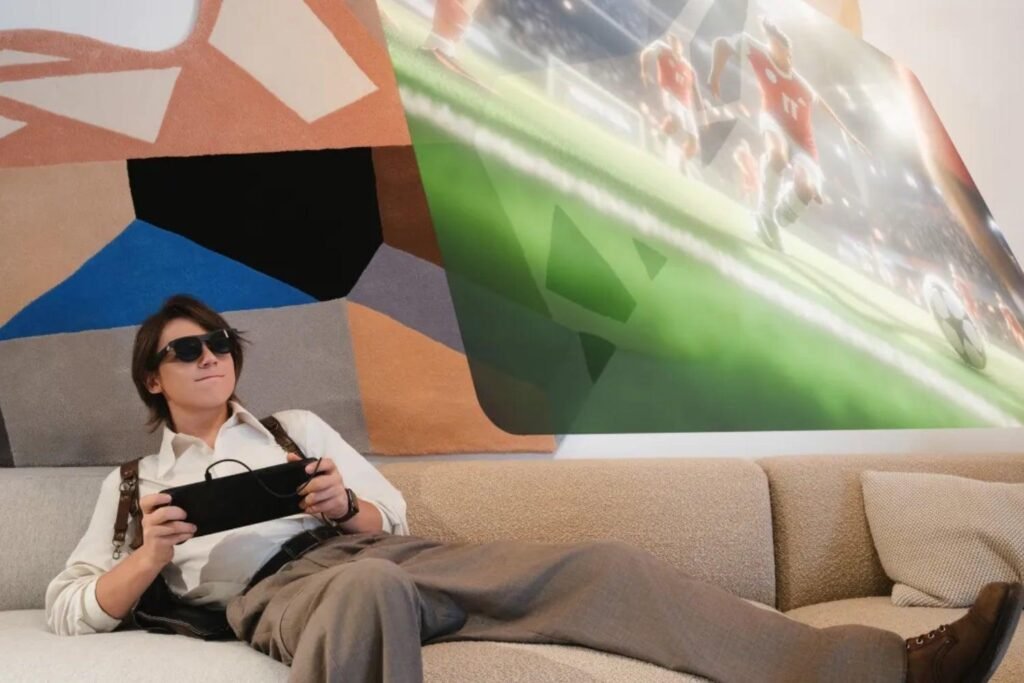
Movies are only one part of the opportunity.
A wearable display can also become a portable gaming screen.
Connect the glasses to a gaming handheld, laptop or smartphone and suddenly the user can have a much larger virtual display without carrying a monitor.
This could become increasingly interesting as handheld gaming devices become more powerful.
Instead of carrying a laptop and external monitor, a user could potentially carry a small gaming device and a pair of display glasses.
The glasses provide the screen.
The handheld provides the processing power.
The result is a surprisingly compact entertainment setup.
The Real Challenge Is Comfort
There is, however, a major problem.
People are accustomed to watching television without wearing anything on their face.
Smart glasses change that.
Even if the display looks excellent, the experience depends heavily on how comfortable the glasses are after 30 minutes, one hour or two hours.
Weight matters.
Heat matters.
Pressure on the nose matters.
The shape of the frame matters.
And the quality of the lenses matters.
A pair of glasses that feels impressive for ten minutes could become uncomfortable during a two-hour movie.
This is one of the biggest challenges facing the entire category.
The technology must become good enough that users stop thinking about the hardware.
Battery Life Is Another Problem
Some smart glasses include their own batteries.
Others, such as simpler display-focused designs, can rely on a connected device for power.
That can make the glasses lighter, but it also means the user needs a cable or another compatible device.
For consumers, convenience is critical.
If the experience requires connecting several devices, managing cables and constantly worrying about battery levels, people may simply return to their television.
The winning product will probably be the one that makes the process feel almost invisible.
Put on the glasses.
Connect.
Watch.
That’s it.
Could Smart Glasses Actually Replace TVs?
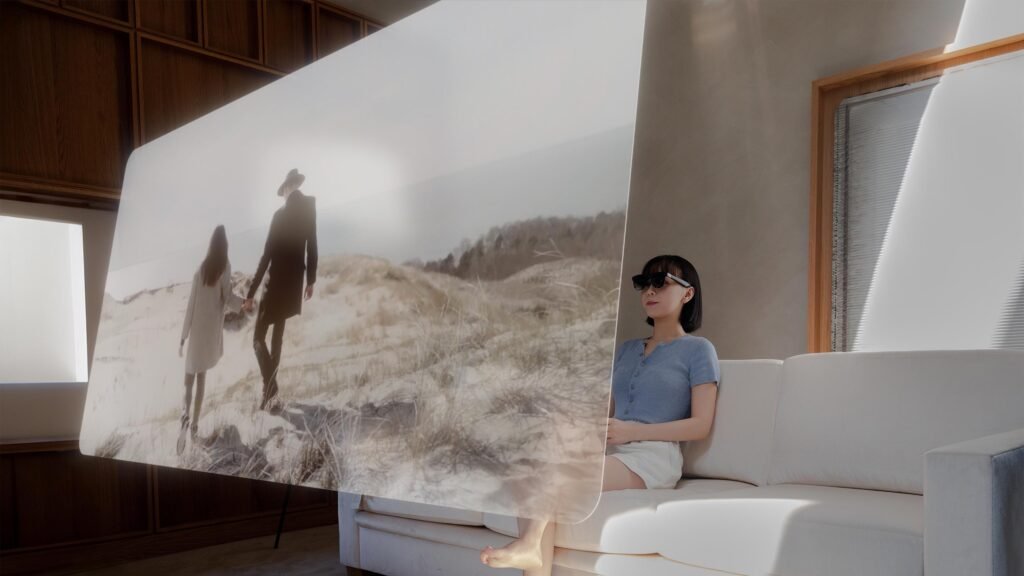
Probably not — at least not completely.
Televisions have a major advantage:
they are social.
A family can sit around one television.
Friends can watch a football match together.
A group can play games.
Nobody has to wear anything.
Smart glasses are much more personal.
That means they are more likely to become a complement to televisions rather than a replacement.
But that does not make them less important.
Smartphones did not completely replace laptops.
Laptops did not completely replace desktop computers.
Streaming did not completely eliminate cinemas.
Technology rarely replaces everything at once.
Instead, it creates new ways of doing familiar things.
Smart glasses could follow the same pattern.
The Bigger Revolution May Be the Disappearance of the Screen
The most interesting aspect of this technology is not the glasses themselves.
It is the possibility that the physical display could eventually become less important.
Today, we think of computing in terms of screens.
A phone has a screen.
A laptop has a screen.
A television has a screen.
A monitor has a screen.
But if wearable displays become good enough, the screen could become something that exists primarily in software.
You would not necessarily carry a physical display.
You would carry a device capable of creating one.
That is a major conceptual change.
Smart Glasses Could Become the Next Personal Computer Interface
The industry is already experimenting with several versions of this idea.
Some glasses focus on cameras and AI assistants.
Others focus on audio.
Some are designed for augmented reality.
Others are essentially wearable monitors.
The category is still fragmented.
But the direction is becoming clearer.
Companies are trying to move computing away from the rectangular screen that has dominated technology for decades.
The smartphone may remain the central computing device for years.
But the way we interact with it could change dramatically.
Instead of constantly looking down at a phone, users could eventually interact with information through glasses, voice, gestures and spatial interfaces.
XREAL’s Approach Is Interesting Because It Is Simpler
The XREAL A1 demonstrates a more conservative approach.
Rather than trying to put an entire computer inside the glasses, the device focuses on the display experience.
That could actually be an advantage.
Every additional component increases weight, power consumption, heat and complexity.
A simpler device can potentially be smaller, lighter and cheaper.
And consumers may be more willing to experiment with a $300 wearable display than with a much more expensive futuristic headset.
This could help manufacturers understand what people actually want before attempting to build more complicated products.
What Happens When the Technology Gets Smaller?
This is where things become particularly interesting.
Today’s wearable displays still have obvious limitations.
But hardware generally becomes smaller, more efficient and cheaper over time.
Displays improve.
Processors become more efficient.
Batteries become denser.
Wireless connections become faster.
Sensors become smaller.
If that trend continues, today’s relatively bulky display glasses could eventually look primitive.
Imagine glasses that are almost indistinguishable from normal sunglasses while still providing a large virtual display.
At that point, the technology could become much more mainstream.
The Entertainment Industry Will Have to Adapt
If wearable displays become popular, streaming companies and content creators could also benefit.
Movies could potentially be optimized for immersive personal viewing.
Games could be designed around enormous virtual screens.
Sports could offer alternative viewing experiences.
Concerts could become more interactive.
And advertising could eventually move into entirely new formats.
The important point is that wearable displays do not simply create another screen.
They change where the screen exists.
Instead of being in the living room, it can be anywhere.
Privacy Will Become More Important
There is also a downside.
As smart glasses become more advanced, privacy concerns will increase.
Camera-equipped glasses can potentially record people without them realizing it.
Display glasses may not have the same problem, but the broader category of smart eyewear raises difficult questions about surveillance and consent.
Governments and technology companies will likely face increasing pressure to create clear rules around what these devices can record, what data they collect and how that information is processed.
The more capable the glasses become, the more important those questions will become.
The Future May Not Look Like Science Fiction
The most interesting future for smart glasses may not involve holograms floating everywhere.
It could be much simpler.
You wake up.
Put on your glasses.
Your calendar appears in your field of view.
You check a message.
You start a movie.
You play a game.
You join a video call.
Then you take the glasses off and everything disappears.
The technology becomes invisible.
That is usually when technology becomes truly powerful.
Smart glasses still have a long way to go before they can seriously challenge the television.
But the direction of the industry is becoming increasingly difficult to ignore.
For decades, bigger screens were considered better.
Now technology companies are exploring the opposite idea:
What if the screen didn’t need to exist physically at all?
Devices such as XREAL’s display glasses show that consumers can already carry a large virtual display in something that resembles a normal pair of glasses.
The experience is not perfect.
The technology still has limitations involving comfort, cables, power and compatibility.
But the underlying idea is compelling.
A television occupies a room.
A laptop occupies a desk.
A smartphone occupies your hand.
A wearable display could occupy nothing except your field of view.
And if manufacturers can make that experience comfortable, affordable and effortless, the future of home entertainment may not be a bigger television.
It may be the moment when the television disappears altogether